• Categories

  • Archives

  • Top 10 Most Read

The Real Thing – ft. Gur Benshemesh (Part 4)

SILENCE & CO.

Welcome back to the Real Thing and part four of our chat with Gur Benshemesh.  Today we talk about the tension of making frenemies of our enemies.  Details of Silence & Co. will be discussed during the interview and may spoil parts of the story for those who have not yet read the work.

——-

So, in the book, Agent—actually, that’s a question I should ask: what’s the full name of the FBI agent who’s trying to capture Alex?  I tried to go back and look for it, but I think I keep missing it.

[Laughs].  It’s Tom Fowler, but I think we only mention it at the very beginning of the book and never again.

Okay, so Alex has this tense relationship with Agent Fowler, but it’s also a very familiar one because they’ve known each other for years.  Ultimately, Fowler ends up helping Alexander.  Why?

Going back to nonfiction, in organized crime and espionage, the two sides are so close by necessity.  You can’t be this paragon of policing and never talk to anyone who’s slightly shady, because you won’t ever make out what’s going on.  To a certain extent, there’s a give-and-take relationship, and I think historically, police have respected criminals who are really good criminals—people who don’t hurt innocents necessarily, or are very hard to catch.  There’s that cat-and-mouse relationship that both sides know.  I think that level of respect and familiarity is something that you see again and again.  The Whitey Bulger cases are sort of the most famous example that are coming up now.
Continue reading

The Real Thing – ft. Gur Benshemesh (Part 3)

SILENCE & CO. PAGE 2

Welcome back to the Real Thing and part three of our chat with Gur Benshemesh.  Today we talk about the the drug business in South America, and the sexual appeal of smart women.  Details of Silence & Co. will be discussed during the interview and may spoil parts of the story for those who have not yet read the work.

——-

The bulk of the story takes place in Columbia and you do a great job showing how pervasive and institutionalized the drug market is there.  You show these street gangs kind of taking over the roles that big drug cartels once had.  Does that reflect the actual situation on the ground over there?

I really like South America.  I spent a fair amount of time there and visually, it’s an amazing place.  It’s got a really amazing energy there, and I thought the story benefited from tapping into that energy, and contrasting it to New York.

In terms of the gangs, when I was at USC, I did a very interesting general education course all about urban street gangs and it was taught by a fascinating professor who was this little, nerdy, college professor-looking guy.  He had spent six years for sociology purposes with the Mara Salvatrucha, which is the most hardcore Salvadorian street gang in L.A—crazy, crazy guys who drive-by’s and stuff.  It was one of the most fascinating terms I had in college and it left me with a long-term interest in this topic.
Continue reading

The Real Thing – ft. Gur Benshemesh (Part 2)

SILENCE & CO. PG 1

Welcome back to the Real Thing and part two of our chat with Gur Benshemesh.  Today we talk about the tension of having a moral compass in the mafia, and when killing your family may be the most sensible option.  Details of Silence & Co. will be discussed during the interview and may spoil parts of the story for those who have not yet read the work.

——-

When we meet Alexander Marazano, the protagonist of Silence & Co., he’s already pretty disillusioned by the work he does and yet he seems pretty committed to the work.  How do you explain that tension?

In terms of the character arc that I was trying to work with Alex, we meet him at a very interesting point.  He’s in his late twenties and he’s done the mob thing and the army thing and now he’s back [in the mob] and at the top of his game, but he’s starting to question it.  There is money, there is women, and there is power and there is big houses, but there’s always a cost to everything to being part of that world and maintaining that power.  He sees Vincent, his dad and this big mob boss, and Saul, his uncle and this rich and powerful mob figure, and he’s not sure whether he wants to follow in their footsteps and become the biggest and baddest name in the mafia, or whether it’s not for him and he wants to go off and find something on his own that isn’t a legacy from his family.

He sees that yes, there is power and money and it’s glamorous, but the day-to-day is simply not worth it.  That’s the discovery he makes, but every person has to make that decision for himself, right?  Donald Trump apparently still needs more money and more power and bigger hair and more hairspray.
Continue reading

The Real Thing – ft. Gur Benshemesh (Part 1)

SILENCE & CO.

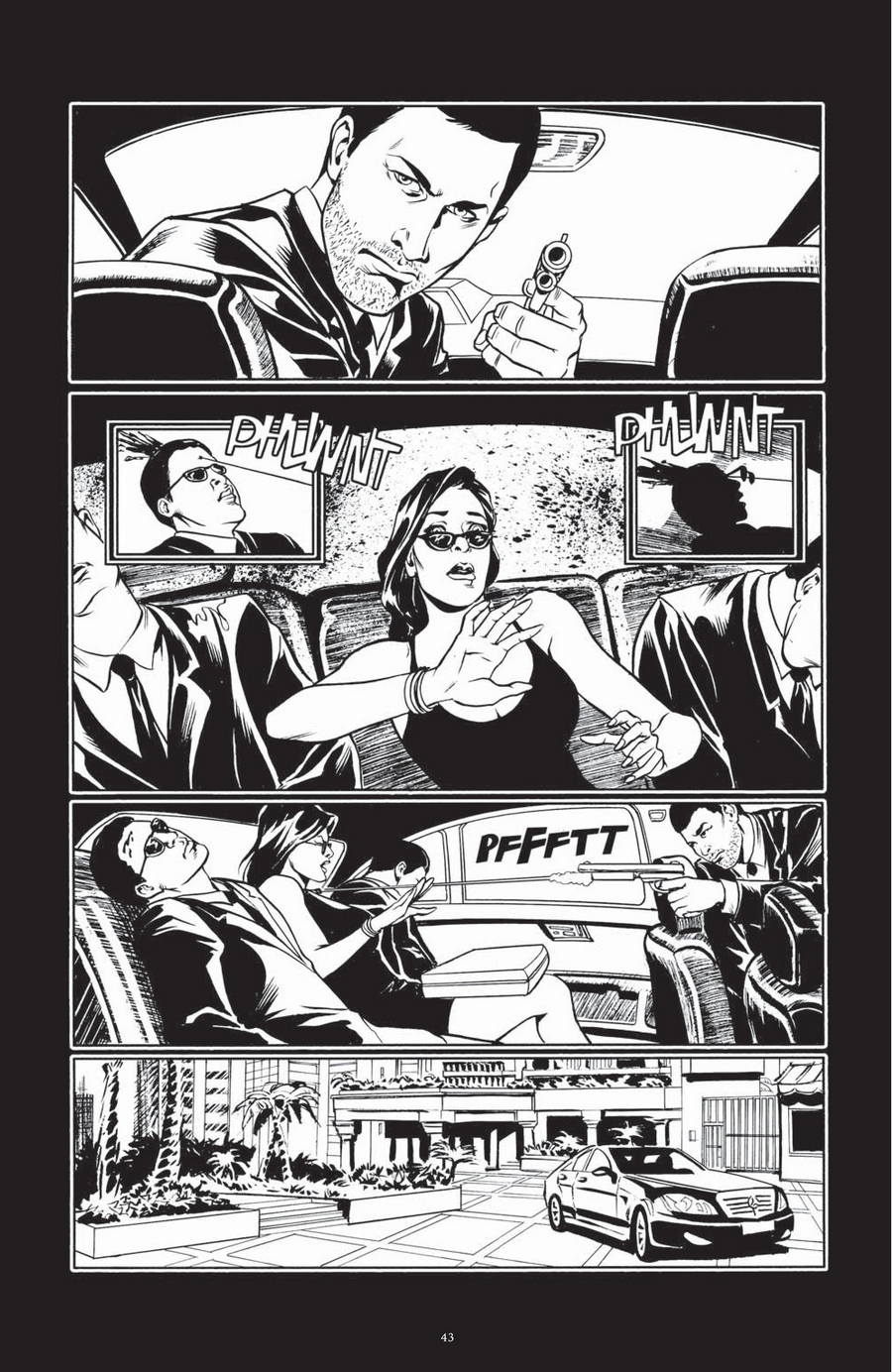
Gur Benshemesh, a native Londoner who now lives in Amsterdam, started his career in screenwriting.  His short screenplay, Morgan Street Watch Company, received critical acclaim and won prizes at several film festivals, including the Colorado Film Awards, the New York Screenplay Contest, and the Oregon Film FestivalNow he’s venturing into the comic book world.  His first graphic novel, Silence & Co., follows Alexander Marazano, a member of an Italian mobster family, as he makes his name as an internationally renowned hit man.  Along the way, he comes to terms with the nature of his work and his own moral compass.

This interview has been edited and abridged for purposes of length.  Details of Silence & Co. will be discussed during the interview and may spoil parts of the story for those who have not yet read the work.

——-

Silence & Co. is your first graphic novel, yet you got some pretty big names to collaborate with you on the project.  Ron Randall, who does the art, is a mainstay at both DC and Marvel, and your letterer John Workman and cover artist Steve Lieber have both won Eisner Awards.  How did you get them to work with you?

Funnily enough, these things are sort of one step at a time.  I got talking to a couple of guys who put me in touch with Ron; they thought he’d be a good creative match for the project.  He read the script and reacted very strongly to it; he’s kind of into that action-y, hit man, secret agent type thing.  He did some test pages for us and they just looked fantastic.  Once the art started coming through, Ron, I believe knows John Workman through some other work they did together and he sent him a couple pages and John was really, really excited about the book.  Again, it was just a dream—it worked surprisingly smoothly.  From what I understand, Ron is a studio mate at Periscope Studios with Steve Lieber, so we got him to do the cover, which I think came out fantastically.
Continue reading

The Real Thing – ft. Kelly Sue DeConnick (Part 2)

Hello again from the Real Thing, where we give you, absolutely free of charge, part two of our talk with Kelly Sue DeConnickYesterday we spoke about the place of women behind comics.  Today we talk about women in comics (and some dudes as well).

——-

You’ve said that you were a fan of Wonder Woman and Lois Lane long before getting into Supergirl.  We’ll get to talking about the Girl of Steel in a bit, but what do you appreciate about those two lady characters?

I’m not sure if I was into Greek mythology and that sparked an interest in Wonder Woman or if it was the other way ’round, but I eat the Paradise Island/Greek pantheon stuff up with a spoon.  As far as the women themselves, Wonder Woman is… aspirational?  When I was a little girl, she was what I wished I could be–regal, just, compassionate, capital-g Good,  powerful… tall.  She is so awesome–literally, so awe-inspiring–it’s kind of ridiculous, but I love it.  I love her for it.

Lois, on the other hand…well, Lois is more what I am, what I get. She’s aggressive, bullheaded, dangerously willful, self-righteous and not half as smart as she thinks she is.  And I love her for that.

How did you become a fan of Supergirl?  What was her appeal to you?

I had to find my way into Supergirl, honestly.  I think I relate to her the way a mother relates to her overachiever.

The Supergirl movie was, shall we say, neither a box-office nor a critical smash.  Let’s say you had the creative reigns on it.  What would you have done differently?

I haven’t a clue. I haven’t actually seen it recently enough to say.  I’ll tell you what I wouldn’t change–the cast! Faye Dunaway, Peter O’Toole, Mia Farrow… I don’t know what went wrong with Salt either, but it wasn’t the cast.

Even though Kara is ostensibly more alien than Clark, there have been varying portrayals of her acclimation to Earth culture.  Sometimes she seems totally “with it,” pop culture and all, other times she’s distant or naïve about Earth customs.  What’s your take on her relationship to Earth?

I think it’s important to remember she didn’t grow up here.  Clark was raised on Earth from infancy.  He doesn’t really know another home.  Everything he lost is, for all practical purposes, theoretical.  Kara knows what she lost.  She’s an orphan and a refugee.

I feel it has to be a little tricky writing a title that’s had multiple previous writers.  You want to respect what they’ve laid down, but you must also have your certain ideas about directions you want to take with the series and character.  How did you balance that with Supergirl?

I think you’ll drive yourself insane if you worry too much about that. I think you have to trust your editors and your own instincts and let the rest go.

I really like how in Supergirl #65 you had Kara state to Lois, “That’s why you want me.  Because my parents are dead.”  It reminded me how tough she’s had it for a few years now: losing her planet, getting pack her parents and people, and losing them again.  This case she’s on involves a lot of family-less kids.  Is that a sore spot you’ll continue to explore in this arc?

Not explicitly, but it explains a lot about Kara and about why I wanted to give her bit of a break.
Continue reading

The Real Thing – ft. Kelly Sue DeConnick (Part 1)

Growing up among the military, Kelly Sue DeConnick discovered American comics amidst foreign lands.  Years later, she took her foreign experiences with comics for a spin as an adapter of manga for VIZ and Tokyopop, then put her creative chops into writing special and limited features for IDW, Image, and Marvel.  Her first gig at DC is an arc on Supergirl, where she takes the Maid of Steel to school.

——-

You grew up on military bases overseas and so your access to American pop culture was mostly limited.  How did you get into comics, of all things?

Wow! You did your research–I love that!

Comics were very much a thing on base when I was growing up–the Stars & Stripes bookstore at Hahn AFB in Germany carried what I remember as an impressive selection. And if you didn’t want to spring for the 45-cent cover price, you could pick up a stack for a dollar at one of the Saturday swap meets.  We only got one English language TV station, so reading—and comics—were the thing.  (I’m sure there’s something sociologically significant about the predominance of super-hero comics in a society of soldiers, but that’s purely speculation on my part.)

Anyway, everybody read them.  And this was the 1970s, so the women’s movement was a thing too. My mom used to pick up Wonder Woman comics for me as treats and rewards.  I think she thought they were empowering.

Way back in the day, it was traditional for soldiers to get rations of comics, among other things.  Was that still the case while you were around those bases?  Are there still comics nerds among our military men?

Is that so?  I did not know that. How very cool.  No, as far as I know that was not the case when I was a kid.  Our folks bought them.

Despite the fact that I have not been a part of that world for a great many years, I can say with some confidence that there are indeed still comic nerds among our military men and women.  Every once in a while Matt and I will send some of our books overseas as part of the anySoldier.com project. I have instructions up on my website if you’re interested.

You spent a good chunk of your work life adapting manga for US readers.  There are a lot of stylistic differences between Eastern and Western comics, but what are some which really pop out to you?  What can each school learn from the other?

Boy… I wish I had a better answer for this.  When I first started reading manga I found the plot lines wildly unpredictable as compared to Western comics. It took me a couple of years to start recognizing their tropes.  So if you’d asked me this question in 2003, I would have said, naively, that the Japanese plotted with heady abandon.

Now I guess, the differences that jump out to me are more on the systemic/business end.  The Japanese didn’t have their industry infantilized (is that a word?) in the 1950s, so they have a far greater selection of genres.  The US market suffered a kind of ‘bottle-neck effect’ thanks to the CCA.  The lack of diversity has limited our audience, which, in turn, dictates our distribution system… there are days when you look at something like what they’ve got in Germany or France and the American comics industry feels broken and doomed.  But then my husband reminds me that sequential art has been around since Lascaux and I pick my chin up.  Comics will survive. We may not be able to continue making our living in the current model, but comics will survive.

I fear I’ve drifted off on a tangent.  I do that frequently.  Sorry.

As do we all, as do we all.  Do you have any theories on how the stylistic differences in Eastern and Western comics may come from certain cultural differences between their creators?

Mmm, maybe?  I don’t know.  I hesitate to speculate as I have a decidedly American perspective and I’m afraid I’d come off as an ethnocentric ass, like I’m ooing and ahhing at how exotic Asian comics are, you know?

Oh, wait–I do have this theory that the Japanese economy of language reflects an island culture where space is at a premium, whereas our Western tendency to use three words when we could use one reflects a culture of (we thought) endless resources.  Or perhaps that’s just me.  I do seem to love the sound of my own voice.

Hey, me too!  I’ve always been fascinated by how publishers adapt manga, with all their cultural and linguistic idiosyncrasies, to make them as accessible as possible to an American audience.  Can you talk about the kind of thinking and work that goes into doing this?

Ad nauseum, yes.  But let me see if I can control myself.  Every adapter has their own style, but my approach is to try and divine the author’s intent, and adapt the language to produce that effect.  It’s decidedly subjective, but I think if I’ve done my job well, my hand is invisible–I try to keep my ego out of it.  Ultimately, I want the reader to  experience the story with minimal awareness that they’re reading it in translation. (That said, I prefer to footnote distinct cultural references rather than to localize or eliminate them.  That can be disruptive, but it’s my preference.)

Hey, lookie there.  I was almost succinct.
Continue reading

The Real Thing – ft. Kenny Keil (Part 2)

Welcome back to the Real Thing and part two of our chat with Kenny KeilPreviously, Keil talked about self-launching his first comic book project without a leg-up from any established publisher, major or minor.  Today, he talks about what makes his comic one of the funniest products on the off-road market.

——-

The entirety of Tales to Suffice is pretty much humor material.  How long have you known you were a “funny guy”? 

I always suspected it, but years of rejection letters from the Laffy Taffy people can wear a guy down.

I know you have a love for sketch and improvisational comedy, and Tales certainly has a sketch-comedy quality to it.  Did you ever do any of that, outside the comics medium?

I strive to get that sketch-comedy feel in my Tales to Suffice stuff, but up until recently that’s been the extent of my comedy writing experience.  The thing about comedy (or anything) is that you’re going to suck when you first start out.  And the great thing about comics is that they allow you to suck in the privacy of your own home without an audience watching.

What are some comedians or comedy shows you really love, and what are some that have influenced your own sense of humor and the humor in Tales?

I came up on stuff like SNL, The Simpsons, and Letterman, with a little Monty Python tossed into the mix.  Arrested Development, Curb Your Enthusiasm, 30 Rock and a great deal of Adult Swim shows have rocked my world in more recent years.  As far as stand-ups go, I dig Rock, Carlin, Chapelle, and pretty much anyone who’s ever appeared on the Comedy Death-Ray podcast. Despite all of this, the comic sensibilities of Tales to Suffice remain best described as Dorf meets Chespirito.

What was the first tale to suffice, and how did the idea come to you?

Dang… I can remember a comic I read in 1984, but not a comic I made in 2007!  I’m thinking it was either The Red Atom or Ray Gunn, Space Sleuth.
Continue reading

The Real Thing – ft. Kenny Keil (Part 1)

Kenny Keil conceived, wrote, and drew his first series while working a day job as a designer. Tales to Suffice parodies a wide range of comic book genres and conventions, making jokes right down to the ads.  This combination of spoof and satire earned him critical acclaim when he released it through an indie publisher, but mainstream exposure remained elusive.  Using Kickstarter for seed money, Keil recently self-published Giant-Sized Tales to Suffice, which collects all his seen and unseen material.

——-

For some of us, comics are an addiction.  What was your first hit, the one that got you hooked?

Superman #395, May of ’84.  I’m pretty sure I couldn’t even read yet.  And the truth is I only bought it for this really sweet looking ad on the inside cover for an Atari game called Joust.  But I remember flipping through the book until it fell apart, just soaking in all that cool iconic Superman imagery and trying to piece together a narrative from the pictures alone.  By the way, the story?  Totally bonkers.  I still own the comic and to this day it loses me somewhere between the secret island of magical Viking warriors and the mind-controlling communist space satellite. It’s great.
Continue reading

The Real Thing – ft. Aaron Lopresti (Part 2)

Welcome back to the Real Thing, and part two of our chat with Aaron Lopresti.  In part one, Lopresti talks about how he gigged his way into the comics biz, and today, he talks about one of his biggest gigs yet.

——-

How did this gig with Weird Worlds come about?  Who was the mastermind behind the format and how’d you get to pitch your feature?

Long story.  When I came over to DC I was talking to Dan Didio about writing and drawing something.  At the time, he suggested I create a monster character to replace Swamp Thing in the DCU.  Vertigo had control of the character and would not give it back

So I created Garbage Man and then bugged Dan continually for two years to get him to schedule it.  Dan and the powers that be finally decided to do an anthology book and put Garbage Man in it.  I don’t know if the Weird World series was created to accommodate Garbage Man or if they created it and decided Garbage Man would be perfect to run in it.  Either way, Dan came to me and said this is where Garbage Man is going.

In an interview with Comic Book Resources, you said you conceived Garbage Man to fill the void left by Swamp Thing.  When did you first get exposed to the character and what aspects of him or his story stuck with you?  Any particular storyline you’d suggest to new readers?

I only read the Wrightson issues and some of the Nestor Redondo issues.   I have never read the Alan Moore issues because when it came out I was still too attached to the Wein/Wrightson material.  So I would recommend issues #1-10.  Although, some of the Redondo stuff that came after Wrightson is really nice and underrated.

What I took from the character was more of a feeling than any thing specific. In the 70s comics were tackling new material (horror, sword and sorcery, etc) and doing it in a mature fashion that was still accessible to all ages.  The art was a cut above the average comic and the stories were often poignant but still entertaining.  That is what I am trying to capture with Garbage Man.

What are some traits from Swamp Thing you wanted to emulate with Garbage Man, and some you maybe tried to get away from?

I wanted to keep enough of the traditional formula without copying the character or storylines.  Provide an origin story that was reminiscent of what we saw with Swamp Thing and Man-Thing (science gone wrong) and create a character with an old-school look (super-hero humanoid physique) and above all else, have the monster maintain his humanity.   I would have liked to maintain the “monster of the month” formula as well but the serialized format has prevented me from doing that.  (Monster of the Month means a new monster villain every issue)

The idea is to incorporate these “classic” elements and then tell your own story.  If you do it right, you have a new story and characters that at the same time feel familiar and comfortable.  I guess by the end of it all we will see if I succeeded.

What’s your reaction now that Swamp Thing has been officially returned to the DCU proper, post-Brightest Day?  Is he the same Swamp Thing you remembered?

I haven’t read the issue where Swamp Thing returns yet so I can’t give you a definitive answer.  But from what I know and the Finch cover I saw, he still seems to be more what Alan Moore created and less of what Wein and Wrightson created.   Although, Dr. Alec Holland will be reinstated in the Swamp Thing persona, I still don’t see the character returning to its original incarnation.   I will have to see the direction the book goes once he gets his own series.
Continue reading

The Real Thing – ft. Aaron Lopresti (Part 1)

There are a ton of writers and artists working in the world of comics, and here at WCBR, we spend most of our time talking about their products.  Now we’d like to introduce a new, hopefully ongoing, feature where we chat with the real thing.

Aaron Lopresti started in film, but transitioned into commercial art and later, into comics.  His work was first widely seen in Malibu Comics’ Ultraverse, and since then he has done work for both Marvel and DC, including art duties on Gail Simone’s run of Wonder Woman.  Most recently, his art has appeared in DC’s Weird Worlds, a sci-fi miniseries with multiple features.  Lopresti not only draws the “Garbage Man” feature, he also writes it, his first high-profile writing gig.

——-

If there were a museum dedicated to Aaron Lopresti, and an exhibit for Most Influential Comic He Read, what comic would be put in that glass case?

Wow.  That’s an original question.  Unfortunately I don’t have an easy answer. There have been several comics at different times in my development and growth as an artist that have had a profound influence on me.

I would say first Captain America #113.  Steranko’s work in that book was mind-blowing.  I became a huge Wrightson fan around 1977 and had to retroactively discover Swamp Thing.  His treatment of Batman in issue #7 was incredible.   Walter Simonson’s visual style and storytelling in Thor #337 was inspirational.   But probably my two favorite comic stories of all time came later.  The Killing Joke by Alan Moore and Brian Bolland showed me how intricate and clever writing and illustration in comics could be.  Finally, Mike Ploog’s Adventures of Santa Claus inspired me to new heights shortly after my professional career began.

What’s the first thing you ever drew that you’d consider your first venture into comics art?  Let’s say in your museum, this would be the first thing patrons see in the marble art gallery.

I started getting into comics around age 11.  I immediately formed my own comic label with my next-door neighbor.  I did a ton of covers featuring all of the characters we created but as far as I can remember I only did two partial interiors.  Morty the Meatball (my Howard the Duck  rip-off/also stolen from a TV commercial) and Solar Man.  I can’t remember which one I did first but I think they were both around age 12.

You studied film writing and directing at USC, then worked at Tri-Star Pictures for a time.  Did you learn things that influence your comics writing and illustration today?  Do you see any similarities between the two fields?

Film school really helped my writing and understanding of how to put a story together (although some may ague that point).  However, my art suffered because a lot of the wild stuff you might do as a comics storyteller you don’t do as a director. In film school I was trained to devise shots that did not attract attention to themselves.  If you are calling attention to your “cool” shots you are pulling the viewer out of the movie. When I tried to get into comics, I had to look at a lot of Jim Lee’s work to recapture my dynamic storytelling sense that I had as a kid!

There are similarities between film and comics in that they are both venues for storytelling.  But there is a whole lot more you can get away with in comics than you can in film.  Crappy dialogue can be glossed over in comics, but it won’t go unnoticed in a film.  Story pacing and character development can be handled quite differently as well.  A successful comic creator can fall flat on his face trying to make a film (as we have seen).  Likewise filmmakers can struggle just as mightily when trying to write comics.
Continue reading

Design a site like this with WordPress.com
Get started