• Categories

  • Archives

  • Top 10 Most Read

Thor: God of Thunder #17 – Review

by Jason Aaron (Writer), Ron Garney, Emanuela Lupacchino (Artists), Ive Svorcina (Colorist)

The Story: Thor brings the pain to Malekith as the final fate of the league of realms and the dark elf criminal is revealed.

The Review: Not all titles are winners. There will always be an arc, a character or a certain addition to the story that readers will dislike or certainly not appreciate as much as the rest. Quality is not something consistent in most titles after all, nor is personal appreciation. We may love something, but there must be highs and lows in order for the better elements to be easier to perceive.

It is then, to my surprise, rather nice to see that while this arc might have begun in the most obvious of ways, with Malekith being presented just in the time for the movie, there was an actual direction to the story. While the general progression to this point had some good and bad parts, Jason Aaron does show that he can actually do something with some less-desirable elements in the book.

The first thing that Aaron manages to do is actually surprise readers, throwing twists after twists in this issue alone, providing for a great number of satisfactory scenes for those who had no idea of the actual direction the story could go for. With the story being rather straightforward before, the writer makes for a nice use of what had been set up earlier to provide for something rather inventive and expansive for the nine realms and its future in the Marvel universe.
Continue reading

Thor: God of Thunder #16 – Review

by Jason Aaron (Writer), Ron Garney, Emanuela Lupacchino (Artists), Ive Svorcina (Colorist)

The Story
: There is a traitor in the league of realms. Who could it be?

The Review: I am currently less than impressed by the current storyline in the book. While it is obvious that Jason Aaron is doing the best he can with some elements that aren’t nearly as good as those he introduced in his first mega-arc, this one still seems to be a manner to properly introduce Malekith to a new readership because of a very specific release a month ago. From the beginning of this story, a lot of the best elements were simply thrown to the side in order to tell a story about a serial-killing dark elf, with Thor now sharing the spotlight with other characters.

However, despite my initial negative overview of this whole thing, I do have to admit that this issue did provide plenty of better elements to the story. With some inner conflicts in the league of realms, the return of how mythology is presented in the Marvel universe alongside a good dose of humor, this issue does raise the bar in terms of quality and enjoyment.

The first thing that Jason Aaron does right is in how he portrays the failings of the league of realms, which was a nice idea, yet poorly executed. Showing just how the group could not really work due to some distrusts and to how politics can influence things in the nine realms, the group disband here due to not only the fact that they aren’t very effective together, but also due to an error from the god of thunder himself. This results in something more beside the cyclical and constant chase for Malekith that the group did in the previous issues, which is a change that is most welcome.
Continue reading

Thor: God of Thunder #15 – Review

by Jason Aaron (Writer), Ron Garney (Artist), Ive Svorcina (Colorist)

The Story
: The league of realms has got to start cooperating seriously. Perhaps a bit of debauchery would do them good before fighting Malekith?

The Review
: It’s always a bit frustrating to follow a book that started off very strong, only to see it falters after a while. It may be due to a change of artist, or perhaps some tie-ins to events from other books, but whatever the cause it is always disappointing to see something cherished become something less.

It is unfortunately what seems to have happened to Thor: God of Thunder under Jason Aaron’s pen, as the impossibly grandiose story arc that introduced this new take on the popular character had been simply too good. With big stakes, time-travel and some powerful themes, it was simply too big to be simply followed on, especially with an arc focusing on Malekith the Accursed, a character popularized by Walt Simonson in his legendary run. Simply put, this arc isn’t big enough to properly take advantage of the ideas first introduced in the ”God Butcher” and ”Godbomb” arcs.

To his credit, Jason Aaron do try to make this story about a league with members from most of the realms fun, with plenty of absurdity and fantasy put forward. There is a bigger emphasis on some of these individual characters alongside how they interact, with some like Screwbeard, Sir Ivory and Lady Waziria coming out as a bit more fleshed out. The only one that is coming off as rather boring and one-note is Ud the troll, who could truly benefit from something more beside violence and pettiness. When even the mute giant comes off as a more entertaining character than the always whining troll, there is a bit of a problem here.
Continue reading

Thor: God of Thunder #14 – Review

Jason Aaron (Writer), Ron Garney (Artist), Ive Svorcina (Colorist)

The Story: The league of realms is formed as they try to hunt down Malekith before he does too much damage to the nine realms.

The Review: New ideas are dangerous. It’s not a particularly pleasant thing to say, but capes comics aren’t always known for their originality as they rely a lot of times on certain tropes to thrive in the market. Nostalgia sells, so it’s usual to see things that are familiar, yet not blatantly so that it becomes tedious or unoriginal. A book with familiar characters or with a title that is already a proven seller will always have a better chance at growing rather than an entirely original book with newer characters. It’s not exactly the market as it is now, but it could be described pretty closely as such.

It is why I am both glad and a bit disappointed to see Jason Aaron trying to play with many elements of the Thor mythology from the Marvel universe. There is a sense of fun and exploration to what the nine realms are with some of the concepts brought forward by the writer, with the league of realms, the fact that there is a council of realms and so forth. The willingness of Aaron to mess around and to introduce some new elements to Thor’s mythology speak well for him as a writer.

Unfortunately, it would be better if some of those elements worked a bit better, as there is perhaps an abundance of suspension of disbelief needed for some of the additions to truly shine. While the idea of a league of realms with a composition of denizens from multiple realms is an entertaining one, it is a bit baffling to see it go forward considering two facts. The first one is the simple truth that Thor, as a character, is known as the hero of the nine realms, which is not a self-proclaimed title but an actual one given to him, meaning that he is most probably trusted by a great many to be a person that can protect others. The other reason can be seen in the previous arc, as Thor had to deal with a god-killer through time and space. Simply put, Malekith doesn’t really seem like much of a challenge, or even one that can really compare to Gorr in terms of scope. He is more defined and can become an apt villain in terms of interest, yet he just doesn’t seem to be a foe as worthy as the previous one.
Continue reading

Thor: God of Thunder #13 – Review

by Jason Aaron (Writer), Ron Garney (Artist) Ive Svorcina (Colorist)

The Story: Malekith the Accursed comes out of his prison and cause some chaos.

The Review: Well, here we are again. Another story that is set to tie-in many elements from a movie for the new readers. While this does not necessarily means that the story including those elements will be bad, the more pessimistic readers might see this as an editorial obligation. The more optimistic ones might think that the writer can be skilled enough to incorporate those elements in his story without hurting the narrative flow and the themes. Between the two, who would be closest to the realities presented by this issue?

There’s a little bit of both here, as unlike the amazing last issue, most of the ideas revolving around the ideas of godhood in the Marvel universe are dropped in order to provide a story featuring Malekith the Accursed. It is a bit disappointing to see such a novel approach to the god of thunder being dropped in order to showcase a character that never was the greatest or most impressive foe in a line-up that include such antagonists as Loki, the Destroyer armor and the Enchantress.

Still, Jason Aaron makes for the most of it as he uses the nine realms and some of the ideas of including some of the actual Norse mythology from Walter Simonson in his tale. The scenes with the dark elves going to rescue Malekith from his prison in Niffleheim are well-paced, show plenty of action and delve into the mythology with enough depth as to bask the readers in the more fantastical angles of Thor’s corner of the Marvel universe.
Continue reading

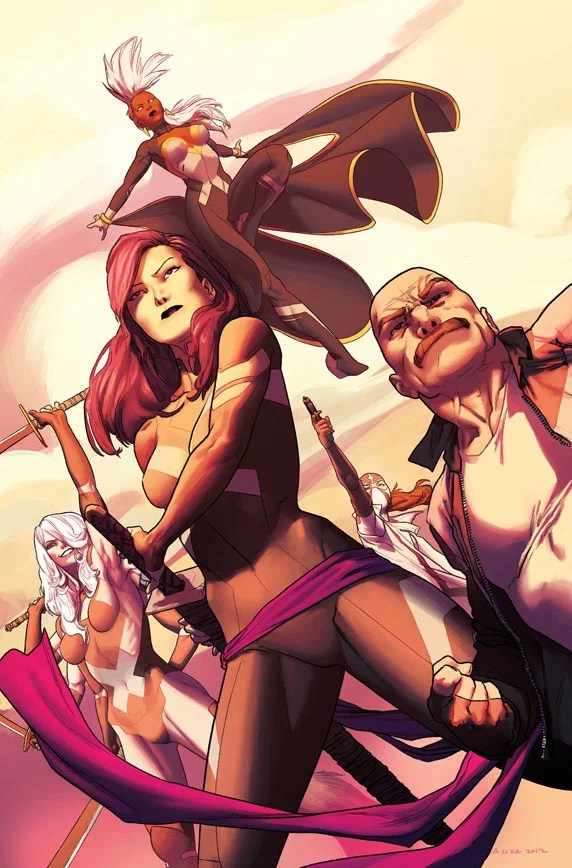
Uncanny X-Force #2 – Review

UNCANNY X-FORCE #2

By: Sam Humphries (Writer), Ron Garney (Penciler), Danny Miki with Scott Hanna (Inkers), Marte Gracia with Israel Gonzalez and Wil Quintana (Colorists), VC’s Cory Petit (Letterer)

The Review: One of my big comic book regrets of late is that I didn’t pick up Remender’s run on Uncanny X-Force. I borrowed the odd issue from friends but didn’t get the big picture, and from what I hear the whole run is an epic Must Read; I’m basically waiting for Marvel to package the whole thing up in an Omnibus edition so I can try and read it all in one massive sitting. Anyway, the point is that as well as missing out on some great storytelling, I also feel that I’ve missed out on some key moments which inform Sam Humphries’ turn on the title.

This feeling was a bit more pronounced with the first issue (lots of vague plot points discussed between Storm and Psylocke and glimpsed in flashback panels) but the sense still lingers here. This, along with the general bluster that dogs the books composition, makes things a little hard to follow. I can’t quite work out whether I like it or not. There’s good and bad, and I’m not sure if any one side really wins out.
Continue reading

Uncanny X-Force #1 – Review

UNCANNY X-FORCE #1

By: Sam Humphries (Writer), Ron Garney (Artist), Marte Gracia, Israel Gonzalez (Colorists)

The Story: Psylocke, alongside Storm and Puck, gets on a case of hive-minding drugs thanks to a tip given by Wolverine.

The Review: This book has an incredible challenge ahead of itself. Not only it is a first issue which needs to captivate readers with some unknown characters and setting, but it is the direct follow-up to a beloved tenure on the title by Rick Remender. Writer Sam Humphries has some huge shoes to fill on this title.

Thankfully, there seems to be some potential for this new volume of the series, as there are a lot of elements that are taken and followed from the previous run, while there are some new ideas and characters added to the mix to make this worthwhile. There’s the definitive touch of Remender inside this issue, but Humphries does not shy away from new directions.
Continue reading

A + X #1 – Review

By: Dan Slott, Jeph Loeb (Writer), Ron Garney, Dale Keown (Artist), Danny Miki, Cam Smith, Mark Morales (Inker), Wil Quintana, Frank D’Armata (Colorist), Clayton Cowles, Albert Deschesne (Letterer)

The Review: Buying this book was a somewhat difficult decision; lotta great books out this week but only so much cash in my pocket. I’d collected all of AvX Vs alongside the main event book and felt like I’d reasonably gotten my money’s worth, though the $3.99 price point sometimes caused a heavy sigh. The execution is very similar here with a mix of creative teams delivering two done-in-one stories per issue, though in this case the featured Avengers and X-Men have joined forces instead of butting heads. As such, this is pretty much as close to a Marvel Team-Up book as we can get right now and perhaps that’s reason enough to consider a purchase. But does this first issue do enough to entice us back for a few more?

Let’s take a look:

Captain America + Cable: First, forget Cable, they should have called this segment Captain America + Ron Garney! I would pay good money to read an entire issue of Garney drawing nothing but Cap taking a 12 hour snooze or painting a fence. He was (as has often been said) born to draw the character, and with editorial wisely pairing him with Dan Slott, the result is a story that captures some of that classic Waid/Garney magic. With Cap and Bucky taking on a deadly mission behind enemy lines during WWII, Cable drops in through the time stream to lend a hand against Atticus Trask’s diabolical Nazi Sentinels – a perfect set-up.

Slott’s definitely in his element; he writes an assured Captain America who effortlessly orchestrates spontaneous feats of strategy with his sidekick, and styles a brash, cocky Cable for him to spar with. A new twist on the Sleeper concept, Germans getting called “Fritz, and a sly reference to Bucky’s future as the Winter Soldier – brilliant fun. It’s a lean, compact little story without an ounce of fat, packing a satisfying beginning, middle and end within a tight 11-page window.
Continue reading

Fantastic Four #606 – Review

by Jonathan Hickman (writer), Ron Garney (art), Jason Keith (colors), and Clayton Cowles (letters)

The Story: The Fantastic Four go on a mission in a strange environment to save the life of an old friend.

The Review:  I think Hickman came into this with a good idea, but due to comics being just as much of a visual medium as a literary one, if not moreso, that idea just cannot be executed.

The problem is that so much of the issue hinges on the big twist at the end.  Hickman does his level bet to keep it mysterious as to where exactly the Fantastic Four actually are and what their mission is.  The whole issues is meant to tease you and keep you guessing as to their mission and location, only to shock you with its genius at issue’s end.  The problem, however, is due to the fact that we can actually SEE their surroundings means that we already know what the twist is just few pages into the comic.  So we’re left with Hickman playing coy with us for an entire issue, acting like he’s one step ahead of us when, actually, we’ve figured out the ruse long ago.

All of this teasing and coyness that’s so focused on keeping things a secret (when we’ve already figured it out), also leads to some really lifeless dialogue.  In fact, I’d say it’s the most lifeless, drab dialogue of Hickman’s entire run, who usually is able to communicate so much heart and significance in very few words.  Here, it’s just a bevy of science-talk at best.  None of the dialogue really carries any emotion or character and it feels like the characters are just going through the motions.
Continue reading

Wolverine: Weapon X #15 – Review

by Jason Aaron (writer), Ron Garney (pencils), Jason Keith & Matt Milla (colors), and Cory Petit (letters)

The Story: Can a Deathlok find salvation?

What’s Good: Without a doubt, the main Deathlok focused upon last month is the strongest point of this issue, as he takes center-stage yet again.  He makes for an unlikely protagonist, but a compelling one, as Aaron turns the tables by making the human inside the cyborg the sociopathic monster, while the AI is the empathetic side, showing an interest in humanity and emotion.  In the end, it’s a clever move by Aaron, as he makes the machine component of the Deathlok more human than the actual human component.  The end result is a robot that’s easy to root for and has allied itself with humanity, and as we learned from Terminator 2, that’s badass.

Much of this is accomplished through a fantastic use of textboxes, which act almost as parallel thought bubbles, or even conversations between the AI and the killer inside the Deathlok.  The slow, coming to consciousness for the AI is elegantly done and its eventual superseding of the killer’s mind feels appropriately momentous.  Once the AI is firmly in control, Aaron does a great job in making those textboxes feel claustrophobic and trapping, as the killer’s dialogue goes totally ignored, those textboxes become a kind of prison where the character is locked away.
Continue reading

Wolverine: Weapon X #14 – Review

by Jason Aaron (writer), Ron Garney (pencils), Jason Keith & Matt Milla (colors), and Cory Petit (letters)

The Story: We peek into the mind of the most successful Deathlok and his creation before Miranda and her commandos attempt to complete their desperate sabotage mission.

What’s Good: Opening with an intense monologue and moving on to depraved narration throughout, Aaron does a fantastic job with the voice of the serial killer turned Deathlok who takes center stage for much of the issue.  I’ve always appreciated it when a writer puts so much into what would otherwise be an incidental character.  The murderer’s voice feels authentic and very unsettling.  There’s also a definite cool factor to seeing what thought processes rest behind the automaton behaviour and dialogue we’ve been getting from the Deathloks thus far and it’s wonderfully horrific to learn that what lurks behind that cold droning is something very, very evil.  It imbues the Deathloks with a very nice sense of internal conflict and it’s sickeningly enjoyable to see how for a serial killer, being a Deathlok is like a video game.

Aaron shows us that what hides beneath the surface is often far more disturbing than what we can see, even if what we can see is violent and awful enough already.  It puts the Deathloks into a whole different light, making them even more menacing when we aren’t privy to the narration, now that we know what’s going on behind those dead eyes and robotic statements.

There are other little demonstrations of Aaron’s twisted imagination as well.  The machine the rebels in the future use to convey their psychic messages to the present day Miranda is guaranteed to give rise to plenty of ghoulish grins.  Meanwhile, the book’s ending is a wonderful twist in that it involves present-day Miranda turning the tables on the Deathloks by effectively using their own tactic against them; the most innocent character thus far looks to get just as brutal as the Deathloks themselves.  Then there’s the implied identity of the rebels’ “general,” which looks to be another inversion.

Garney’s art is a joy on this title, as it has been throughout.  The man is clearly made for a Wolverine book, particularly one as gritty as this.  His Deathloks continue to look great and his facial expressions are expertly done.
Continue reading

Wolverine: Weapon X #13 – Review

by Jason Aaron (writer), Ron Garney (pencils), Jason Keith (colors), and Cory Petit (letters)

The Story: The New Avengers get involved as Cap and Logan confront the inventor of the Deathloks.

What’s Good: Going into this issue, I was not overly thrilled with the idea of Aaron bringing in the New Avengers.  I liked his inclusion of Captain America, but bringing in a whole team, I feared, would dilute the comic.  What I didn’t count on, however, was the fact that Aaron writes an awesome Spider-Man.

His Spider-Man is absolutely hilarious.  His banter is awesome and his constant ribbing of the Thing is equally riotous.  But Aaron’s Spider-Man’s wit is so sharp that it borders on the metatextual.  For instance, his complaints regarding the fact that characters from the future always come from a dystopian wasteland, or his mocking of the sheer number of catch-phrases that the Thing has are both wonderfully done.  When Aaron writes Spider-Man talking and bantering exactly like the Thing, it’s utter genius and a hilarious statement on the character.

Then, not done yet with character, Aaron presents us with a grizzled, commando Spidey of the future who is a tragic shadow of his present-day go-getter.  Aaron’s Spidey, so madcap and hilarious in his present day version, finds himself unable to tell a joke or find humor in the future.  This alone speaks volumes about the darkness of his environment and in retrospect, is chilling.

Beyond this, what we get from Aaron is basically a smattering of coolness.  We get a headless Deathlok flailing about and punching through a guy’s chest.  We get a surprising callback to Aaron’s Wolverine: the List one-shot.   Then there’s a demoted mad scientist who makes cyborgs from roadkill, who serves as a surprising source for comedy (“Take care….of my possums…”).
Continue reading

Wolverine: Weapon X #12 – Review

by Jason Aaron (writer), Ron Garney (art), Jason Keith (colors), and Cory Petit (letters)

The Story: Logan and Bucky Barnes battle Deathloks to save the future.

What’s Good: It was clear last issue and it’s even more clear this issue: Jason Aaron loves the old Terminator movies.  The influences run throughout, and given that those movies are two of the greatest science fiction films of all time, that’s far from a bad thing.  We have the dystopian near future with a hunted group of underground rebels, and when one character discusses the Deathloks’ plan of coming to the present to snuff out the future leader of the rebellion, well, it’s just all kinds of cool.  The idea of taking a classic plot like that of Terminator and tossing it into the Marvel Universe and involving Wolverine as a kind of wildcard is just total genius.  It shouldn’t work, but it does, and it’s all kinds of fun.  If you have any love for the Terminator films, it’s hard not to totally geek out.
Continue reading

Wolverine: Weapon-X #5 – Review

by Jason Aaron (writer), Ron Garney (art), Jason Keith (colors), and Cory Petit (letters)

The Story: Wolverine heads to an oil rig to put down Blackguard once and for all.

What’s Good: It’s clear that Aaron has a strong hold on Logan’s voice. Once again, he shows that, with some very strong internal narration this month. The captions come together into a weird mish-mash that sees Logan discussing religious beliefs, philosophy, morality, and his past with Xavier. All of this is done in that pitch-perfect, grizzled tone that we all know.Though this narration only appears in the last third or so of the issue, it feels highly personal and is executed perfectly. It makes the book feel more intimate while also causing its conclusion more grand.

Wolverine’s moralizing provides a stronger sense of closure and his revelation of his only fear was well-done. The reveal was surprisingly, almost lovably, mundane, but the manner in which Aaron spins out from this into Logan’s deeper psychology adds the needed complexity. It also leads to a kill that is particularly brutal in its simplicity.

We also get a couple little reveals that really are rather cool. One of which is perhaps a little expected, but thankfully, Aaron compensates for this by not making the scene a particularly big deal. The latter scene is a bit of a head-scratcher, but not in a bad way.

As far as Garney goes, it’s clear that he was meant to draw this series, giving everything a rather scratchy feel. Colorist Jason Keith helps bring out the best in him, making everything feel bright and really helping to give life to some truly awesome splashes involving landscape and sunsets. Certainly, the action is fast-paced, violent, and enjoyable, with a fair share of impressive explosions, pyrotechnics,… and sharks.

What’s Not So Good: While the reasons are hard to pinpoint, this issue felt a little underwhelming overall. I suppose a good part of this had to do with most of the final action scene seeing Wolverine spending the majority of it in a vehicle. This really subtracted from the visceral savagery that has defined this series. It made the final action scene, while awe-inspiring and huge, less impactful.

The first half of the book was also a bit lacking. Some of it is pointless. Why have Wolverine be apprehended by HAMMER if nothing comes of it and nothing changes? Do we need another scene of Maverick telling Logan that these are impossible odds? None of this is particularly offensive, but it feels like filler.

I also find myself again completely uninterested in the journalist, who mercifully spends this book almost as an afterthought. Aaron hasn’t really given much of a reason for me to care about her, nor enough page space to really develop plot or character-wise. It’s a shame that an entire arc is gone now, and the character is still bland and cliched.

Finally, despite my love for Garney’s take on this book, this isn’t his strongest issue. The quality here can be a little uneven; certain panels see a drop in detail, others become a little too scratchy, losing definition.

Conclusion: Not quite as awesome as I’d hoped, but things do kick up a level when the internal narration starts.

Grade: B-

-Alex Evans

Wolverine: Weapon X #4

By Jason Aaron (Writer), Ron Garney (Art), and Jason Keith (Colors)

Some Thoughts Before The Review: Wolverine may be overexposed these days, but Jason Aaron’s Weapon X series is definitely a keeper.

The Story: Wolverine and Maverick think they can take down the CEO of Blackguard before the Senate vote…

What’s Good: The best thing about Wolverine: Weapon X #4? The brutal, exciting action that takes up most of the book. Artist Ron Garney and writer Jason Aaron deliver what is easily one of the best fight scenes of the year, as Wolverine squares off against a Blackguard soldier. While I hesitate to say too much because it could easily ruin many of the highlights of the battle (Jason Aaron’s contributions in particular), I absolutely must mention how awesome Garney’s two page fight montage looks. Most of it is a prime example of the artist at his best and a great piece of evidence in favor of the argument that Garney is simply one of the best Wolverine artists around.

The slower stuff in Weapon X #4 holds up against all the action rather well. As you probably know by now, Jason Aaron writes one hell of a gruff, badass Wolverine and proves it through the dry, humorous dialogue. Ron Garney’s artwork (complimented by Jason Keith’s impressive color work) is very cinematic and does a fine job telling Jason Aaron’s story. The characters look fantastic, the action (as I mentioned) is near perfect, and the overall tone is a perfect fit for a series like Weapon X.

What’s Not So Good: Jason Aaron’s Blackguard story, while decent, continues to be predictable and fairly bland. The laser claws are cool and the basic concept behind it is sound, but nothing particularly surprising has happened (outside of one thing that happens to Maverick). Another complaint I have is that occasionally Ron Garney’s work looks a bit rushed. A few panels are oversimplified and, quite frankly, pretty rough-looking. It doesn’t hurt the overall art package too much, but it is noticeable because most of the book looks so damned good.

Conclusion: While the story leaves a bit to be desired, Wolverine: Weapon X is worth it for the action alone. If you’re a fan of Wolverine, consider the latest issue of Weapon X to be a must buy.

Grade: B+

-Kyle Posluszny

Wolverine: Weapon X #3 – Review

by Jason Aaron (writer), Ron Garney (art), Jason Keith (colors), and Cory Petit (letters)

The Story:
The jungle cat-and-mouse game continues between Logan and Strikeforce X.  Meanwhile, we meet the head of Blackguard and Maverick gets his hands dirty.

What’s Good:
Despite my love of Jason Aaron, I almost dropped this series.  It wasn’t because it’s a bad comic, in fact it’s been pretty solid, but only due to my “Wolverine fatigue.”  Aaron seems to have been attempting to get around this through simplification, divorcing the character from the main Marvel Universe and boiling down the character to its bare essentials: he’s badass and he stabs people.  Unfortunately, while fun, this doesn’t exactly get me excited enough to add another $3.99 comic to my pile.

Thankfully, I can say that this is the best Weapon X issue to date.  Aaron has finally established a voice for this series, making it a much more engaging read.  This month, with the introduction of Blackguard’s corporate head, military contracting politics, “men in black,” conspiracies, and political corruption, the series has become much more nuanced and finds itself becoming very much a “State of Play”-styled espionage/political thriller that nonetheless features a little furry guy stabbing people in the jungle.  Either way, the series ends up feeling more intelligent and finally sucked me in.  It finally carves out its genre of choice through focusing more on the bad guys, and I can honestly say that the comic is all the better for it.

Meanwhile, as was the case last month, I can say that Ron Garney is currently drawing my favourite Wolverine.  Logan looks positively bestial, demonic even, despite Garney making his height very apparent.  Logan actually LOOKS like a Wolverine: short, stalky, and feral.  It really takes the action scenes to a new level.

What’s Not-So-Good:
The reporter continues to fail to grab me as a character, despite Maverick’s badassery this month.   She appears to merely be the means of achieving that “political thriller tone,” and lack any unique or defining characteristics.  I just don’t find her to be a very strong character (as evidenced by my forgetting her name).  All the more groan-worthy is Aaron’s need to make apparent her faith in Obama’s “change platform” and the new administration.  It’s not a big deal, but honestly, at this point, any mention of Obama in my comics is like nails on a chalkboard.

Garney also appears to struggle a bit drawing her.  Granted she’s dressed entirely differently, but in the two scenes we see her in, she appears to be two different people.

Also, some readers may not be that high on the main bad guy of the series, who may seem at the moment to be a little too clichéd (the unethical, power hungry CEO).

Conclusion:
Well, I like this Wolverine comic better than any of the other offerings out there.  Aaron has a clear love for the character and this title is finally coming into its own.  The best praise I can give it is saying that it’ll be staying on my pull-list.

Grade: B+

-Alex Evans

Wolverine: Weapon X #2 – Review

by Jason Aaron (writer), Ron Garney (art), Jason Keith (colors), and Cory Petit (letters)

The Story: Logan seeks out the new Blackguard Weapon X commandos as, he heads to Columbia. Meanwhile, reporter Melita Garner decides to try to figure out who exactly Wolverine is.

The Good: Jason Aaron really has a knack for Wolverine’s character. Not only does he write a great Wolverine, but it’s clear that he has a lot of affection for the character as well (“little hairy dude who likes to skewer bad guys”). Aaron writes a great Logan. The textboxes are fantastic, and Wolverine sounds like Wolverine, with a good use of Logan’s trademark, gruff slang that doesn’t become so dominant as to render Logan an unintelligent “badittude” hillbilly. Logan’s voice suits the character with its affable nature, but also sounds as if it’s clearly coming from a smart character.

The massive action scene at the end with Wolverine fighting a pair of “Adamantium Men” was high-paced and thoroughly enjoyable. Much as Aaron has a clear grasp of the Wolverine character, he’s also showing a real talent for plotting out action.  The blow-by-blow, move-by-move frame sequencing is incredibly fluid, and natural.  It’s clearly well thought-out and logical, while also thrilling and indisputably “superheroic.” One frame led very naturally to another despite the speed. It’s good work.

Aaron also infuses the comic with a little humor. Logan’s booze-riddled existence is as much a laugh in this issue as it was last month. However, the real highlight is during the big brawl at the end. Wolverine does his trademark roar, looking to rush into combat; yet only to end in a hilarious frame of him scampering off into the distance, running right by his opponents, who are as stunned as the reader.

Art-wise, this is a solid comic, which, for better or for worse, has that sleak “Marvel comic” look.  Nothing distinct or stand-out, but nothing to complain about either.  That said, when the script calls for it, Garney can draw one helluva scary-looking Wolverine. Somehow, Logan’s small stature has been highlighted by Garney, and yet that only leads to him looking more bestial and frightening.

The Not-so-Good: There’s only one big downfall in this issue.  Despite occupying half the issue, the Adamantium Men just aren’t very compelling right now.  I know Wolverine despises anything Weapon X, but I still wish we could see a little more personality or character from these commandos. Right now, they’re simply lame.

Even the art design of these guys is just not that interesting. In an effort to alleviate their blandness as adversaries, Garney tries to make them look more “inhuman” as they have glowing neon-green eyes and similarly colored “energy claws.” Unfortunately, to me, it just ends up looking a little unnecessary.  Shiny eyes don’t make for menacing, compelling villains.  Somehow, it just looks silly and contrived.

That said, for all my whining, I’m sure this will soon be a non-issue.  The commandos mention having a mysterious “boss,” who will probably end up being the real adversary of this arc.

Conclusion: Right now, this is probably the best Wolverine comic on the stands, and at issue #2, the most accessible. With tThat said, fans of Aaron’s breakthrough “Scalped” will also find a lot to love.  In Logan’s rough demeanor and alcohol-swilling ways, the ties are quite clear and it’s more obvious than ever that Jason Aaron was the right man for this job.

Grade: B

-Alex Evans

Wolverine: Weapon X #1

By Jason Aaron (Writer), Ron Garney (Artist), and Jason Keith (Colorist)

Some Thoughts Before The Review: At first, like any sane person, I really wanted to dismiss Weapon X as something that I need not waste my time reading or reviewing. I mean, at first glance, it seems to have all the trappings of what would pretty much be THE ultimate Marvel cash-in series. In my mind I thought, “It stars Wolverine, launches just weeks before a film starring the character hits theaters, and is subtitled “Weapon X” (which just so happens to be an integral part of the Wolverine movie)…yep…” Then I noticed that the creative team attached to the book is the same team responsible for “Get Mystique!” one of my favorite Wolverine stories of all time. Suddenly, Wolverine: Weapon X became a must read series…

The Story: After getting a tip from Maverick, Wolverine heads off to investigate the latest attempt at resurrecting the Weapon X program. It turns out that a private military contractor recently bought Weapon X files off the black market and is looking to give it’s mercenaries a boost. The investigation into the facility hosting the experiments triggers some old memories of Wolverine’s time as part of the program…

What’s Good: Jason Aaron and Ron Garney waste no time establishing the gritty, violent tone Wolverine: Weapon X will have. Both the visuals and the writing do a fantastic job of tapping into the dark side of Marvel’s main mutant. While it’s definitely too early to tell just which directions the first arc will take, it’s obviously going to be a brutal, bloody affair. And I, for one, could not be more pleased about that.

What’s Not So Good: I guess my biggest complaint is that the debut of Weapon X is very much a textbook example of how a standard first issue should play out. The first threads of a plot are introduced, Wolverine’s character is established, and off he goes with a purpose. The formula works, that’s for sure, but I wish the series would have hit the ground running a bit harder. I mean damn near everyone is already familiar with Wolverine on some level, so why not just get to it? Sure, it’s a blast reading Aaron’s take on Wolverine no matter what the character is doing. And sure, I couldn’t be much happier with Garney’s distinct visual style. But I wish things moved forward a bit more from a plot perspective instead of spending so much time establishing Wolverine as a badass…most people already know that he is.

Conclusion: I really like the first issue of Weapon X, especially on a technical level, I just wish it had a bit more substance. That said, what substance there is has some interesting storytelling potential that, under the control of Jason Aaron, Ron Garney, and Jason Keith, should be in good hands. I look forward to see what happens next.

Grade: B+

-Kyle Posluszny

10 Questions: Ron Garney

By J. Montes

Ron Garney gained much notoriety in the 1990s with his run on Captain America with Mark Waid. His energetic style coupled with Waid’s action-packed scripts not only boost the sales of a sinking title, but re-energized Captain America as one of Marvel’s flagship characters. From there, Garney drifted to other titles like The Incredible Hulk, Green Arrow, and JLA before landing on Amazing Spider-Man with J. Michael Straczynski.

The work Garney did on Amazing Spider-Man is nothing short of controversial and engaging. In it, Peter Parker reveals his identity to the world (and grapples with the ramifications), uses his new “Spider-Armor” designed by Tony Stark, witnesses the shooting of his Aunt May, and nearly kills The Kingpin. Sadly, most of these events would be rendered null by “Brand New Day”, but they still stand on their own merits and arguably push Spider-Man down the darkest path of his career.

Following his run on ASM, Garney did a short stint on Wolverine with Jason Aaron and is now working on Skaar: Son of Hulk with Greg Pak. His work here is a huge departure from what fans may be used to – not only because of the lack of an inker on his work, but also because of the involved fantasy setting.

Your run with Mark Waid is regarded as one of the best runs on Captain America. Do you have an itch to go back and work on that character?

Not really an itch. At the time I was doing it back in the 1990s the title had gone on such a rollercoaster ride [Editor’s Note: Captain America was taken away from Waid and Garney so that it could be rebooted as a “Heroes Reborn” title by Rob Liefeld] that I thought I’d never want to again. But after I got to draw him again in my Amazing Spider-Man run, I remembered how much fun it was. I think that’s what made it so enjoyable, just being able to draw the character without the political hoopla surrounding a suddenly “hot title”. So yeah, I’d like to draw him again at some point if the story is right.

Your art has evolved throughout the years, but I’ve always felt your work’s most constant, and greatest strength is the energy you put into your characters. You have a great sense when it comes to portraying dynamic, hard-hitting action. Was this skill something you always had or something you really had to work hard at?

Thanks!  I don’t know if I have a method for doing it that’s conscious on my part, but it’s a process of feeling it, I suppose; getting the eye to move through the story at an exciting pace that makes sense. Visually, I go back over the pages and reread and draw them until I think they flow right. And (with) the figures I try to put them in their ultimate positions for action – meaning following through to the end of their form – the extensions of the legs or arms. The figure work is a large part of it.

A lot of artists use photo reference and models for their work these days. What method do you use? If you’re using photo referencing, let me tell you: it’s pretty hard to tell with your artwork.

Not generally, no. I will if I have to draw a place like Kansas City in the 1920s, for example. I’ll want the authenticity, but I don’t generally reference figure work unless I’m having real trouble with it. I might look at myself in a mirror once in a while with a light bulb to cast shadows or what have you, but it’s rare. To me, the work itself can lose a bit of the charm and personality when photo referencing too much in certain places. There’s a lot of guys who do it brilliantly and it seemed since the advent of Alex Ross’ popularity that it became the craze. Whenever I’d spoken with Alex I’ve told him I blame him for it. *laughs* It seems like it became a big competition as to who could photo ref the best. That’s the way I view it, I suppose. I’m not saying it’s wrong, just not right for me. But I suppose it was an inevitable backlash to the manga craze in the 1990s.

Back to your work evolving, you’ve recently started having your work digitally inked. Why did you decide to forgo using inkers on your work? I’ll argue that some artists like Leinil Yu can pull it off, but if you look at his stuff on Secret Invasion, it looks (in my opinion) more crisp with an inker.

Well, sometimes just because it’s ‘crisp’ doesn’t mean it’s anything more than to the one who likes it that way. I know people who really like the less ‘crisp’ look and people who like it rougher as well. As far as the pencils, I wouldn’t even say they’re “digitally inked”. On Wolverine I wanted to try it and I loved the results – how the pencils looked colored – and that was the bottom line for me.  I love Leinil’s work uninked, and I love it inked. There’s something really cool to me about the rawness of the pencils and in my case it works if I have the time and not so much if I’ve been rushed, but it’s the same thing in my inked work. It takes time and a meticulousness for it to work really well. Yes, the inked pages are a beautiful art form but, I think uninked, it’s a cool approach to experiment with. Without exploration there’s no growth – regardless of whether every single page or cover gets pulled off or not.

Fair enough. Is this new “penciled only” style something you’ll be using more in the future or something temporary?

We’ll see. It depends on the project, but yeah I’ll use it again and again. But I’ll do the ink approach too, so you can wipe the sweat off your brow Jason! *laughs*

I see how it is! But in all seriousness, I do prefer your inked stuff. But after hearing your reasoning it makes more sense to me now and I can respect your decision to try something new. I honestly thought Marvel was just trying to save money or cut corners. Moving on, Skaar is much different from the work you’ve done in the past. How much of a challenge is it for you to do a fantasy setting?

It’s fun! I wouldn’t say it’s more of a challenge – just getting into a different mindset. I like looking at old Roger Dean Yessong covers and things for inspiration. Before comics, I intended to be a fantasy illustrator. I had tons of oil paintings in that vein. Unfortunately, they were all stolen from my apartment years ago and I never went back to it. But, if you go to my Myspace page you can see some of my fantasy sketches there.

Well, it all makes sense now. Your creatures and dragons from Skaar are fantastic. I’ve never seen this side from you before. Where do you draw your inspiration for these creatures?

I just drew them. I went through quite a process of redrawing till I got them to where I liked. Obviously, the scales were the toughest thing about it – they’re very challenging to draw – more so than I thought they’d be, but also very gratifying and pleasing when you get them right. There’s something cool about the shape of the heads and such. There was a page I drew where I sort of let my Maurice Sendak come through. It’s a splash page of three dragons blasting fire down at Skaar and I couldn’t get Where the Wild Things Are – my favorite childrens book – out of my head, and I think it came through on the page.

Your Amazing Spider-Man run was fantastic. How was it working with Joe Straczynski?

I enjoyed the scripts.

How do you feel about the direction Marvel Editorial decided to take with “One More Day”? It was almost like they rendered a lot of your work and JMS’ story null.

Well, I’m sure that Joe (Quesada) did what he thought was best for the character at the time. Did he pull it off? That’s up to the readers to decide for themselves. But as much as I understand that point of view a lot of fans have – it’s comics and history in comics can be rewritten infinitely. Each history is viable depending on who’s writing it. Yeah, I like the work that we had done, but in my mind it happened – it’s just that a character changed history. I think I read somewhere there’s a theory that Mephisto was actually the metaphor for Joe Quesada, himself, and I burst out laughing at that.

You’ve done many iconic Marvel characters – Captain America, Spider-Man, Wolverine, Hulk. Who would you like to tackle next if given the opportunity?

I’d like to a more lengthy run on Wolverine at some point, and I’d like to do Thor or the Fantastic Four.  There’s plenty.

JMS and Garney reunited on Thor would be glorious! Thanks, Ron!

Thanks Jay!

RECOMMENDED READING:

Captain America: Operation Rebirth
Wolverine: Get Mystique
Spider-Man: Back in Black
Civil War: Amazing Spider-Man
Skaar: Son of Hulk

Skaar: Son of Hulk #2 – Review

By Greg Pak (writer), Ron Garney and Butch Guice (art), Paul Mounts (colors)

I’m a big fan of Greg Pak and Ron Garney’s work. I enjoy just about everything they do. And dammit, I want to like this book so much.

But I just can’t recommend it.

I still have reservations on how Skaar’s early years were tossed out the window (last issue), but since there’s no turning back I’ve come to accept the given story. Pak is trying very hard to make this a sprawling epic and this issue does everything the previous didn’t – but it’s still not enough. Skaar is immediately thrust into the confrontation with Axeman Bone, and I’m glad we’re not given the cliche outcome of “You can’t defeat me yet. Come back in a few years.” Instead, Skaar pretty much whoops everyone’s ass – even taking on some dragons – and it’s a most welcomed sight. Frankly, I’m surprised that this isn’t in Marvel’s MAX adult line. The intense violence is some of the most graphic I’ve seen in a mainstream Marvel book. That said, well scripted action sequences an awesome book this does not make. And that’s really all this issue is: a big fight and an introduction to a new character.

As for Ron Garney, well, the scenes he renders are freaking amazing. There’s no dispute that he’s perfect for this book. BUT. But… for the love of god, give this guy an inker! I don’t care how much he argues, fix this now. Stop trying to ape Dark Horse’s Conan style and give us something truly beautiful. You know, like the superior high fantasy art Marvel did in the 1970s? I can’t convey how much this pisses me off. Look at the cover of this book for Christ sakes – it’s fantastic and it’s INKED. Imagine how much better this book would look if someone inked Garney’s work.

I rest my case.

As much as I love the artwork, there’s a bit of disjointedness going on with the storytelling. This makes it hard to tell what’s going on at times. I’ll admit I had to do double takes and rescan over the art to figure out what was going on. A bit annoying, but if you can let this go you’ll be mesmerized by the art – especially when Skaar takes on the dragons.

The story is on the short side at 14 pages. Why so short? I’m thinking Garney was running behind on his deadline. This book is almost two months late, after all. For the remaining pages we get a back-up story with art by Butch Guice which gives us a different perspective on things, but is nonetheless, filler. There’s more meat to this backup story, but it honestly made me yawn. Butch Guice’s work is dependable as always, however – no complaints there.

I don’t know what’s going on over at Marvel, but if the lateness is going to continue I’d rather the powers at be just cancel the book. As much as I want to like this book, there’s too much going against it to make me want to continue buying it. Art that’s hampered by the non-presence of an inker and 14 pages of story? I’d rather put my money on a title that’s more timely. Besides, I can get this same fantasy element from Conan. So really guys, what’s the point? (Grade: C-)

– J. Montes

Skaar: Son of Hulk #1 – Review

By Greg Pak (writer), Ron Garney (pencils), Paul Mounts (colors)

Being a fan of Planet Hulk, Skaar is a book that has tons of potential. After all, Hulk’s romp on Sakaar is one of the greatest stories ever told for the green behemoth. When you pair the story’s architect, Greg Pak, with one of the most explosive artists out there in Ron Garney, it almost seems like a recipe for comic gold. Unfortunately, Skaar’s first outing gets off immediately on the wrong foot.

Don’t get me wrong, I love Ron Garney – he’s one of my favorite artists – but the work he’s done on the last few issues of Wolverine completely turned me off. And it’s not that his compositions were bad, but the lack of any sort of inker really hurt his work. Some artists can get away without the use of an inker’s skills (like Leinil Yu or Cary Nord), but it takes extremely tight pencils or an extraordinary colorist to bail you out, or a combination of both. Well, Paul Mounts fails to bail out the penciled work here, and Ron Garney’s pencils are scribbly and loose.

I can’t begin to tell you how many panels in this issue are riddled with scribbly black lines to portray weight and shadow. It’s fugly, unrefined, and too raw. But maybe that’s what Marvel wanted to portray in this book – a raw, primal feeling. Personally, I think it’s crap. I own original Ron Garney art with inks by Bill Reinhold. I know how good his art can look inked. And until Garney starts to use an inker again, I won’t be praising him.

I understand the need to accelerate Skaar’s growth. The team felt the need to get into the thick of things and make an impression on the readers as quickly as possible.

That formula backfires here.

Instead of taking his time showing personal growth and humanizing Skaar, Pak makes him a grown man-child in a matter of pages. There’s so much story that could have been told but what we’re given is a series of skips and stutters that mar the flow of the story (if you want to call it that). Remember in the movie version of Conan The Barbarian where Conan’s a child and in a matter of seconds he’s an adult? That’s pretty much the same concept here, but there’s nothing that makes his emergence compelling – and that’s because he’s not revealed until the last page.

Maybe this first arc will read better as a trade, but as a debut issue it’s completely below average. The art is dirty, the coloring is muddled, and the story lacks any substance. I enjoy all three creators on this book and they all let me down. I love the world of Sakaar based on what Pak gave us in Planet Hulk, but Hulk’s son has a long way to go if he hopes to compete with similar, more superior titles like Conan (Busiek’s run is mind blowing) and Joe Kubert’s Tor. (Grade: D+)

– J. Montes

A Second Opinion

I jumped back into reading comics after the Planet Hulk/World War Hulk storylines so I am coming into this Skaar series with only the most basic knowledge of what happened during those events. I mention this so you know where I stand with this review in contrast to Jason’s. Also, before I begin, I want to say that I have no idea the potential this story holds since the setting and characters involved are completely new to me. In other words, I am taking this debut issue completely at face value. With all that said, even though I agree with some of Jason’s points, I find myself satisfied with the premier of Skaar.

Skaar #1 is an extremely quick read, but I hesitate to fault the book for this when the writing is so effective. Greg Pak does an excellent job quickly recapping events, bringing the reader up to speed in only a few pages. Unfortunately, this speedy storytelling continues past the recap of events and brings Skaar from child to young adulthood much too soon. I like the story of a warrior as much as the next guy and appreciate a good fight, but a little bit of characterization, of any sort, would have gone a long way. While it is unfortunate how quickly Skaar’s maturation takes place, Pak does a nice job writing the villagers/slaves in a way that brings more to the Skaar character even when he is nowhere to be seen. Also, the barbarians are ruthless (yet humorous), it says a lot about Pak’s writing ability when generic characters can effectively keep the book interesting.

As for the art, I can’t possibly be as critical as Jason. I felt that the “unrefined and too raw” look fit the book quite well. This is a brutal, unrefined, alien world and the artwork reflects that in a certain way. Addressing the inking issue, I honestly don’t think I could picture this book with the type of inking used in something like Secret Invasion. There is a certain charm to the way things are portrayed in this book and, while it isn’t exactly pretty, it works given the subject matter and story style. I also like the creatures Garney has created, making the world feel sufficiently bizarre and alien.

Overall, Skaar didn’t exactly blow my mind, but I did enjoy it for the most part. It really is as though Conan was born in the Marvel universe on an alien planet and I like that concept. This wasn’t exactly the strongest way to kick off a new series, but I find myself hooked regardless. (Grade C+)

-Kyle Posluszny

Wolverine #65 – Review

Jason Aaron (Writer), Ron Garney (Artist), and Jason Keith (Color Artist)

Before I begin this review, let me just say that it’s a shame that this is Jason Aaron’s last issue on Wolverine before Mark Millar takes over with his “Old Man Logan” arc. I have no doubt that Millar’s arc will be a solid, entertaining, and a truly original take on Wolverine, but Jason Aaron has crafted something great with the “Get Mystique!” arc. He truly “gets” both Wolverine and Mystique and has used that understanding to make an increasingly high-stakes game of cat and mouse (with a mutant twist, of course). I hope that Mr. Aaron is given the reigns to Wolverine somewhere down the road, because this might just be the most entertaining Wolverine story I have ever read. With that said, let me get on with the review.

Wolverine #65 hits all the right notes, in all the right ways, and it really is everything someone could hope for in a finale. We get the brutal, satisfying Wolverine and Mystique confrontation we have been waiting for, no strings attached. We also get a satisfying conclusion to the flashback sequences that have helped create an interesting and complimentary side-story to the main event. Nearly everything about this book, and really this arc as a whole, is top-notch and I can’t recommend this one enough. An extremely satisfying book all around.

Jason Aaron once again nails the complex dynamic between Wolverine and Mystique. We see they are more similar than one might think, while at the same time presented with stark contrasts. Aaron’s take on both characters is just superb. The story, on the surface, is incredibly simple, yet Aaron has managed to create enough layers to keep things interesting and the reader guessing. I can’t wait to see what he does next time he gets his hands on either of these characters. His dialogue is crisp, the inner monologues work extremely well, and the story moves at a brisk pace.

I wish I could have the same sort of praise for the artwork, but there was something lacking. Ron Garney and Jason Keith have done some great things in the previous issues, that’s why it’s a shame that some aspects of this book feel rushed. It’s still a very solid effort, but I can’t help but feel that an extra layer of polish would have done wonders. That said, the action flows smoothly and the fight between Wolverine and Mystique is a thing of brutal beauty, especially one particular splash page that stands above them all.

I can’t recommend this book, or this arc enough. I urge any Wolverine, Mystique, or X-Men fan to check it out. One thing is for sure, the bar has been set incredibly high for Mark Millar. Here’s hoping he delivers with “Old Man Logan.” (Grade: A)

-Kyle Posluszn

Wolverine #63 – Review

By Jason Aaron (writer), Ron Garney (artist), Jason Keith (colors)

After a very rocky debut, Jason Aaron and Ron Garney unleash their second collaborative effort with Wolverine #63. Sadly, it’s more of the same. It’s well documented that I am a big fan of both creators. Jason Aaron’s work on Scalped is superb and Ron Garney has always delivered top notch art – especially on his latest Amazing Spider-Man run. There’s a persistant problem that’s plaguing this book and it’s not one, but both creators’ fault.

Ron Garney’s is the lesser problem and could easily be rectified. Get him a damn inker! I don’t know who’s decision it was to let him pencil this book without an inker, but it was a poor choice. The pencil work is, at times, muddy, uneven, and undefined. If you had an inker on this stuff it would undoubtedly look so much sharper. It’s a shame, too, because Garney is doing some excellent storytelling and it’s all going to waste.

Jason Aaron, however, is the bigger problem. Much like Craig Kyle and Christopher Yost (the writers of X-Force), Aaron’s portrayal of Wolverine is just awful. Wolverine continues to trot around Asia and Africa on the heels of Mystique only to be fooled and foiled time and time again. There’s even a point where he actually catches up to her (again) and has a drink. He retardedly (is that a word?), like a James Bond villain explains the plans he has in store for her only to see her slip away (again). Is Wolverine really this stupid? How many times is he going to fall for this crap before he catches her? Why is Marvel’s editorial staff approving stories like this? You think just because a writer has a good resume it gives him free license to do what he wants? This is just awful work.

To be fair, there are a few moments that I liked. The flashbacks between Wolverine and Mystique are getting more interesting. Also, the scene where Wolverine’s looking for an excuse to smack down an American solider in Baghdad is pretty hilarious. But fleeting moments like these don’t make a good story. Until Aaron starts treating Wolverine with the respect he deserves, this book isn’t worth your $2.99. Sorry, this book fails, but I’ll give it a “plus” for humor and the flashbacks. (Grade: F+)

– J. Montes

Wolverine #62 – Review

By Jason Aaron (writer), Ron Garney (art), Jason Keith (colors)

A little rant before I begin. Wolverine has to be a Skrull. He’s in Europe in Uncanny X-Men, Afghanistan in his own book, New York in New Avengers, Running around X-Force in their book, and off in space in Astonishing X-Men. There’s no way he can be in that many places!

Because of his overexposure for more than two decades, let it be known that I’ve not bought a Wolverine comic off the stands since Wolverine #1 back in 1987. So what motivated me to pick up this issue? Three words: Aaron and Garney. If you’re not reading Jason Aaron’s Scalped, you’re missing out on one of the best Vertigo titles being published today. And Ron Garney? Well, I’ve been a fan of his since his Captain America days. I like his work so much that I also own a piece of his original art from his Amazing Spider-Man run. As you can see, picking this book up was very much a no-brainer to me.

But is it any good?

Our new creative team begins a story arc exploring Wolverine and Mystique’s past and present relationship. Now, I’m not good on mutant continuity as I used to be, but I had no idea these two knew each other since 1921! Is this something new or is this common knowledge?

In the present, Wolverine’s in Afghanistan looking for Mystique after the events of Messiah Complex and he’s determined to get his payback. He chases her across Africa and into Asia, and every time he gets close, she slips away. What I don’t understand is why Wolverine is running around in his X-Men uniform to all these places. I mean, doesn’t he want to at least try to blend in with the locals and get the jump on her? Because of logic problems like this, this first chapter ends on a disappointing note. Wolverine is not stupid, and yet he’s portrayed as a complete idiot. I really expected more from Jason Aaron, and so should Wolverine.

Garney’s art does not disappoint. But as good as it is, it lacks the refinement that Bill Reinhold gave it when they were together on Amazing Spider-Man. His Wolverine and Mystique, however, are excellent. Jason Aaron brings his trademark “natives speaking in languages we don’t understand” routine. He does this a lot in Scalped and he does it here, too. We get the gist of what the Mexicans and Afghanis are saying, but it’s never fully translated. As I said, his script is lazy and there are logic problems, but I have hopes that he’ll find his footing and turn things around. (Grade: D-)

– J. Montes

Design a site like this with WordPress.com
Get started