• Categories

  • Archives

  • Top 10 Most Read

She-Hulk #7 – Review

By: Charles Soule (story), Javier Pulido (art), Muntsa Vicente (colors)

The Story: Ant-Man and Hellcat cut She-Hulk down to size.

The Review: I’m sure Soule had his reasons, but it was still kind of bizarre for him to break off the one ongoing mystery of this series, just as it was really starting to take off. For one thing, his choice required all the characters involved to suddenly decide the case they had dedicated themselves to investigating wasn’t worth the effort anymore, going against all of their usual tenacity. That inconsistency would nearly be a plot hole if Soule hadn’t suggested a touch of the supernatural might be involved.

Still, shelving the Blue File for the time being allows Soule to take another stab at that delicate genre balance between superhero and legal drama, and he succeeds this issue. Past premises have been heavy on the law, light/repetitive with the vigilantism, but this one reverses that trend: Rufus, an inventor working out of Jen’s office building, wants her to negotiate a contract for the purchase of his and his partner Reza’s shrink-ray technology, but he needs her to find Reza first. Here’s the wrinkle: Reza, in a fit of proprietary rage, may have shrunken himself into hiding.
Continue reading

The Private Eye #7 – Review

By: Brian K. Vaughan (story), Marcos Martin (art), Muntsa Vicente (colors)

The Story: No one deserves to go down this way—not even a sex doll.

The Review: Brace yourself—personal story coming through. A few months ago, I switched email accounts. My old one kept having this problem where someone would hack into the account and send spam mail to all my contacts, usually with subject lines like, “Check this out,” or, “You won’t believe this!” The third time this happened was the final straw. Of course, when I made the switch, I let all my contacts know. I just forgot to do the same with my commercial subscriptions.

Consequently—and this is the point of this otherwise bizarre anecdote—I never received an email from Panel Syndicate letting me know the latest Private Eye issue was out. It wasn’t until after reviewing the latest Saga did it occur to me that I hadn’t read an issue of Vaughan’s other ongoing in a while. But here we are, better late than never, as some might say. Anyway, I’m sure fans will agree that unlike many series, Private Eye doesn’t suffer for the wait.
Continue reading

She-Hulk #4 – Review

By: Charles Soule (story), Javier Pulido (art), Muntsa Vicente (colors)

The Story: So is there a union for superhero-lawyers, or no?

The Review: I was fine with She-Hulk committing itself to be a legal drama/comedy for as long as it chose, but I also expected it to commit itself equally to the superheroics once the time for legal ball-busting came to an end. Soule seemed to be setting up the title for just that kind of confrontation when Doom made a direct attack on American soil—in a federal courthouse, no less—to pluck his son from Jenn’s grasp. A She-Hulk v. Doom battle seemed inevitable.

And this issue gives it to us—but… Well, it’s just not the big blowout we’ve been waiting for. Instead, it winds up being yet another sequence of Jenn destroying robots, which is about the only costumed action we’ve had since this series began. Doom doesn’t even go out to deal with her personally; he simply sends out a bigger robot as his proxy, and even that comes to nothing. Apparently, Jenn takes the trouble of sneaking into Latveria in order to settle the case, not fight it out.
Continue reading

She-Hulk #3 – Review

By: Charles Soule (story), Javier Pulido (art), Muntsa Vicente (colors)

The Story: A rich client is a good thing—usually.

The Review: I can’t tell you how many times I’ve said in a review that I didn’t care what was going on in a story because I didn’t care about the characters involved. I’m quite sure I’ve said this even when it’s the first issue that the characters ever appeared in. Some might say it’s a little unreasonable to expect instant charm from every character, and they’d be right. But it’s hard not to set the bar that high when writers like Soule make it look so easy.

From the first line he utters in this issue,* Kristoff Vernard, adopted son of Dr. Doom, passes the first test of being interesting, if not exactly likable: “Urgh. I am not accustomed to making a request more than once.” And soon enough, he passes the likability test as well, once he explains, in eloquent though lofty terms, why he needs to leave Latveria for America: “Here…in this strange country, I can be anything. I must take the risk. I would take any risk for freedom.” For Americans, the patriotic appeal is almost irresistible. Kristoff’s pursuit of freedom will do it for everyone else.
Continue reading

The Private Eye #6 – Review

By: Brian K. Vaughan (story), Marcos Martin (art), Muntsa Vicente (colors)

If writers can generally be divided into two camps—the plot-driven and the character-driven—so can readers. I’d definitely say that it’s the characters that do it for me. Obviously, I love stories that have both in equal measure, but I admit that even if the plot is a directionless mess, I will follow along like a lamb to slaughter if the characters leading me on are complicated and interesting. Which is to say that character specialists like Vaughan can always count on my eternal loyalty.

My absolute favorite thing about Vaughan is he takes the time to make every character fully realized, no matter how big or significant their role in the overall story. Too often, comic book writers place their focus entirely on one or two principals, using everyone else as filler. But in a Vaughan comic, even the most inconsequential figures can be compelling on their own.
Continue reading

She-Hulk #2 – Review

By: Charles Soule (story), Javier Pulido (art), Muntsa Vicente (colors)

The Story: Jenn makes some potentially brilliant/disastrous hiring decisions.

The Review: In reviewing the debut issue of She-Hulk, Kelly Thompson of Comic Book Resources observed an unbalance between Jennifer Walters, superhero, and Jennifer Walters, esquire, noting it could turn off devotees of traditional superhero books.  Being more of a DC man myself, it’s awkward for me to be in the position of Marvel apologist, but once again, I’m going to respond to this seeming criticism of one of Marvel’s newest titles.

You see, I’m of the mind that the superhero genre already confines itself too much to spandex-clad action sequences, pitting hero versus villain in various scenarios of moral difficulty.  I find nothing wrong with (and even encourage) a superhero title that places more emphasis on the hero than the super.  It certainly shouldn’t be a reason to criticize a series, although it’s a perfectly good reason for certain people to find another series to read.
Continue reading

She-Hulk #1 – Review

By: Charles Soule (story), Javier Pulido (art), Muntsa Vicente (colors)

The Story: There’s only one way to hurt She-Hulk.  A bad performance review.

The Review: In the interest of exposing possible bias, I should tell you that I had a lot of reasons to be excited for this series.  First, it’s one of those rare female-led titles.  Second, the female in question has an actual job.  Third, the job in question is lawyering, which appeals to someone still struggling through law school (i.e., me).  Finally, we’ve got a superb creative team featuring three individuals who have all made it on my Favorite Things lists of the past two years.*

So maybe I’m just geeking out when I say that from the get-go, Soule gets She-Hulk exactly right.  In a single page, he sums up everything marvelous and exciting about She-Hulk as a superhero: her power (ripping apart giant war-vehicles with ease), her boldness (drinking games with fellow booze-bags Thor and Tony Stark), and her sensitivity (crouching down to shake hands with a fan about a tenth her size).  The very next page, we see Jennifer Walters in business wear, reclined in her shared office at Paine & Luckberg, LLP, the firm where she works as one of its brightest associates.  “This is also the She-Hulk,” Soule reminds us.
Continue reading

The Private Eye #5 – Review

By: Brian K. Vaughan (story), Marcos Martin (art), Muntsa Vicente (colors)

The Story: The only thing harder than bursting the cloud is putting it back together.

The Review: When I was a newly-minted freshman in high school, a classmate extended the first overture of digital friendship I encountered in the new millennium.  AIM* was the Facebook of that period, meaning it was largely the province of youths who had way too much time on their hands.  Lord, the many hours I spent hooked to my 56K Netzero connection, just to occasionally participate in the most inane conversations that were mostly emoticons.

At the time, though, this was just about one of the coolest things you could do, along with everything else internet-related.  Nowadays, chatting, downloading, and browsing have become so much a part of my life that I only vaguely recall how I got by without them.  In fact, I’d be hard-pressed to imagine what life would be like if, by some disastrous circumstance, we’d have to live without the internet again.  As Vaughan sets out in Private Eye, however, an internet-less life would probably be an okay one.  In some instances, it might even be an improvement.
Continue reading

The Private Eye #4 – Review

By: Brian K. Vaughan (story), Marcos Martin (art), Muntsa Vicente (colors)

The Review: With all the drama of the past couple issues, I very nearly forgot that this is a detective comic we have in our hands (read: on our screens).  So far, a lot of the developments in Patrick’s newest case have fallen into his lap, though at the cost of a middle finger.  If this is karmic revenge for his initially refusing to take on the case in the first place, but at least he has some incentive to take control of the situation by putting his nose to the ground again.

His first attempt doesn’t bring him quite the results he might have been hoping for, however.  Smooth as he is, he has the misfortune of plying his skills against an equally slippery vendor of “Fine Nyms & Alternate Identities.”  Like any good gumshoe, however, Patrick doesn’t let a flabby woman with a face mask nor her knight in shining armor (literally) stop him.  Raveena sees it as a “total dead end”; Patrick calls it “just a cul-de-sac.”
Continue reading

The Private Eye #3 – Review

THE PRIVATE EYE #3

By: Brian K. Vaughan (story), Marcos Martin (art), Muntsa Vicente (colors)

The Story: Patrick is deprived of his ability to tell people to f— themselves at the most inopportune moment.

The Review: It makes sense that when you have a story that exists in a world of secrecy, where hardly anyone knows anyone else’s real name (never mind the amorphous thing we call identity), that there’d be some initial distance between you and the characters.  Inevitably, however, the needs of a story demand that we learn more about them and what makes them tick, even if they’re unreliable narrators whose every other word can’t be trusted.

Even Vaughan can’t get away for too long without giving us a little more insight into Patrick and why he does what he does.  Considering the dangers posed by the life of a paparazzi, it can’t just be about the money.  In a surprising development, Patrick’s backstory takes a kind of Batman route: a child, his mother, her imprudent choice, a late night, a chance encounter, a murder, and a life subsequently haunted with unanswered questions:

“What happened…?  You’ll never ever know, will you?  If only there were more cameras in the world.  If only they still had one at that crosswalk.”
Continue reading

Private Eye #2 – Review

PRIVATE EYE #2

By: Brian K. Vaughan (story), Marcos Martin (art), Muntsa Vicente (colors)

The Story: Lord help the mister who comes between a gal and her sister.

The Review: I have to admit, I do love reading a story written by a master storyteller, someone who’s a veteran at all the fundamentals of good narrative work.  Even when the story itself isn’t anything new, if you have someone at the helm with enough experience to get his points across efficiently and to switch up the pace at the right moment, then you’ll get a much more enjoyable read out of it.  Certainly it beats an interesting story poorly done.

With Private Eye, Vaughan displays how honed his chops have become over years of writing top-notch comics.  His first issue set up the series’ world, protagonist, antagonist, and premise in short order without overtly feeling like a set-up, as if Vaughan has gotten so used to this basic kind of work that he can drum it off without thinking.  Here he introduces supporting characters and scaffolds upon the foundation of plot he laid down last month, proving as adept at second issues as he is at firsts.
Continue reading

The Private Eye #1 – Review

THE PRIVATE EYE #1

By: Brian K. Vaughan (story), Marcos Martin (art), Muntsa Vicente (colors)

The Story: Life can be rough for a man in a future of pay phones and no wifi.

The Review: In Vaughan’s afterword in this issue, he explains why he’s offering The Private Eye strictly online, “where we could offer our new work to readers around the world the second it was finished—DRM free, in multiple languages, for whatever price each reader thought was fair…we thought it was the simplest way to widely distribute what we really about: original stories and beautiful art.”

An inarguably noble motivation, of course, but I couldn’t help thinking that it took years of doing major projects with DC (Y: The Last Man) and Marvel (Runaways) for Vaughan to develop the profile he has, and it is only that profile, with all the reputation and credibility that comes with it, that allows Private Eye to reach out to as wide a readership as it does.  How likely do you think a maxiseries about a “futuristic U.S. that no longer used the internet” would find commercial success otherwise?

With that in mind, let’s simply appreciate the good fortune and circumstance that allowed Vaughan to bring such a story to us.  Even more than Saga, which is really an old story in new clothes, Private Eye shows off Vaughan’s cutting imagination in the same way Y: The Last Man did.  From the very first page—heck, from the very cover—the series throws you headfirst into its dazzlingly unique world, threatening to overwhelm you with its bizarre sights and sounds.

So let’s get our bearings.  The place: Los Angeles (our protagonist is reported as fleeing across “upper Wilshire Boulevard”).  The time: some sixty years into the future (a commercial on the “teevee” advertises for an upcoming car sale celebrating the country’s “tricentennial triumph”).  The setting: a society where everybody can choose their “guise,” either by holo tech or flatex; where investigators, journalists, and police have melded and divided into the legitimate “press” and the felonious “paparazzi”; where privacy of identity reigns supreme in the law of the land.

It’s not quite dystopia, but it is a stark vision of the future, and nearly all such futures are preceded by a disaster in the past.  So it goes here: we learn that some decades before, there was the bursting of “the Cloud,” and all the secrets anyone thought to keep within it came raining down for everyone else to see, leading to the world you enter now.  This kind of specific portrayal of the future always bears a message for us in the present, and Vaughan, given his past work, clearly excels at that kind of thing.

An intriguing world to be sure, but what of the characters who will navigate us through it?  Our protagonist is one Patrick Immelman, one of the aforementioned paparazzi, whose style of operation is that of your classic P.I.*  Like most gumshoes, Patrick provides a valuable service on the outskirts of the law, tracking down the most precious commodity of all in this world: identities and secrets.  His latest job (from a beautiful dame—it’s always a beautiful dame), however, will get him involved with more than a guy looking for one last glimpse of his high school sweetheart.  When you’ve got a man looking for you, and that man’s nom de guerre is actually “De Guerre” (translated from the French: “Of War”), you’ve got to take that seriously.

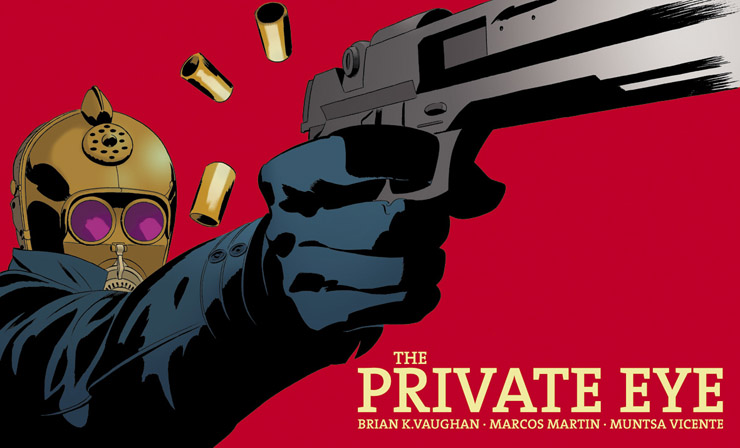
For a story like this, you need an artist who can highlight its uniqueness without actually calling attention to it, and this Martin does brilliantly.  He draws spectacular scenes full of bizarre details with amazing casualness.  If you just glance at any given page, you might take it as a normal slice of life.  But when you take a moment to get a really good look at what you’re reading, you’ll see the incredible richness actually before you: crowds of people where every person has a completely different outfit; rooms chock-full of props; and over it all a retro-modern design sense that feels chic and radical at the same time.  Props to Vicente as well for giving Martin’s somewhat emaciated linework plenty of body and popping hues.

Conclusion: As good of a debut as you can possibly hope for—hip, intelligent, sensitive, and boldly imaginative, on both the written and artistic fronts.

Grade: A

– Minhquan Nguyen

Some Musings: * Notice the repeating motif of “P.I.”  And here’s one more: on the door to Patrick’s office is л—the symbol for “pi.”

Daredevil #6 – Review

By: Mark Waid (writer), Marcos Martin (art), Muntsa Vicente (colors), Joe Caramagna (letters), Ellie Pyle (assistant editor) & Stephen Wacker (editor)

The Story: Daredevil has to beat The Bruiser to help some innocents who know too much.

Five Things: 

1. Fun, street-level story. This is the kind of situation that I usually want to see Daredevil tackling: Innocents end up knowing too much about a criminal operation and are in danger; Daredevil saves them.  Sure, it’s fun to sometimes see Daredevil do something bigger like in that issue of Avengers during Fear Itself where it was smashing the Nazi Battle Mechs, but mostly I want him to do street level stuff.  The story is fun, well-written and lively.  Further, the overall story arc isn’t spread too thin by stretching a 2-issue story into an “epic” 8-issue story arc.  The only folks who might not love this story are those who want every comic to change the “future of the Marvel Universe”, but that’s an unrealistic expectation because that’s never what Daredevil has been about.

2. Interesting new villain. – I’m pretty sure this Bruiser guy is new, but he’s fun.  I really like his overall design with is a cross between SWAT team and luchador.  And his power set is kinda neat too as he can move his center of gravity around to his fists (to punch hard) or his feet (so you can’t knock him down).  I wouldn’t mind seeing this dude again as a B-list Daredevil/Spider-Man villain.

3. Wow, Marcos Martin! – We’ll miss him because he’s off to do some “super secret project”, but Marcos Martin was really getting it done in this issue.  I really enjoy his minimalism.  There’s nothing extra on any of these pages, just what’s needed to tell the story.  Unless the artist is really going to do a great job with the detail, less is almost always more in comic art.  Our brains and imaginations can fill in details much better than we can reconcile things in an image that are screwed up.
Continue reading

Amazing Spider-Man #658 – Review

By: Dan Slott (writer), Javier Pulido (art), Muntsa Vicente & Javier Rodriguez (colors), Joe Caramagna (letters), Ellie Pyle (assistant editor) & Stephen Wacker (editor)

Ghost Rider back-up by: Rob Williams (writer), Lee Garbett (pencils), Alejandro Sicat (inks), Fabio D’Auria (colors), Caramagna (letters), Pyle & Wacker (editors)

The Story: Now that Spidey has joined the FF, what will the first adventure hold? And will it cause any stress in his relationship with Carlie?

What’s Good: It really isn’t correct to say that a writer captures “the voice” of a fictional character.  After all, these are fictional characters and they have no voice other than what is given to them by the writer.  Sure, they can be more or less in sync with what other writers have done with a character in the past, but there really isn’t a correct interpretation of a character.  That being said, Dan Slott writes a great Peter Parker.  His Peter is smart, earnest, socially-awkward, optimistic and funny.  This is the way this reviewer likes to see the character portrayed because it’ll make for such a great contrast when Peter has to get all grim and gritty on a villain during a more serious story arc.

The basic plotline for this issue is: Spidey’s first FF mission.  Fun abounds as Spidey first tries out a costume that doesn’t go over too well with the Thing, but that is quickly forgotten as the gang starts taking on a trio of zany missions that involves them going to France (and having fun with a mime), the microverse and the FAR future.

This issue, we also welcome back Carlie Cooper after Peter’s love life had taken a several issue time-out.  I don’t know about you, but I just don’t feel like it’s a complete Spidey story without the love life angle.  Of course, Peter’s involvement with the FF is going to make it pretty difficult for him to maintain his secret identity and keep Carlie around.  It’ll be interesting to see whether Carlie uses her CSI-skills to figure out Peter’s secret life, and if she does, whether she’ll be understanding or not.
Continue reading

Amazing Spider-Man #657 – Review

By: Dan Slott (writer), Marcos Martin, Ty Templeton, Nuno Plati & Stefano Caselli (art), Muntsa Vicente, Javier Rodriguez, Plati & Marte Gracia (colors), Joe Caramagna (letters), Ellie Pyle (assistant editor) & Stephen Wacker (editor)

The Story: Spidey and the FF give the Human Torch a proper send off by recalling a lot of the good times.

What’s good: How about that?  Given how good Fantastic Four #588 was in its send off of the Human Torch, it is pretty amazing that an issue of Amazing Spider-Man would be an even better send-off, but that is exactly what happens in this issue.

The premise of the issue is pretty simple: Spidey swings by the Baxter Building to apologize for missing Torch’s funeral service.  What ensues is a recollection of some of the great times that Spidey and Torch have had over the years.  Of course, there is some legitimate villain-busting in the stories, but most of the fun comes from the fun moments where Spidey & Torch are camping and playing tricks on each other, or where Spidey is pulling Torch’s pants down in front of teenage admirers or where the Spidey & Torch inspire Sue Storm to embrace her juvenile side (who knew she had such a side?) and take down villains in a very creative way that ends with Sue having some trouble with the law.

There really isn’t much more to say about the story, because it isn’t complicated, but it is incredibly well executed and you’ll laugh-out-loud 5-6 times in this issue.  Slott and company really captured the FUN side of Human Torch in a way that Hickman & Dragotta didn’t in their very strong FF #588.
Continue reading

Amazing Spider-Man #656 – Review

By: Dan Slott & Marcos Martin (storytellers), Muntsa Vicente (colors), Joe Caramanga (letters), Ellie Pyle (assistant editor) & Stephen Wacker (senior editor)

The Story: Spidey struggles with the loss of his Spider-Sense as he tries to hold true to his new “nobody dies” creed.

What’s Good: Here’s a newsflash: Marcos Martin is a really gifted graphic storyteller.  I greatly appreciate the freshness of his page layouts and panel designs because he almost never has a page that is just a boring grid, yet he mixes is up without doing weirdly shaped panels.  Pretty much everything is a rectangle/square, but they are all sorts of different shapes and sizes… some have panel borders, some don’t, some have backgrounds, some don’t.  And even with all this interesting design going on, every page looks visually balanced.  It really makes the comic look different and if you read a lot of comics, you really appreciate some variety!  Of course, Martin’s Ditko inspired linework is pretty darn impeccable too.

One of the fun themes of Slott’s run on ASM so far has been Peter’s new job at Horizon Labs.  Basically, this has given him the resources to craft some new Spidey-gadgets.  A few issues ago we saw the Stealth Suit that allowed him to be invisible and resist the new Hobgoblin’s laugh, and in this issue we get yet another Spidey-suit.  It is very compelling that the creators are actively using Peter’s science background for something greater than simply mixing up web fluid.

The other item that really catches your eye in this issue is the continued evolution of J. Jonah Jameson’s grief over his wife’s death.  In the stellar issue #655, we saw normal grief, but here Jonah molds that grief into an action item, namely that he want to kill any murderers in NYC.  That goes for Alistair Smythe (death penalty) and it also goes for the new bad guy in this issue: The Walking Massacre.  Certainly you can imagine how Jonah’s new “shoot to kill” orders are going to run afoul of Spidey’s “nobody dies”.
Continue reading

Amazing Spider-Man #655 – Review

By: Dan Slott (writer), Marcos Martin (art), Muntsa Vicente (colors), Joe Caramanga (letters) & Stephen Wacker (editor)

The Story: The Spidey characters deal with the death of Marla Jameson.

What’s Good: Tour de force!  The opening two pages of this issue say it all.  I don’t think it’s too much of a Spoiler to discuss it, but you’ve been warned.

If your spouse died, would you remember to turn off their alarm clock?  When do you pick up the book they were reading?  What about their toiletries?  When do you stop wearing a wedding band?  The emotional opening pages allow Slott and Martin to address this void in Jonah’s life, but instead of showing the man sobbing or tearing his hair out, they tell the whole story with silent panels.  A lot of what a person leaves behind are things like alarm clocks set for 7:00 a.m. and toothbrushes.

The entire first half of the comic is a silent panel-by-panel depiction of Marla’s funeral.  Very moving.

From there, the story drifts into a psychedelic dream of Peter’s as he visits with his dead loved ones and grapples with his guilt over the deaths he wasn’t able to stop.  Again, this section has its very emotional moments such as when Peter’s parents appear faceless because he can’t remember what they look like but he can remember the face of the guy who killed Uncle Ben.  It also explores the age-old comic question of, “Why doesn’t Batman just kill the Joker?” Or in this case any of Spidey’s rogues gallery?  Do associates of Spidey’s like Punisher and Wolverine possibly have the right idea?

I personally think the phrase “kills it” is used way, way, WAY too frequently to describe art.  It’s kinda like calling everything awesome.  But, know this; this issue has wonderful art.  I’m a huge fan of guys like Greg Capullo who pour all kind of intricate detail into a panel, but I still LOVE this work by Marcos Martin.  His lines are so clean and simple.  There is almost no cross-hatching.  And, it works so well because it keeps us focused on the storytelling aspects of the art.  There isn’t a single panel in this comic where there wasn’t full consideration given to the size, shape and placement of the panel.  And a couple of the panels reminded me very much of something that JH Williams would have done in Promethea where the entire splash page is basically a collection of borderless panels.  The colors aren’t quite flat colors, but it is nice for a change to see a panel colored for the emotional reaction that the creators want you to have rather than due to what color they think an object would be colored in real life.
Continue reading

Web of Spider-Man #8 – Review

By: Story A: Fred Van Lente (writer), Javier Rodriguez (art), Muntsa Vicente (colors), Joe Caramanga (letters); Story B: J.M. DeMatteis (writer), Val Semeiks (pencils), Dan Green (inks), Chris Sotomayor (colors) & Dave Sharpe (letters)

The Story: The era of “all you need to buy is Amazing Spider-Man” comes to an end as Web begins its first ongoing, Peter Parker story with The Extremist in Story A.  Meanwhile, in Story B, we catch up with what Ben Reilly has been up to.

What’s Good: Both of these stories are quality, but the star is The Extremist by Van Lente.  In this, we are introduced to a titular pseudo-hero claiming that his mission is to take on the purveyors of moral ambiguity (mostly the media and politicians) who sometimes tear down heroes and attempt to understand the motives of the villains.  “No more of this nonsense”, says The Extremist.  He wants the public to know who the good guys are!

Of course, is there a more maligned hero than Spider-Man?  It would seem that this Extremist dude would be a real help to Spidey, but…c’mon…this is Peter Parker.  Nothing works out that well for him.  So watching how Peter’s sense of responsibility can’t just allow this guy to help him.  All Peter would have to do is…nothing.  And Spider-Man would be more popular with the public.

This story is clever on many levels.  Beyond really capturing Peter’s essence (he is too noble for his own good), it ties in very nicely with the heroic age: We need to know who the heroes are AND who the bad guys are.  It also has a very neat solution to Peter’s employment problem and that causes all sorts of problems with his roommate (who I love).  It’s just great… Go read it.
Continue reading

Design a site like this with WordPress.com
Get started