• Categories

  • Archives

  • Top 10 Most Read

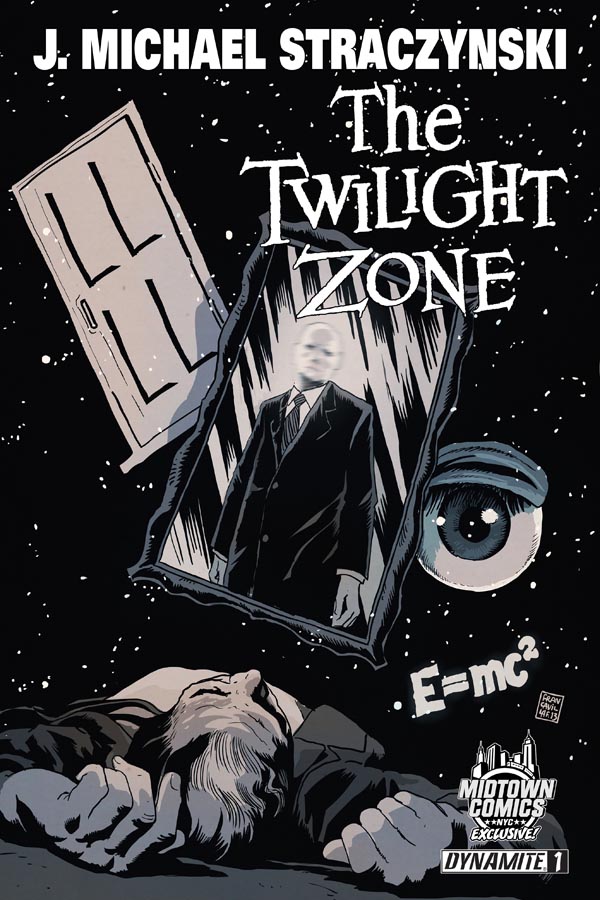
Twilight Zone #1 – Review

By: J. Michael Straczynski (writer), Guiu Vilanova (illustrator), Vinicius Andrade (colorist)

The Story: We all know that money can buy power, but can it buy freedom?

The Review: Happy New Year, everyone, and what a fine time for a new Twilight Zone comic. Clearly Dynamite has high hopes for this series, having handed the reins to Twilight Zone veteran, J. Michael Straczynski. Even so he’ll have his work cut out for him, The Twilight Zone has quite a lofty reputation and not without reason.

Straczynski does an admirable job of recreating the tone of the classic series.  His ‘opening,’ as it were, is a spot-on evolution of Serling’s narration, adjusted for the modern day. It hardly stops there, J.M.S. provides an old-fashioned, yet suitably topical, premise for his story; a smarmy financial shark seeks to escape his life with the help of a mysterious firm specializing in new identities.

The issue’s priority bounces back and forth between establishing tone and exposition in a manner that is, admittedly, somewhat awkward, but generally does so with sufficient charm to pull itself through. The larger than life professions of the characters help to smooth out the script’s tendency towards verbosity and theatrics. It would be strange to hear lines like this in everyday life, but our subject’s pomposity makes it believable and Straczynski’s talent makes it enjoyable. There’s an attention to lyricism, stops, and starts in the dialogue that reminds that this series is based on the brainchild of a playwright. “What about love,” one character asks our subject, “Is there anyone special in your life?” “Yes. Natalie,” he responds, “Beautiful, vacuous Natalie. Hold her to your ear and you can hear the sea.” That line makes me smirk each time I read it, particularly as its narrator grows more and more unreliable.
Continue reading

Ten Grand #4 – Review

By: J. Michael Straczynski (story), Ben Templesmith (art)

JMS and Ben Templesmith are writing a hopelessly romantic comic; introducing new and interesting mythologies to the genre. The characters exist in the real world and are subject to the rules and physics of the world around us, but there are hacks and secret passages and rules that govern the twilight regions between this world and (for lack of a better term) the “afterlife”.

Straczynski is very clear that these aren’t alternate dimensions or some other sci-fi type of convention. This is heaven and hell and purgatory, demons and angels, sins and sinners. Joe Fitzgerald is a private detective who knows a great deal (but not everything) about the rules and shortcuts that govern access to the afterlife. His wife is dead but because of the arcane rules that control his life, Joe has the opportunity to interact with his wife in a small slice of paradise for just a few minutes whenever he dies in the pursuit of an honorable end. It is during one of these moments that Joe realizes that there is something wrong in heaven and his wife is being pursued by dark forces. Joe is determined to call in every favor and use every trick that he knows in order to rescue his wife.
Continue reading

Ten Grand #1 – Review

TEN GRAND #1

By: J. Michael Straczynski (writer), Ben Templesmith (art) and Troy Peteri (letters)

The Story: A hard-boiled PI gets involved with a demonic cult.

Review (with very minor SPOILERS): There’s not a whole lot to say about this comic.  The story is derivative and not reason enough to buy the comic, and while Templesmith’s art is pretty strong, you can get Templesmith art from various collected editions because he’s not really breaking new ground (for him) here.

So what makes me call the story derivative?  Well, the main character is a private investigator or hit man or something.  I guess most people would call him “hard boiled” because that’s a shorter word than “unshaven, dirty, rumpled clothes, heavy drinker, no family”.  Of course, this dude works out of the seedy side of town where he gets approached by a young woman who wants him to do a job. And (of course) she is earnest and (of course) she can only barely afford his fee and (of course) the case has some past connection to the PI.  It’s just very cliche and since it happens in the first few pages of the comic, your attention is already beginning to wander.
Continue reading

Superman #714 – Review

By: J. Michael Straczynski & Chris Roberson (writers), Jamal Igle (penciller), Jon Sibal & Robin Riggs (inkers), Marcelo Maiolo (colorist)

The Story: Stop eating those French fries, Superman, have some self-respect!  Don’t you know you can fly?!

The Review: Superman has been around for so long, has been written by so many different kinds of writers, and has gone through so many permutations that it gets a bit harder every year just to give him a story that avoids the formulaic, let alone one that brings something new to the table.  And while “Grounded” as a premise made an admirable attempt to try break away from familiar plotlines, it long ago lost its novelty and is now knee-deep in clichés.

It doesn’t get any more so than Lois Lane in a threatening situation and Superman coming to her rescue.  To start off an issue with this kind of thing already tells us not to expect much in the way of mind-blowing material.  And even though you have zero doubt Supes will get Lois out of this safe and sound, it’s amusing to see him accomplish the task within the first three pages.  Not surprising, though; we all know Lois is just a tool to get Superman into action, nothing more.

That said, the action we get hardly counts as the big blowout you’d expect at the end of such a long, hyped story arc.  Part of the problem lies with our villain—I’m sure she mentions her name somewhere, but I don’t care enough to really remember or look it up—who nurses, predictably enough, a misdirected, personal vendetta against our hero, and has no qualms about stating it with ridiculous explicitness: “I want you to suffer, Superman!  Like you’ve made me suffer!”

I can only imagine Roberson’s fatigue with this storyline (it does feel like it’s gone on forever, doesn’t it?) has caused him to throw the dialogue to the wind, as it all falls into embarrassingly corny territory: “I am your shadow.  I am all of the doubts and fears you’ve been afraid to face!”  Superman’s response?  “What you are is annoying!”  Terrific rejoinder, big guy.  Your time on New Krypton clearly deprived you of practice in the art of American repartee.
Continue reading

Wonder Woman #613 – Review

By J. Michael Straczynski & Phil Hester (writers), Don Kramer & Travis Moore (pencils), Wayne Faucher, Walden Wong & Drew Geraci( inks), Pete Pantazis (colors) and Travis Lanham (letters)

The Story: In a long bout of desperately needed exposition and explanation, Diana finally learns the details of, and the motivation behind, the Nemesis’s plans for her. But with the truth finally revealed, can Diana hope to overcome her old enemy without losing herself in the process?

What’s Good: Huh! What an odd feeling. I just read a really good issue of Wonder Woman. You’ll have to forgive my dazed reaction here–it’s been quite a long time since this has happened. Although this issue is extremely talky, and features one of the largest single infodumps in recent memory, I am actually okay with that. Information and explanation is what this headache of a storyline has needed for a long time. Would this have worked better if this information was parceled out more, and hinted at over the course of several other issues? Sure, but at this point I’m just happy to finally have a solid grasp on what’s going on, and what the goals of the major characters are. Fortunately, the exposition is delivered on the back of a very nice fight scene and some interesting pseudo-philosophical musings that break the back-story up a bit.

Continue reading

Superman #713 – Review

By: J. Michael Straczynski & Chris Roberson (writers), Diogenes Neves, Oclair Albert, Eddy Barrows, JP Mayer, Jamal Igle, Jon Sibal (artists), Marcelo Maiolo (colorist)

The Story: This is a job for Superman!  What?  He’s not there?  Leave a voicemail, I guess….

The Review: No matter how much you get into a superhero comic, at some point you’ll notice the faint tingle of suspended belief tingling at your amygdala (or whatever part of your brain matters of faith are located in—obviously I should never be anyone’s doctor or shrink).  But keep it at bay you must, otherwise all sorts of uncomfortable questions about the logic and realism of what you’re reading will cow your simple pleasure into submission.

But when the writer himself chooses to address those questions, there’s really nothing you can do about it, is there?  Fortunately, Roberson brings up several valid, thought-provoking issues that neatly ponder the implications of having a super-powered alien in our midst:  the fear of his overwhelming might; whether he can be trusted to use his powers appropriately; the possible resentment from the mere mortals.

The subject matter works; the format which Roberson chooses to address these things does not.  Characters telling stories within stories can be tricky to begin with, but in a comic, a bunch of brief, exemplary anecdotes just produces facts and details with little to no movement or substance whatsoever.  Having Clark and his “guide” asking random passerby their opinions on Superman certainly adds no dramatic depth, and it just seems inherently forced.
Continue reading

Wonder Woman #612 – Review

By J. Michael Straczynski & Phil Hester (writers), Don Kramer (pencils), Wayne Faucher (inks), Pete Panrazis (colors), Travis Lanham (letters)

The Story: Wonder Woman is granted divine intervention in her fight against the Morrigan, and the purpose behind her existence is revealed as well. But can even her newfound allies and knowledge be enough to help her conquer the greatest Nemisis of all?

What’s Good: This is it, ladies and gents: Odyssey is finally over. As much as that fact alone makes me want to break out confetti and pop the champagne, I was really holding out hope that the revelations in this issue would make the past 11 feel worthwhile as a story arc. (Of course, that’s far to large a burden to lay on any one issue, but what can I say? Irrepressible optimist.) While it wasn’t able to deliver on that front, we do at least receive–glory hallelujah!–some answers about what’s been going on, as well as a fairly strong and mostly well-paced story. Diana is given a couple of wonderful character moments that actually allow her to demonstrate the growth and learning she has done over the course of this story arc.

Continue reading

Wonder Woman #611 – Review

J. Michael Straczynski and Phil Hester (writers), Don Kramer & Eduardo Pansica (pencils), Wayne Faucher & Eber Ferreira (inks), Alex Sinclair (colors), Travis Lanham (letters)

The Story: The Morrigan make the final push to force Diana to become one of them. Not everyone survives the battle, and as her friends begin to fall all around her, Wonder Woman is given a terrifying look into one of her possible futures–and at what might happen if she is unable to resist the Morrigan.

The Review: I’m breaking with WCBR’s traditional What’s Good/Not So Good review format for this one. My feelings about this issue are a bit complicated, and I’m having trouble compartmentalizing them even after a few days reflection. (Admittedly, these feelings are more than a little informed by DC’s big re-launch announcement, but more on that later.)

Wonder Woman’s “Odyssey” continues, much as it has for the last few issues: good-but-not-great. With this being the penultimate issue of a huge (and ostensibly very important) storyline, I had hoped to finally get a big revelation about the nature of what has happened to Diana—or at least a few solid pieces of information. Instead what we’re given is more of the same—more (very good) battle sequences, more big set pieces and events…and more mystery. Given the fact that very little (if any) of what happens to Diana in this storyline will matter once the DCU resets to issue #1, I can’t help but feel that a great deal of what made this storyline interesting has been lost. The whole point of the arc was to take a different sort of Diana in an alternate (?) history, and watch her grow, change and mature into the paragon of honor, compassion and virtue that we all know and love. Isn’t that the reasoning behind the arc’s title—to make an analogy to a character that was lost at sea, and had to find their way back home? The reboot announcement denies readers the satisfaction of the all-important homecoming. Or more accurately, it renders all of the character growth, and even that homecoming moment itself, moot by negating its occurrence.
Continue reading

Superman #711 – Review

By: J. Michael Straczynski & Chris Roberson (writers), Eddy Barrows (penciller), J.P. Mayer (inker), Rod Reis (colorist)

The Story: No, Superman–not the electric-blue costume!  The situation’s not that desperate!

The Review: It’s pretty obvious the original premise of Straczynski’s storyline—Superman walking across the country, discovering the real America, or something—has largely faded from view.  This may be a wise choice, since there’s only so much angst to be mined out of it, especially for a dozen-plus issues.  Whatever hang-ups prompted the Big Blue to embark on this bizarre journey in the first place long ago exhausted all dramatic possibilities.

Since his takeover of the series, Roberson has pretty much been giving you the usual Superman activities, and only the non-Metropolis settings tip off the fact you’re still reading “Grounded.”  Except for Supes’ singing of praises for America at the end (those of you concerned after reading the over-sensationalized story in Action Comics #900 can rest easy—he still loves us), Superman steers clear from the dislikable preachiness of this storyline’s early issues.

Instead, he spends most of his time doing what he does best: in the air, helping people with his usual sincerity and sympathy, even someone as troubled as Livewire.  Her outrageous behavior and senseless rants (“Every time I try to have a little fun, you have to come along and spoil everything.”  ) come off a bit contrived, but shutting her down puts Superman’s old electric costume to good use, and at least she gets a more formidable power set out of it.

And at least her antics allow for some fun guest spots.  It’s great seeing Jimmy Olsen using his quick-thinking (and high school physics on top of that) to offer his pal ground support.  Nick Spencer showed us Jimmy really takes off as a character when he has a more active role in facing trouble, instead of acting the mansel-in-distress for Superman to swoop in and save.

We also get cameos from some relatively obscure characters, like Dr. Roquette, young genius of Cadmus (Superboy’s old haunt) fame, now of S.T.A.R. Labs.  Honestly, it’d be great to see her more regularly, with all her retro gear (spangled jacket-vest—really?) and colloquialisms (“Oh, poop.”) intact, as she can serve a very useful, if semi-deus ex machina role to the title.  You can’t say the same for Iron Munro, who has little sway over the plot, and gets hardly any face-time with Superman before taking off to replace Livewire-thrashed dinner jacket.

This issue also introduces a mystery lady with an attitude problem, who has in her possession a crystal a là Kryptonian tech, with Superman’s most painful memories held within.  No doubt she’s a sign this storyline’s finally getting some much needed direction, but she vanishes before you learn anything about her, so her appearance seems rather superfluous to the plot.
Continue reading

Thor – Movie Review (Second Opinion)

The Story: I’m not surprised Thor loves super-unhealthy, diner breakfast food— it’s awesome.

The Review: As a god, Thor’s not really threatened by much, and certainly not by the majority of villains in the Marvel universe.  Besides his loyalty to the Avengers, his connections to Earth lean more on divine fondness for the planet and its people as a whole, with few links to its non-superhero-related mortals—especially as his Donald Blake identity saw less use over time.

Straczynski brought back Thor’s human persona to prominence in his relaunch of Thor, so it’s fitting that in his and Protosevich’s screenplay, they try very hard to give the banished god a personal relationship with Earth.  But actually the time Thor spends exiled on the planet is pretty short—about a few days, film-time (which is about 20 minutes, screen-time).  It limits Thor’s exposure to modern mortality, and makes his intimacy with Jane Foster et al seem rushed/forced.

Helmsworth and Portman are both very likeable, and they definitely have a warm chemistry, but really, they only get several minutes-long scenes alone together, and the moments feel friendlier than romantic.  It’s disappointing Thor gets hauled out of the mortal realm so fast, because it feels like his human relationships have just barely begun.  Which is too bad, because they offer some of the funniest moments of the film (KOing Thor in various ways never gets old).

Aside from wearing a desert small-town outfit for, like, a day, and one funny cultural snafu where he smashes his mug (of coffee?  Hot chocolate?  Whatever it is, he really likes it.) on the floor of a diner, Thor doesn’t get a real mortal life experience.  His heroic actions at the film’s climax are more motivated by his innate nobility than a personal investment in Earth.  He would’ve done the same for any planet of innocents.
Continue reading

Wonder Woman #610 – Review

By J. Michael Straczynski and Phil Hester (writers), Eduardo Pansica (pencils), Wayne Faucher and Eber Ferreira (inks), Pete Pantazis (colors), Travis Lanham (letters)

The Story: Wonder Woman begins to live up to her name as she (finally!) discovers the source of the temporal disturbance affecting her future, and finds a way to begin to fight back.

What’s Good: First of all, minor point, but I LOVE the addition of the “star spangled cape” to Diana’s costume. It’s a small detail, but I really think it works. On a more important note, I’m almost completely on-board with the explanation given for the sudden shift in Wonder Woman’s status quo. I still think it was unnecessary to burden the main book with what is essentially a 12-part Elseworld maxi-series, but the damage is done on that front. The important matter is that this story is FINALLY starting to work itself out of the corner it was written into. We get some very good insight into Diana’s character in this issue, and also–glory hallelujah!–an inkling of where it might be headed. It has taken ten issues, but I finally feel like I have some point of reference when it comes to this story, and I no longer have to feel completely lost and like I simply have to accept events as they occur “just because.”

While you’d still have to go quite a long way to convince me that this storyline is going to do some good for the already much-abused Amazon Princess, but if the last two issues are this strong plot and character wise, I think it will at least avoid doing irreversible damage to her in the long term. (Not counting the bad will that this ill-fated experiment has already engendered, that is.) I’m not sure how this will end, but this issue has at least given me confidence that there is a definite end in sight, and that it won’t utterly destroy one of my all time favorite comic book characters.
Continue reading

Superman #710 – Review

By: J. Michael Straczynski & Chris Roberson (writers), Eddy Barrows & Travel Foreman (pencillers), J.P. Mayer & John Dell (inkers), Rob Reis & Dave McCaig (colorists)

The Story: Can a nerd from the sticks and an emo from the big city work together to defeat an immortal caveman?

The Review: I’ve managed to stay above the fray when it comes to the polarizing “Grounded” storyline Straczynski’s been writing into Superman, but only by not reading it altogether.  The pitch of Superman walking America for reasons you can only describe as misplaced just didn’t appeal.  But with big things coming his way this year, it’s only appropriate to check in with him before the status quo gets shaken up again.

At first, the issue starts off much as you’d imagine: having come upon another city on his road trip, Superman chats it up with the little people and tries to help them with their problems.  But with the appearance of Batman, Roberson switches gears, flashing back to the first adventure of the World’s Finest, before they get the idea to wear their underpants outside their costumes.

In the grand scheme of things, the story’s a very random aside from Superman’s “Grounded” journey.  Batman shows up very suddenly and for little reason, other than to chide Superman’s sabbatical pretty much the same way Lois, the Flash, and Dick Grayson have.  The recollection of their first team-up feels very out of context from the current plot too, being far better suited for Superman/Batman since it’s largely self-contained and kind of messy, continuity-wise.

That said, Roberson writes it well enough, albeit a little predictably.  It has all the typical elements of a Superman-Batman story: showing off their core personalities, acknowledging each other’s strengths and weaknesses, sly hints to their future heroism.  Vandal Savage and his army get defeated a tad too efficiently, and with so little struggle from the villain you never feel Bhutran (gateway to Nanda Parbat, the immortal city) is ever in any real danger.

This would have been a fun, if slightly pointless, excursion if not for Roberson’s attempts to bring some deep, meaningful conversation into the mix.  Clark and Bruce (both past and present) spend way too much of their idle time pontificating on the nature of justice, the value of their work, and on handling death.  It just feels forced, heavy, and a little pompous—which kind of fits given what I’ve heard about Superman’s slightly arrogant attitude throughout this storyline.
Continue reading

Wonder Woman #609 – Review

By J. Michael Straczynski and Phil Hester (writers), Don Kramer (pencils), Sean Parsons and Wayne Faucher (inks), Alex Sinclair with Pete Pantazis (colors), Travis Lanham (letters)

The Story: Of all the people in the world, Dr. Psycho–longtime Wonder Woman nemesis–pulls Diana in a sort of limbo between life and death. There, it is revealed that the Diana we’ve been reading about for the last nine months is merely one of an endless series of aspects of Wonder Woman that have appeared throughout the ages: always different, but always acting as an avatar of hope, heroism and leadership. (In one of those ‘other lives,’ of course, she is Wonder Woman as the DC Universe knows her: born out of a clay statue that was given life by the gods.) Diana’s current nemeses, it is revealed, wish not only to kill her as she is, but to kill everything she will be and ever was.

What’s Good: Wow! Phil Hester is really kicking ass on this. I have no idea how much is his work and how much is JMS,’ but given the dramatic shift in quality and trajectory since Hester took over, I’m more than happy to give him the lion’s share of the credit here. He managed, in this single issue, to neatly summarize everything that has happened, and provide a good and convincing explanation for the cluster we Wonder Woman fans have been subjected to for nine months. The best part of all is that the explanation actually makes some amount of sense, and actually–holiest of holies–gives us some character development! Incredible.

Remember back a few issues ago when I said the series was at a tipping point, and had the potential to be either utterly awesome, or utterly disastrous? I’m 95% sure after this issue that we’re pointed firmly in the direction of awesome. By framing this as more than just another “alternate timeline” storyline, by using it to elevate Diana and show that she is not just Wonder Woman, but that she is–and has always been–an avatar of hope and courage throughout time, and to all races and creeds of people, Hester adds a beautiful bit of meta-mythology to Wonder Woman’s origin story, while simultaneously giving this storyline something it has lacked from the beginning: purpose. The fact that the villains are out not only to destroy this incarnation of Wonder Woman, but to destroy everything that EVERY aspect of her and what she represents, also raises the stakes considerably, and gives a great big shot of adrenaline (and direction) to a story that felt like it was wandering aimlessly.
Continue reading

Superman #709 – Review

By J. Michael Straczynski and Chris Robertson (writers), Eddy Barrows and Allan Goldman (pencils), J.P. Mayer and Julio Ferreira (inks), Rod Reis (colors), John J. Hill (letters)

The Story: Superman is still down in the doldrums (yes, still. Only a few more issues to go, folks!), and Lois isn’t returning his calls. Fortunately, Flash shows up and injects a little excitement–and Kryptonian history–into the mix.

What’s Good: I really liked the art in this issue. Barrows and Goldman make a great team that results in a vibrant setting and beautiful characters (especially Flash…Superman himself sometimes suffers from a lack of facial detail in longer distance shots). Besides, I’ve always been a fan of the Superman/Flash races, and this book has a couple wonderful homages. (Although, I’m firmly in the corner that Flash should ALWAYS win such contests; after all, Superman has powers to spare, and Flash deserves to be the best he is at what he does.)

Also: Wonder Woman undergoes no character destruction in this issue. That’s a plus.

What’s Not So Good: I said it last month, and it’ll probably be said next month, but…this storyline is still going nowhere. “Superman goes through a midlife crisis” is NOT a good story arc idea. Especially not a year-long arc. I do realize that the character has been through a lot (as Flash addresses in this issue), and that it should be addressed. But, although the conversation between Supes and Flash is well written and interesting enough, all I can think about is how long it is til this story finally ends, and he can go back to being HIMSELF. Introspective, brooding, Byronic heroes are great…but if I want that, I’ll go read about Morpheus, or Batman, or Moon Knight. When I pick up a Superman comic, I want to read about Superman– the bright, strong, self-confident hero that is their antithesis.
Continue reading

Wonder Woman #608 – Review

By J. Michael Straczynski and Phil Hester (writers), Geraldo Borges (pencils), Marlo Alquiza (inks), Travis Lanham (letters)

The Story: Diana is forced to take on Cheetah and the other fallen Amazonians in a brutal, bloody battle that the princess does not get the better end of. Fortunately, although the terrible trio manage to destroy most of the rest of the surviving Amazons, Diana has another, more unexpected benefactor come to her aid.

What’s Good: Wow, this issue was…unpleasant. I don’t mean that pejoratively; the violence is extremely effective and well-handled, but is not exactly what I’d call “fun” to read (especially not for someone who loves Diana as much as I do.) Pain of all sorts abounds in this issue for the Amazon Princess, in fact–20+ pages of physical and psychological asskicking.

Here’s the thing though: this NEEDS to happen, if she’s ever going to return to become the Wonder Woman we know she is. No successful heroic journey has ever been completed–in movies, literature, or in real life–without the hero going through either literal or metaphorical hell. This is clearly that moment for Diana–there’s not much father down she can go. But she has her talisman in her mother’s shield and–more importantly–she has hope. Does that sound completely saccharine and corny? Perhaps. But it’s necessary if we’re ever going to make our way (sanely) out of this cluster of a storyline. Diana was so warped and changed so suddenly that the writers (thank you, Phil Hester!) are being forced to take some time, and get back to the absolute essential core of the character, so she can take her rightful place back in the DCU pantheon with a minimum of fuss when this is over. And what is at the core of Wonder Woman? Hope, and compassion. I’m more than happy to sit through a little cliché to get this (more and more ill-fated) change in her character and her status quo out of my face.
Continue reading

Wonder Woman #607 – Review

By J. Michael Straczynski and Phil Hester (writers), Don Kramer with Eduardo Pansica (pencils), Andy Owens, Sean Parsons and Eber Ferreira (inks), Alex Sinclair (colors) and Travis Lanham (letters)

The Story: Diana–who, I can’t help pointing out, has actually started acting like Diana for a change of pace–and two of her closest Amazon guardians descend into a labyrinth to rescue the kidnapped boy, Harry. This being a labyrinth, there is naturally a Minotaur–along with a host of other nasties–to be conquered along the way. It turns out this is only the beginning of their problems though, as Harry’s kidnapping was only a ruse to lure Diana away from the rest of her Amazonian sisters, who are quickly engaged in a battle they may not be able to win without the help of their princess.

What’s Good: Wait a second, Greek mythology? Discussions about fate and the nature of Amazonian sisterhood? Diana actually, y’know, acting like a hero? Dang. It’s almost as if I’ve actually picked up a Wonder Woman book. Which is nice, because I haven’t seem to have read one in almost, what, eight months now?

This is a positive thing, I think.

On a less tongue in cheek (and less snitty) note, Phil Hester has been the best thing to happen to this title since JMS’s ill advised…reboot? Alternate reality? Temporary rip in the space/time continuum? I’m not sure exactly what it was he was trying to accomplish with this (and at this point we probably never will find out), but really, I don’t care. If Phil Hester can keep this storyline treading water long enough to get to its end, and if he can continue to repair some of the damage done to the character and continuity along the way, I’m more than happy to leave the questions of ‘what…exactly…happened here?’ aside. I assume he and the powers that be will have to come up with some sort of explanation at some point, but I really don’t care what it is anymore. Just having Diana–the real one–back again will be more than enough to satisfy this fan.
Continue reading

Superman: Earth One (Hardcover review)

by J. MICHAEL STRACZYNSKI • Art by SHANE DAVIS and SANDRA HOPE

I really don’t like Superman. I give him opportunities to impress me every so often; and I am a fan of Superman: Red Son, but for the most part, he just doesn’t interest me. At all. His back story is completely uninteresting: a dude with the unlimited power who happens to fall into a field and found by the two most wonderful parents in comic book history, raised to be a decently happy guy. Oh, his planet was destroyed. Actually, I always like the part of the origin when pops has to send his son to a distant planet while his own is destroyed around him. But the Clark Kent stuff…I just never feel any emotional resonance to this guy.

Earth One is no different. I did like seeing a young Clark Kent completely abuse his powers to get whatever job he wanted. It also made the scene of his completely failing at the Daily Bugle that much better. This is not a humble Superman at all…until he has to be.  JMS’s story is interesting for the most part, but the pacing was a little awkward. It felt like a three act play missing the third act. Too much time was given to Clark wandering around Metropolis brooding about the fact that he has too much power, and not enough time to develop the struggle between him and Tyrell, the villain. Speaking of, the villain is the best character of the story. Followed maybe by Olsen, whom I’ve never liked more as a character than when reading him in this. Mainly because Olsen is the true definition of what a “super man” is. A guy who, when faced with death, will stand tall and take its photo. Meanwhile, Kent is cowering from responsibility. In fact, it’s seeing Olsen that prompts Kent to do something. But come on, if you were Kent—a guy with almost unlimited power, and you saw this meek little photographer showing more balls than you have in your entire life, wouldn’t you have to man up too?  Scratch that statement earlier. Olsen is the best character of Earth One. But it’s still a really damn good, and underused, villain.
Continue reading

Superman #708 – Review

By J. Michael Straczynski (plot), Chris Roberson (script), Eddy Barrows (pencils), J.P. Mayer with Julio Ferreira (inks), Rod Reis (colors) and John J. Hill (letters)

The Story: The “Superman Squad” arrives from the future to convince the original Superman that he is, in fact, important, and that his heroics do actually help people. Also, Wonder Woman shows up and learns an important lesson.

The Objective Part of the Review: The Grounded storyline continues, and becomes more convoluted and confusing in its purpose than ever. Wasn’t Supes’ purpose in this whole exercise to reconnect with America and the common man? So why does he spend most of this issue jumping through time and navel-gazing (with the help of some quite clunky and badly-integrated exposition from the Superman Squad)? I thought this storyline was about Superman and the people he loves and works to protect. So either I completely misunderstood the point of this year long story arc, or the arc itself has been completely derailed and/or misunderstood in the wake of its creator’s departure.

In spite of the feedback I’ve gotten on my opinion on the artwork for this book, I continue to enjoy it. Is it the best ever? No. But I continue to contend that the basic nature of the geometry and bright, bold colors fits Superman’s world quite well. It would be improved (and look less like a “kid’s” comic book) if the pencil work was more carefully detailed, but overall the effect is a good one, and suits the nature of the book well enough.

The Fangirl Part of the Review: Fair warning on this section: this is my personal reaction to the book as a huge Wonder Woman fan, and has nothing to do with the writing, art or other creative aspects of the book addressed above. That said:

SHAME on you, Joseph Michael Straczynski.

So you decide to give Wonder Woman a confusing, yearlong, semi-out-of-continuity (?) reboot. And a new, ‘gritty update’ style costume. Okay. I can live with that. As a Wonder Woman fan, I’ve certainly been subjected to worse. I can roll with almost anything, at this point, and still find enjoyment in the character and the tale. What I absolutely CANNOT abide that takes place in this issue is twofold:

1) You put a big, HUGE moment for Wonder Woman—quite possibly the single biggest character moment in her entire year long arc, since this is apparently the moment she, you know, DECIDES TO BECOME A FREAKING HERO—in a book that is not hers?! What on god’s green Earth convinced you even momentarily that that was a good idea? Do you realize what a betrayal that is for people who have loyally followed the Wonder Woman book through this reboot arc, and have been eagerly awaiting the big hero-realization moment? I understand that you were supposed to write both books through both arcs, and that a crossover probably made sense at that time. I have no objection with the crossover itself. But to put THIS moment in a book that is not Wonder Woman is a terrible, terrible thing to do to her fans.

2) Location (I reiterate: in the WRONG BOOK) of the biggest Wonder Woman moment to date aside, the execution. Good lord, the execution. Superman gives her the impetus to become a hero? Really? She couldn’t have figured that out without him? She couldn’t have followed her own heart and conscience and compassion (arguably the strongest aspects of Diana’s character) to realize that, maybe using her powers to help people MIGHT be a good idea? She couldn’t have been inspired by her fellow Amazons, or maybe some heroes from Greek mythology? ANYTHING besides randomly running into Superman (while apparently taking a break from the Earth-shattering issues going on in her own storyline) and realizing that, durrr, maybe people with heroic-like powers should actually, y’know, BE HEROIC. Not only that, it sets her very, very apart as a (supposed) member of DC’s Trinity. She should be (and has been, til now) Superman and Batman’s PEER, not their wide-eyed apprentice or sidekick.
Continue reading

Wonder Woman #606 – Review

By J. Michael Straczynski and Phil Hester (writers), Eduardo Pansica (pencils), Jay Leisten, Marlo Alquiza, Wayne Faucher and Eber Ferreira (inks), Alex Sinclair (colors) and Travis Lanham (letters)

The Story: Diana and her friends are assaulted by mystical creatures determined to destroy them, and are forced out of their safe house after a tragedy. Things do from bad to worse, however, when their path takes them to an old, defiled temple, and an army straight out of Jason and the Argonauts.

What’s Good: First, apologies for the rather vague summary; a LOT of things happen in this book, and your reading experience will be far better served by not having them spoiled. And on that note… Holy crap! This is the first issue of Wonder Woman that I’ve purely, unabashedly enjoyed since Gail Simone left! In fact, the very dark and violent nature of this story is the most Simone-esque thing I’ve read since the last issue of Secret Six.

I’ve been waiting and waiting–not very patiently–for the creators to finally tip their hand as to what, exactly, is going on with this incarnation of Diana. While this issue doesn’t give any huge answers, it at least (FINALLY) puts some solid ground beneath the reader’s feet. We have our hero, we have her supporters, we have a main villain, and our hero gets to show off the full extent of her fighting abilities. (Somehow she seems to have forgotten the whole “I can fly!” thing, but…) That is a LOT more than we’ve gotten from this series in quite some time, and all of it is very well, if simply, handled. This script isn’t going to revolutionize the medium, but at this point I’m so happy to have a cohesive story set up for Diana that I’m more than willing to forgive a little generic plotting. Besides, the action was good–damn good. Watching Diana kick that much ass was a stand up and cheer moment for me. Damn did I miss her!
Continue reading

Superman #707 – Review

By J. Michael Straczynski (plot), Chris Roberson (script), Allan Goldman (pencils), Eber Ferreira (inks), Marcelo Maiolo (colors) and John J. Hill (letters)

The Story: Superman continues–still–his trek across the U.S. While keeping himself busy assisting with everyday emergencies in a small town, he discovers a factory that is in danger of exploding. When Lois shows up to write a story about how the factory heads have been dumping chemicals into the local ground water, Superman must weigh the cost of the truth against the jobs of thousands of innocent people.

What’s Good: Great news! For the first time in half a year, reading a Superman comic didn’t piss me off! I know, I was shocked too. But it’s true: while not stellar by any means, this issue is at least decent, competent, and refrains from being insulting or completely and utterly trite. Better yet–and I can’t stress this enough, for the first time since the storyline started–it actually delivers on the premise that the entire storyline is built around: Superman is actually in a town, talking to people and helping them solve actual, basic problems.

My favorite part of the whole book–of the entire storyline so far, really–is the scene with Superman putting out the factory fire. The self-narrating he does, explaining his actions, thought process and the powers he uses to save the day, has a wonderful Golden Age flavor to it that had me smiling the whole way through. Most fun I’ve had reading Supes in quite some time.
Continue reading

Wonder Woman #605 – Review

By J. Michael Straczynski and Phil Hester (writers), Don Kramer, Eduardo Panasica and Daniel HDR (pencils), Jay Leisten, Marlo Alquiza, Wayne Faucher and Eber Ferreira (inks), Alex Sinclair (colors) and Travis Lanham (letters)

The Story: An interlude, as Diana returns home to relax, recover, and engage in some exposition and–amazingly–character development as well. The short slice of home life is cut short when Diana sneaks out away from her guardians, and comes face to face with a threat she may not be able to handle.

What’s Good: I’ll be honest, on reading this issue for the first time, I wasn’t a fan. It felt like such a huge and sudden shift in both setting and in character–from a dangerous desert wasteland to a penthouse apartment, and from a dark, gritty and confused Diana to a far more upbeat and happy Diana–with next to no actual transition. On the second reading, however, while these complaints still mostly stand, I started to realize that I don’t care. I don’t care if it takes a slightly awkward and mostly unexplained transition to get Diana back to where she needs to be; the fact that some sense of normalcy is being reestablished, and most of all, that Diana is acting like someone other than Conan the Barbarian, is enough for me, and I’m happy to put up with whatever small hiccups in storytelling are necessary to get it. This issue feels almost like a reboot (of a reboot?), and I can’t say that’s a bad thing.

Once things get rolling, the story is really quite good. We learn a bit about Diana’s childhood, the way she was sheltered by her guardians, and the way she discovered her need to fight cruelty and injustice. I don’t particularly love flashbacks, but this particular set was sorely needed to give the reader–FINALLY, after six bloody issues!– some idea of who this ‘new’ Diana is, and what makes her tick as a character. After six issues of the grim n’ gritty “damn the gods!” version, it’s comforting to hear her discuss battling injustice and using her powers to, y’know, help people in need. Those are absolutely fundamental aspects of the character that should never, ever change, no matter how much you may want to tweak her history and origin.
Continue reading

Superman #705 – Review

By J. Michael Straczynski (writer), Wellington Dias and Eddy Barrows (pencils), J.P. Mayer with Eber Ferreira (inks), Rod Reis (colors), John J. Hill (letters)

The Story: Superman encounters a very young, very special fan who needs rescuing from an all too ordinary villain.

What’s Good: JMS writes the character of Superman well, I’ll give him that. Not that Supes is the most complicated character in the comic book pantheon, but JMS gives him a strong and suitably wholesome voice. He writes Superman’s young fan suitably sympathetic as well—again, not the most difficult of authorial tasks, but it works well within the story.

I’m digging the artwork, especially Rod Reis’ colors. The pencil work walks a fine line between trying to look realistic while still maintaining the fanciful, slightly cartoony look that serves a character like Supes so well. The colors contribute greatly, both by being visually appealing, and by maintaining the upbeat, primary-color infused palette that is a Superman hallmark. In spite of their bold nature, the colors never become so oversaturated that they are overwhelming or distracting.

What’s Not So Good: So Supes looks like Supes, and he sounds like Supes, but here’s the problem: this story is not worthy of Supes. Now don’t take that the wrong way (small spoiler warning ahead); domestic violence, and ESPECIALLY child abuse, is very serious, and nothing to belittle. In fact, it’s exactly the heinousness of the offence that makes it so maddening here, to see it used for nothing but cheap and ham-fisted emotional manipulation.

I’m already on the record as saying that I like the entire concept of this story arc, and I still do. Superman taking some time off from world-saving to reconnect with his human side is a great idea. And if handled well, this sort of domestic violence plot, while a tad cliché, still seems like a natural sort of every day problem for Superman to solve.

Except, the whole arc—and this issue in particular, which finally made me lose my patience with the whole thing—is not being handled well at all. Where the book’s art strikes a nice balance between realism and cloying cartoonishness, the writing takes a flying leap off of that balance beam. None of the supporting characters have any development at all beyond their very basic archetypes—the cute kid, the abusive father, and so forth. It’s grating, juvenile and insulting.

Conclusion: I came into this arc loving the concept, and wanting to like it in the worst way. I gave JMS every benefit of the doubt (see my review of #702), but I have to draw the line somewhere. Putting Superman in an after school special about why it’s EVERYONE’S responsibility to prevent domestic violence is ridiculous, does nothing to further the character, and does nothing to help achieve his set goal of reconnecting with humanity. While it’s hard to argue with the overall message of the book—beating your kid is bad, yo, and you should tell someone if you see a child getting slapped around—is hard to argue with, the insultingly ham fisted and sanctimonious way in which it’s delivered is just too much.

Grade: C-

-SoldierHawk

A SECOND OPINION
Continue reading

Wonder Woman #604 – Review

By J. Michael Straczynski (writer), Don Kramer and Eduardo Pansica (pencils), Jay Leisten (inks), Alex Sinclair (colors), Travis Lanham (letters)

The Story: Diana faces off against the mysterious warrior bent on destroying the last of the Amazons. As the battle rages, the warrior reveals some of his past, and Diana begins to fully understand–and tap into–the divine power that is her birthright.

What’s Good: Well, it took five issues, but I think it’s safe to say that this storyline is finally starting to come into its own. The action and fight scenes are crisp and well paced without becoming tiresome and overbearing. Diana is also starting to feel and act like herself again, which is a huge relief. The last few pages that depict her discovering her new power marks the first time I’ve cracked a genuine grin while reading Wonder Woman in a very, very long time. THIS is the Wonder Woman I’ve been waiting for, and the one that makes me look forward to opening the next issue.

Also, I have to add: I usually avoid variant covers (and their markups) like the plague, but the variant for this issue–with Diana as the Vitruvian Man–had me pulling out my wallet on the spot. Awesome stuff.
Continue reading

Superman #703 – Review

By J. Michael Straczynski (writer), Eddy Barrows (pencils), J.P. Mayer (inks), Rod Reis (colors) and John J. Hill (letters)

The Story: Superman continues his flat-footed journey of reconnection with the common man, but is interrupted first by Batman, and then by a common man who has quite suddenly gained some very uncommon powers…

What’s Good: The first good news to report is that the dialogue has been toned down quite a bit, and that’s for the better. Instead of being completely over the top aw-shucks-gee-whizz-jes’ folks hokey, the corn factor has been reduced to more manageable levels. Not soon enough, either. It’s all well and good to watch Supes interacting with everyday people; it’s quite another to watch him interact with a bunch of stereotypes.

The art team is doing some very nice work here as well. I especially love the bright, energetic colors Reis uses to bring Superman’s world to life. They’re warm without being sappy or overly saturated, and inviting without being saccharine. More even than the (quite cool) heroic poses Barrows gives Superman to strike, it’s the colors and the balance between them that sets this world’s tone and give it a smattering of verisimilitude. In the same way the right dark and shadowy art can make you believe (at least momentarily) that, yes, maybe someone like Batman could exist, Reis’ vibrant palette builds a world that allows for someone as good and pure-hearted as Superman to exist.
Continue reading

Wonder Woman #603 – Review

By J. Michael Straczynski(writer), Don Kramer, Eduardo Pansica and Allan Goldman (pencils), Jay Leisten and Scott Koblish (inks), Alex Sinclair (colors), Travis Lanham (letters)

The Story: While trying to escort the Amazon refugees to safety, Diana is attacked by the Keres—evil spirits of death—and is dragged down to the Underworld. She escapes with the help of Charon, the one-time Ferryman who is ruling the Underworld in Hades’ absence. Upon returning to her refugees though, Diana finds that she’s gone straight from the frying pan and into the fire.

What’s Good: While I’m still not…really…sure…where they’re going with this story (it’s been three issues; we should have at least some idea by now, right?) I still really enjoyed this issue. The combination of Greek mythology and Wonder Woman mythology is pretty damned inspired. I find it strange that this storyline has added so much of the Greek mythology back into Wonder Woman–she was fighting space aliens before this arc–while simultaneously divesting her of so many of her personal mythological elements. It’s an odd dichotomy, but it works well. Watching a “normal” human working their way through the creatures of Greek mythology while attempting to realize their godly potential is compelling stuff. It’s what makes all of the original tales of demigods so timeless, and it’s a very effective device here as well.
Continue reading

Design a site like this with WordPress.com
Get started