• Categories

  • Archives

  • Top 10 Most Read

Uncanny X-Men #11 – Review

By: Brian Michael Bendis (writer), Frazer Irving & Kris Anka (art)

The Story: The next stage in Sentinel technology takes on its human counterpart.

The Review: I think that it’s safe to say that Cyclops’ story is one of the most interesting threads that Bendis is playing with on this series. As he drifts dangerously close to Magneto’s viewpoint, how can the man who killed Charles Xavier honestly see himself as the man’s successor?

Bendis hasn’t been spending too much time answering that question, but this week he gives us a glimpse into Scott Summer’s mind. I expect that reactions to Scott’s inner thoughts will vary as much as they did to he and Wolverine’s schism, if not more, however I also think that the writing Bendis commits to these thoughts are a step above what this title has been getting.

For the first time we see Scott’s walls start to crumble. The responsibilities of being a leader to the mutant movement, the shame and joy of his students’ control rivaling his own, and the cruelty of a world that has finally given him the slightest glimmer of hope weigh heavily on this issue. Little things like Scott’s thoughts on having Angel on his team and his musings about what would happen if he died really bring out the best in him and anchor a character who’s found the only thing to lead with more responsibilities than a nation.

That said, it sometimes seems like Bendis is too close to this story. The opening page begins with a short monologue by Scott which begins, “Human cowards. You never learn.” That sounds like Magneto. That sounds like a particularly one-dimensional Magneto. What’s more, on that same page, Scott expresses confusion when the sentinel refers to him as a terrorist. It’s clear that Bendis at least sympathizes with this character, but sometimes it seems like he’s either blind to differing views or chooses not to bring them into Scott’s title.
Continue reading

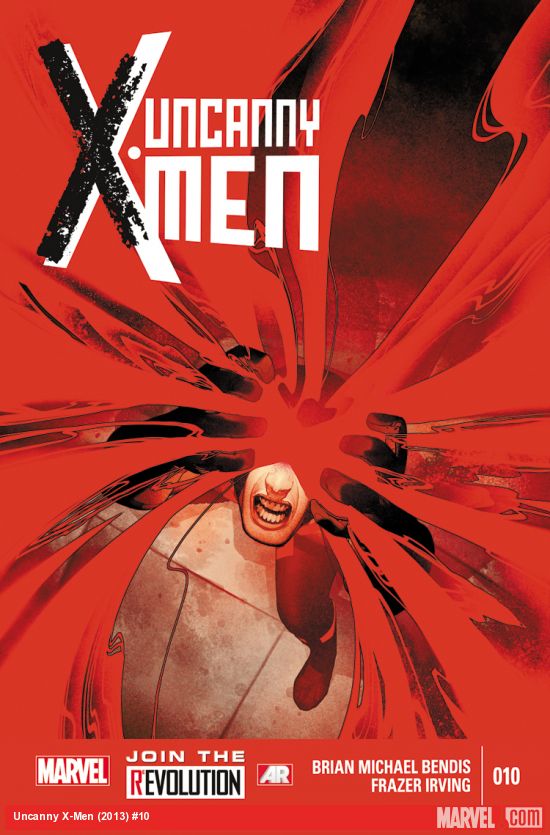
Uncanny X-Men #10 – Review

By: Brian Michael Bendis (writer), Frazer Irving (art)

The Story: Apparently the revolution will be televised.

The Review: Oh Uncanny X-Men, what will we do with you?

It’s been clear from the beginning that this would be a somewhat different incarnation of the X-Men’s flagship title. Brian Michael Bendis has shown a clear enthusiasm for the idea of Cyclops as a revolutionary and the idea of focusing a relaunch of the original X-Men title around, debatably, an incarnation of the Brotherhood sounds absolutely fascinating. So where are things going wrong?

Well, firstly this issue is too dialogue-driven. Some of you may be rolling your eyes at another review calling Bendis wordy, but I assure you that this is an anomaly, even for him. It’s not that Bendis engages in his trademark banter, but rather that very little actually occurs in this issue.

The lack of action doesn’t stop the characters from talking about it, though. Cyclops’ training session is actually quite interesting but it would probably be even more so if Bendis would trust the events of the story to speak for themselves. He’s not telling rather than showing, but he chooses to both show and tell a single action rather than making time for more to happen.
Continue reading

Batman Incorporated #0 – Review

By: Grant Morrison & Chris Burnham (story), Frazer Irving (art)

The Story: Batman Inc. takes a lesson from high school cliques: membership by invite only.

The Review: I’ve never had the same problem with derivative characters the way some comic book commentators do.  I believe the prejudice comes from a belief that such characters represent laziness or lack of inspiration or something.  Frankly though, I don’t see how they’re any worse than song covers or interpretations of jazz standards, both of which I love.  There’s no harm in imitation so long as it introduces new ideas to stand on its own.

While none of the inductees of Batman Inc. will instantly become your new favorite character from this issue alone, Morrison gives each a reason to be liked.  More than almost anyone else in the biz, he’s the master of economy in writing.  In a few lines, even a few words, he can convey a character’s entire personality and something of their background as well.  Reveling over a fifteen-minute murder-solving, Knight (as in “and Squire”) crows, “I’ve done harder bloody crosswords.”  That one line says most everything you need to know about Knight, doesn’t it?
Continue reading

The Shade #11 – Review

By: James Robinson (story), Frazer Irving (art)

The Story: Now where is Dr. Who when London needs him?

The Review: As we get near to the end of this series, it’s worth reflecting back on the reasons why Shade embarked on this journey in the first place.  At the time, he seemed like a man who wanted for nothing: an endless supply of wealth, a penthouse in his favorite city, a girlfriend he loved, even some begrudging respect in the superhero community.  Yet something made him feel unsettled enough to leave.  The quest for his blood just gave him the excuse to do it.

So what was he really looking for?  If you thought his story is about the unbreakable bonds of family, the last panel of this issue makes it pretty clear that such bonds are anything but.  Considering the enormous amount of deference Shade has given to his descendants in the past, his actions seem a bit shocking, but no more than a bit.  Robinson throws the twist at us at the very last second with no build-up, and Shade seems no more blasé about it than usual.
Continue reading

The Shade #10 – Review

By: James Robinson (story), Frazer Irving (art)

The Story: By now, the Shade views restraints as nothing more than foreplay.

The Review: In my estimation, Robinson runs middle of the road when it comes to the sheer originality of his ideas.  If Geoff Johns basically takes classic yarns and makes them like new, while Grant Morrison continually spins new concepts and structures in comic book storytelling, then Robinson does something in between: he’ll take an old concept and buff it up, add his own zany take on things, but he doesn’t quite play any of it out in a radical way.

I think we can all agree that if nothing else, Robinson has made Shade a powerfully compelling figure, which is an impressive step up for an obscure Justice Society (sigh—remember them?) villain.  And certainly, Robinson hasn’t exactly been lacking in unusual material (e.g. religious vampire vigilante in Spain, cosmic Egyptian gods enslaved by a cabal of naked businessmen, etc.).  But he has a bit of difficulty pulling off a climax or resolution that truly surprises you.
Continue reading

The Shade #9 – Review

By: James Robinson (story), Frazer Irving (art)

The Story: Aren’t you guys too old to be playing the Egypt Game?  (And yes, that is a reference to the Zilpha Keatley Snyder children’s novel, which is awesome.)

The Review: For anyone wondering why of all characters DC would choose the Shade to star in its first wave of miniseries, the last eight issues should’ve given you the answer: this foppish, elegantly-spoken man is quite unlike anything you see in comics nowadays, and his life and history is filled to the brim with interest.  If he was real, I have no doubt in my mind he’d be advertising for Dos Equis right now—and selling twice as much as Jonathan Goldsmith.

Yet the one area where Goldsmith beats out Shade is in brevity.  As a lover of words, I can’t help but admire the top-hatted man’s turns of phrase, so elaborate they practically have lace on the edges.  Even so, I can see where his particular voice, a mixture of Henry James’ highly involved syntax and Oscar Wilde’s sardonicism, can become a weary fog to navigate through.  But it’s precisely the loaded nature of Shade’s narration that allows him to offer exposition, character, and action all at the same time.  In other words, Shade himself knows how to tell a story.
Continue reading

MQ’s Favorite Things of 2011

Right around now, when most people are speculating on the year to come, I tend to reflect on the year that has passed.  I think of opportunities missed (cross-country road trips) and those taken instead (law school).  I think of people who have left my life and others who have entered it.  And of course, I think of all the things I’ve seen and read.  Now, I’m sure many other geek-culture sites will have their obligatory “Best Of” lists, all with varying degrees of integrity and sense.  Here, I just want to share my unbridled enthusiasm for the things I’ve enjoyed the most from the past year, which may or may not have any connection with what is actually good or bad.

——-

Xombi

I love the fantasy genre—always have.  I’ve grown up on a daily diet of sword-and-sorcery fiction, but there’s a big difference between these flights of fancy and the subtle works of magical realism, where writers make the natural and supernatural stand side-by-side.  In Xombi, John Rozum incorporated science and the occult together to craft a thoroughly weird, wondrous world where castles float on giant skulls, golems fly on rocket packs, and nuns call on the saints to bless their guns.  Rozum also developed sympathetic, even lovable characters, none of whom wore a cape or descended from any legacy superhero brand.  He made a Korean-American man his star without once calling attention to his race or culture.  And he did all this with the help of Frazer Irving, whose impressionistic art allowed the fantastic elements of the story to seep into your very senses.  It made me almost sick to see the series cancelled, and I still miss it deeply.

Jimmy Olsen

Nick Spencer knows how to make the old new again.  Nothing proves that better than his taking a campy, bowtie-wearing photojournalist/semi-sidekick and turning him into a hero of overlooked geeks everywhere.  Jimmy Olsen recalls the spirit of the great Silver Age stories by making you feel like anything can happen and the universe is one giant playground to run around in, wearing only your boxers if you please.  But more than the zany plots (repelling a massive alien invasion by boredom), what I love about this story is its enormous heart.  Through all his adventures, Jimmy shows that even an everyman with no powers and few skills to speak of can win the day, be a hero, and get the girl.  Also, Chloe rocks

The Unwritten

Nothing could have made me happier as an English major than to have an ongoing series devoted to not only exploring works of literature, great and small, but the very nature of storytelling itself.  While Mike Carey spent early issues of The Unwritten laying down a rich plot that traversed both the fictional and nonfictional worlds, this past year has seen him and critical collaborator Peter Gross tackle bigger, more profound questions, ones where even the non-answers can have enormous impact.  Ambitious in every way (you don’t make a “Choose Your Own Adventure” issue unless you have serious guts and chops), this title has the distinction of actually living up to its lofty goals most of the time.  As someone who loves words, I find reading about reading almost as much fun and stimulating as reading itself.

DC’s New 52

It’s impossible to hide the fact that I’m an unashamedly devoted DC fan.  When I think of heroes I want to meet in real life, the ones I wish were real and saving the world right now, I think of Superman, Wonder Woman, the Flash, and so many other illustrious names in the DC canon.  While I never participated in the Marvel-vs-DC debate as fiercely as some, it always bothered me that DC was such an entrenched second banana to its longtime rival.  So it was admittedly gratifying to see the publisher take such dramatic steps to clean up its convoluted continuity, reinvigorate its brand, and place its creators on projects they believed in.  More than the fact that DC finally overtook Marvel in sales, I’m just incredibly happy with the wide variety of stories spinning out of the DC stables, and how much stronger as a whole their entirely line of comics have become.  Compared to the stuff they offered in 2010, I’m much prouder to call myself a DC follower now than before.
Continue reading

Xombi #6 – Review

By: John Rozum (writer), Frazer Irving (artist)

The Story: I don’t know about you, but I have a sudden urge to play Cranium.

The Review: Every writer on the market has a measure of imagination; you can’t get anywhere in writing if you don’t.  But it’s fair to say that some have a little more than others.  While you have plenty of people who can take classic ideas and polish them up to make them like new, only a very few, dare I say special, individuals can dream up something so unheard of that it deserves the classification of originality.  I contend Rozum is one of those special guys.

But don’t take my word for it; take Rozum’s, in his description of the Sisterhood of Blood Mummies: “…they each have developed a second, external [circulatory system] connected to a second heart.  The extra blood…gives them incredible energy and endurance levels…  To protect themselves they wear cloaks woven…by spiders which crawl all over these cloaks making any necessary repairs and feeding on the mosquitos drawn to the sisters.”

Rozum also delivers a solidly crafted story.  Though he dropped in a handy plot device last issue with the Pearl of Wisdom, he doesn’t use it give David and his pals a convenient way out of their predicament.  Of all the revelations the pearl offers to David, he chooses not the one that will help him defeat Finch, but one that eventually serves a different, but nonetheless crucial task in reviving the fortunes of the ruined Floating Skull.  It says a lot about the kind of person David is.
Continue reading

Xombi #5 – Review

By: John Rozum (writer), Frazer Irving (artist)

The Story: Riding on pterodactyls.  Golems with rocket packs.  Nuns and guns.  ‘Nuff said.

The Review: There’s been a lot of speculation, both dark and ecstatic, about the upcoming state of the DCU, post-Flashpoint.  Through it all, I’ve managed to keep my cool, encouraging cautious optimism whenever possible.  But one of the few things that threatens to break my veneer of objectivity is the thought that among the new lineup of titles coming this fall, Xombi will not be counted with them.

While it’s true I have a soft spot for David Kim, since we share a racial demographic, I really just appreciate that Rozum treats him as a person, not a cliché.  Even if you strip away David’s last name and distinctly Oriental (yup, I said it—I’m Asian so I can) appearance, his character remains just as sympathetic.  His good nature, decency, and affectionate manner are qualities we can all appreciate in a hero, and none of it has anything to do with his race.

You have to admire how the entire cast always shows fully-formed personalities well beyond their stereotypical appearances.  For example, your first instinct is to understand Nun of the Above’s distaste for magic as part of her religious devotion, so it’s all the more surprisingly impressive when she snaps, “I don’t agree with all church doctrine, but embracing the occult as Julian does only invites darkness.”  Bitter personal experience, not dogma, fuels her prejudice.
Continue reading

Xombi #4 – Review

By: John Rozum (writer), Frazer Irving (artist)

The Story: So you worked as a librarian in a castle built on a giant floating skull—how quaint.

The Review: The most delightful thing about reading Xombi is the deep sense of creativity fully at work here.  Most of the fantasy elements we get from mainstream comics tend to play in familiar, safe territory: magicians, demons, ghosts, and the like.  Even when Rozum uses these archetypes as the basis for his stories, he always gives them fresh spins, but usually, he goes much farther afield, pitching the most unexpected concepts at you.

In this issue, Rozum packs in a lot of fun asides that get only a brief mention, unlikely to be even seen in the future: “…vegetarian recipes from Mars from back when it had natives to still call it Ma’aleca’andra; four of the seven swords of skin; a jar containing a captured chimney wraith; pearls of wisdom collected from oysters grown in the Sea of Tears…”  They arrest your imagination, but always feel like they only scrape the surface of what’s in store for this title.

Most of these details get offered by the latest strange case to fall into David’s indestructible hands, the shockingly well-preserved Annie Palmer.  Even though her attempts to explain her unusual past results in an incredibly chatty issue, she has an active, sympathetic narrative voice that gets across all the expository history of her life on the Skull Stronghold and her grim affair with the impeccably manipulative Roland Finch.

Hearing how Finch causes the denizens of the Stronghold to destroy themselves from within (and using Annie to do it) really brings new meaning to the jerk boyfriend.  The guy has the perfect tone to be a top-rate villain: an overgrown spoilt child with such a nauseatingly high opinion of himself that he won’t even dirty his hands to get his goals done.  By the time he finishes his callous speech to the devastated Annie, you’ll want to suckerpunch him yourself.
Continue reading

Xombi #3 – Review

By: John Rozum (writer), Frazer Irving (artist)

The Story: I’m not crazy—you’re crazy if you think this skull in my hand isn’t also a laser gun!

The Review: The burden of most mainstream superhero comics comes from their constant need to deliver action to the readers—not necessarily physical fights between heroes and villains, but something obvious always has to be going on.  This trend doesn’t allow for much tackling of profound subjects except by chance, and then it often gets clumsy or superficial treatment.  But the best crafted comics revolve their plot around the message they want to get across.

Small wonder Rozum places right in the thick of this issue’s action a monologue from a ghost to a character who can’t tell himself if he’s dead or alive.  The ghost (the doomed James Church?) states it’s not just David’s Xombi status; it’s the tragic fact that most of the living don’t truly take advantage of life, the natural evolution of that old adage, “Youth is wasted on the young.”

Though slightly long-winded, the speech is nonetheless important not only in the context of the story, but for the series.  Besides the undeniable poignancy of the scene (“I wish I could smell the dew on the grass before I go,” the ghost says sadly in his last moments), it also gives our hero a deeply personal mission beyond whatever supernatural case he latches onto next.  The ghost’s farewell advice to David—and to us, essentially—is to stop regretting what he doesn’t have and cherish the overlooked treasures already before him.

Rozum smartly bookends the scene with the tense showdown between the freed Marantha and the supporting cast of Julian Parker, our Catholic ladies, and Rabbi Sinnowitz, who carry out their duties with experienced efficiency.  With everyone getting plenty to do, the issue feels rich and lively, especially since we also get to see David’s abilities in fairly gruesome action as he gets repeatedly mauled, only to run back into the fray seconds later.
Continue reading

Xombi #2 – Review

By: John Rozum (writer), Frazer Irving (artist)

The Story: If anything has ever validated my fear and loathing of trick-or-treaters, this is it.

The Review: The world grows more devoted to the laws and products of science all the time, but the supernatural still holds a powerful grasp on our imaginations and curiosity.  It’s been used to answer all the questions logic and empiricism can’t, to explain the mysteries science has made no headway in.  The supernatural is at its creepiest and most intriguing when it brings to life the stuff our rational minds know better to accept, but we subconsciously still wonder of.

This issue plays on exactly that, one of the best examples being the rustling husk, a creature whose grim origins are described as follows: “Those dead wasps and yellowjackets you see littering your window sills?  These homunculi hit men are made from swarms of their ghosts, driven mad with desperation at trying to get through the window glass to the outside.”  The concept is at once startling, frightening, tragic, wildly imaginative—and thus irresistible.

Really, the greatest strength of this series is the originality of its many ideas: the bullets embodied with the powers of the saints, the miniaturized prison for supernatural criminals, the “snow angels” whose very bodies warp space, the soulless Halloween children—the list goes on and on.  Many comics go through dry spells of several issues before they deliver a fresh idea, and some never offer any at all.  On that point alone, Xombi deserves a ton of praise.

But the grander and more far-reaching ideas have more risk of confusing the plot.  Rozum is not totally immune to this.  James Church got introduced to us as a reader infected by a book virus turning him into a real-life Mr. Hyde.  Now we find that complicated setup is a blind for a much more ancient, destructive creature, sealed within the miniature prison without the wardens’ knowledge.  Left unchecked, these twists can quickly become discouragingly bewildering.
Continue reading

Xombi #1 – Review

By: John Rozum (writer), Frazer Irving (artist)

The Story: Can some super-powered nuns and a guy who never needs to use the restroom work together to defeat a miniaturized serial killer?

The Review: Once a staple of comics, the horror genre has grown out of favor, nowadays only found among the less-trodden stands of indie publishers than the throng of titles from either the Big Two.  It’s the times that have changed; the threshold for what can horrify people has gotten a lot higher, and so many of even the mainstream series feature horror elements that it’s hard to generate enough potent, new ideas for a dedicated horror comic.

After reading the first issue of Xombi, you may be convinced that at least with Rozum at the helm, there’s plenty of fresh ideas to keep the title going for a long time.  Rozum first wrote the series back in the early nineties, and in this revival, you get a swift re-intro to the character and the grim origins of his powers, which seem just as compelling as when they first appeared.  But more than that, you get the sense this title offers something different from the rest of the pack.

Consider the opening events alone: a painted tiger mauling a cow in a completely different painting, chickens giving live birth, movie characters disappearing off the reel—as the talking heads on a quarter, a nickel, and some pennies indicate, these are all the signs of something even more unnatural to come.  Despite the small scale and not necessarily original nature of these things, Rozum strings them together in an effectively creepy way.

The title also gets a truly oddball cast of characters.  David Kim, the titular Xombi, is the least of it.  You also get a posse of metahuman Catholics, including a shrinking nun, one with clairvoyance, and a schoolgirl blessed with heavenly light.  Just to give you a sense of what kind of people you’re dealing with here, let me say they don’t flinch at much—even a shrunken prisoner impaled to a dollhouse wall with a normal-sized pair of scissors through her sternum.
Continue reading

Batman and Robin #16 – Review

By: Grant Morrison (writer), Cameron Stewart, Chris Burnham, Frazer Irving (artists), Alex Sinclair and Frazer Irving (colorists), Mike Marts (editor)

The Story: We see Thomas Wayne in 1765 summoning the demon Barbatos. We then shift forward to now, where Dr. Hurt is facing Batman, Robin, and DC’s spoiler for the whole Return of Batman miniseries. Problem is, Hurt’s got a lot of help, Dick has been shot in the head and the Joker is the wild card (so to speak).

Publishing Issues: I gotta get this out of the way before I do the rest of the review. On my way to my LCS, I was thinking of what a great thing it was that DC had taken its time to fully explore the implications of the death of Bruce Wayne and how I liked how they were taking their time to bring him back right. I thought the same thing contentedly as I read this issue, until I got to page 15, where suddenly I see two Batmans, one of whom is Bruce Wayne. I rubbed my eyes, flipped back a couple of pages, and find that the build up and explanation offered is….”You came through the fireplace.” WTF? OK, I don’t read most of the message boards for a reason. I want to be able to read each comic on its own terms, creator to reader, no intermediary. I think that’s honest. It took me a while to connect some of the whisperings I’d heard about publication schedules and finally realized that this issue occurs *at least* later than The Return of Bruce Wayne #6, if not later. So, I’m not going to get into my frustration, but needless to say, I felt a bit like someone had told me who the killer was before I’d finished my popcorn in the movie. Totally, totally not cool on DC’s part. I don’t care what their editorial/creative problems are. If some fraction of DC’s comics routinely get delayed for one reason or another, DC should build that into their business plan, especially on something as coordinated as an event. Now I don’t even want to read ROBW #6. Nice work, DC.

What’s Good: First part of the book (Thomas Wayne in 1765), was very moody and cool, classic Morrison. And visually impressive, even if that artist’s style isn’t 100% to my taste. The fight between Batman, Batman, Robin and the 99 Fiends was dynamic, but I never felt like anyone but the fiends were in real danger. It felt a bit like filler. Despite this, Damian certainly stole the show. Check out the visuals and the outcome of his fight with the guy with the flame thrower! The Hurt/Batman conflict in the Bat Cave continued the fun, and Pyg was twisted and depraved in central Gotham. The ending with the Joker was unexpected, tone-perfect and satisfying.
Continue reading

Batman and Robin #15 – Review

By: Grant Morrison (writer), Frazer Irving (artist), Janelle Seigel (assistant editor), Mike Marts (editor)

The Story: Batman and Robin Must Die, Part 3: The Joker has Robin in his insane clutches, but he must convince the boy wonder to go after Thomas Wayne instead of giving the Joker his comeuppance. Damian isn’t known for his ability to persuade, though. Batman is in the clutches of Thomas Wayne, who is also a raving lunatic. And Gotham is in the clutches of an addiction-withdrawl infection. All in, a crappy day to be in a cape and tights.

What’s Good: Irving’s art blows the doors off the barn. His attention to detail, deft use of color, and style suited to the moodiness of the psychologically-unhinged, make him my premiere choice for drawing Batman and Robin (even over Quitely). The Joker in the first three pages (well, any pages where he appears, really) is hypnotic. I had to drag my eyes from one panel to the next, because they didn’t want to leave where they were. The layouts were intriguing, with unexpected open white spaces on some pages, and panels to set symbolism and mood, some having classical roots, others having more dystopian 24-hour-TV-news roots. The action sequences, especially of Robin, were really, really good (check out Damian with his boot to the Joker’s throat and the part where he leaps at all of Pyg’s piggies). Brilliant art.

Morrison has been putting in pretty flawless performances in the last few months on BM&R and the Return of Bruce Wayne. This issue is no exception. Each character has his own, vivid voice. Morrison’s choice of words and cadences make the Joker sound unhinged, Thomas Wayne sound British and slimy, Pyg insane, Damian arrogant and frustrated, and Alfred….I’m not sure…was it disdainful or fearful? Doesn’t matter. He sounded different from every other character in the book. Morrison gave each one a feel, so that the art was free to characterize in the areas it does so best: expression, body language, setting, etc. Fine writing all around.
Continue reading

Batman and Robin #14 – Review

By: Grant Morrison (writer), Frazer Irving (artist), Janelle Siegel (assistant editor), Mike Marts (editor)

The Story: Batman and Robin Must Die, Part 2: Robin is still locked up with the Joker. Batman and Commissioner Gordon are surrounded by the enemy. And the full-on war between the Joker and the Black Glove blows up.

What’s Good: Right off the bat, Batman and Robin under Frazer Irving is visually arresting. Irving does different things. Colors and light become watery and fluid. The camera shots shift disconcertingly (intentionally) between complete pictures and tight close ups that drive up the tension and add to the mood of dislocation. Backgrounds are uneven sprays of paint with no defined source of light, eerie and effective. The villains, psychologically distorted outside of moral boundaries, are chilling, alien, and disturbingly plausible. Irving is my new favorite Batman artist.

Morrison on scripts has moved the plot forward with events and reversals, but this is the least part of the satisfaction of this book. The moody and unhinged dialogue opens crooked windows onto the insides of Pyg, the Joker and Black Hand. The Joker gets some awesome moments against Robin, and says some very revealing things, but at every moment, the cagey look and the mask of his expression scream that he is unreliable and that everything he says is lie or manipulation. Pyg is an utter, utter whack job and the more he talks, the more creeped out I am. The action is intense and fast and tumbling in the confused way that hard-boiled fiction reflects the chaos of the world in its narrative style. The reader is deliberately exposed to a measured amount of confusion and disorientation to bring him closer to the psychological state of the heroes and the victims.
Continue reading

Batman and Robin #13 – Review

By: Grant Morrison (writer), Frazer Irving (artist), Janelle Siegel (assistant editor), Mike Marts (editor)

The Story: Batman and Robin Must Die, Part I: Morrison serves us up a split narrative: today, when Batman and Robin are prisoners of Thomas Wayne, and three days earlier, when everything started to go down the toilet.

What’s Good: Oh my frakkin’ god! The art is amazing! Irving’s pencils, inks and colors leap out of the page, grab you and yank you into the story. Irving’s art hadn’t impressed me in the Return of Bruce Wayne. Maybe it was hard to tell what his style was doing in the late 17th century. Here in modern Gotham, doing the Joker and Thomas Wayne and Dick and Commissioner Gordon, not to mention Gotham itself, Irving’s skill and talent just blew me away. In my opinion, Irving was made to draw Batman and Robin, moreso even that Quitely, and I know how much that says. If you doubt me, check out the Joker, in any panel of this book. Irving’s style has a European flavor and the subtlety of his expressions is brilliant. Check out the six expressions on display on page two. Not a one is alike; he is capable of expressing a range of emotions. His shadowing is weird and compelling, while his scenes of surreal debauchery and the Joker’s insane faux-sycophanty were lurid and haunting.
Continue reading

Batman: The Return of Bruce Wayne #2 – Review

By: Grant Morrison (writer), Frazer Irving (artist), Mike Marts and Janelle Siegel (editorial team)

The Story: Bruce Wayne, damaged memory and lost in time, has disappeared from the Stone Age and reappeared in the new world of the puritan colonial Gotham. He’s been given an identity by a local woman who’s been accused of being a witch. Bruce does his detective thing to unravel a supernatural mystery. In the “meantime” (if meantime is defined as being simultaneous with moments before the heat death of the universe), Superman, Green Lantern, Rip Hunter and Booster Gold trace the Omega energy to the end of time. They find Bruce (not the same-time Bruce as the one in puritan Gotham…stay with me…time travel is all paradoxical) but not before he strands.

What’s Good: The whole thing. Wow. What great art. Frazer Irving’s work is a unique blend of stylized and creepy that’s simply awesome. His puritan witch hunt scared me. His scenes of Bruce fighting a spectral evil was moody. His expressions were evocative (the accused witch’s face when Bruce wakes up, Superman’s posture and expression when facing the archivist), requiring no words at all. And the archivist… Holy $#!^! What an awesome alien! It was made all the spookier with the one glowing, off-center eye.

Grant Morrison, who started slow in the last issue, barreled this book along. The story is fragmented, with shards set in the doomed future, pieces set in a monstrous psychedelic mindscape, and scraps hidden dark caves and in terrified puritan Gotham. Personalities grind together. The plot thickens. Superman spills the stakes: “He took your memories and relied on your survival instinct… You’ve been booby-trapped! Darkseid turned you into a doomsday weapon and aimed you at the 21st century!” This is heady stuff and very cool. This is why I like Darkseid. Find me a better evil genius whose name doesn’t start with “Tha” and end with “nos.” This isn’t sharks with lasers on their heads. Think about it. Darkseid booby-trapped one of the greatest superheroes of all time and shot him at the 21rst century. How cool is that? Continue reading

Design a site like this with WordPress.com
Get started