• Categories

  • Archives

  • Top 10 Most Read

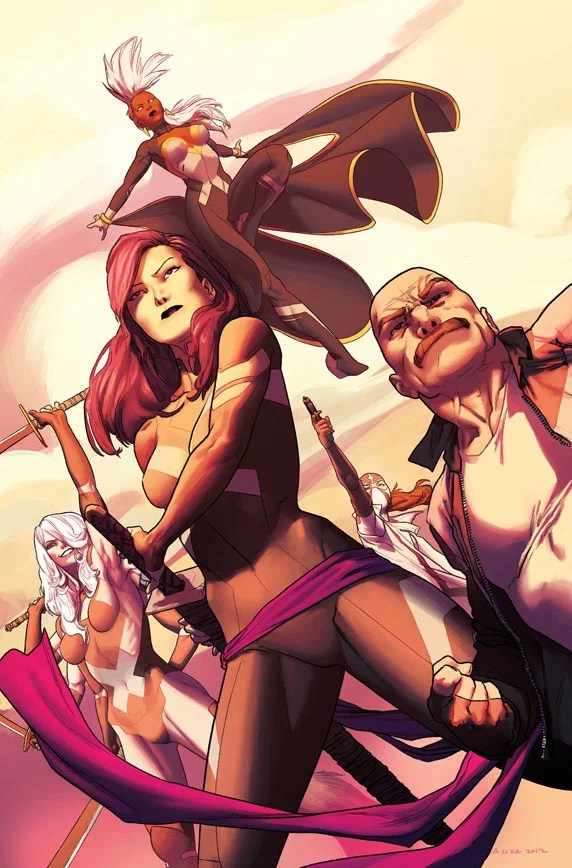
Uncanny X-Force #2 – Review

UNCANNY X-FORCE #2

By: Sam Humphries (Writer), Ron Garney (Penciler), Danny Miki with Scott Hanna (Inkers), Marte Gracia with Israel Gonzalez and Wil Quintana (Colorists), VC’s Cory Petit (Letterer)

The Review: One of my big comic book regrets of late is that I didn’t pick up Remender’s run on Uncanny X-Force. I borrowed the odd issue from friends but didn’t get the big picture, and from what I hear the whole run is an epic Must Read; I’m basically waiting for Marvel to package the whole thing up in an Omnibus edition so I can try and read it all in one massive sitting. Anyway, the point is that as well as missing out on some great storytelling, I also feel that I’ve missed out on some key moments which inform Sam Humphries’ turn on the title.

This feeling was a bit more pronounced with the first issue (lots of vague plot points discussed between Storm and Psylocke and glimpsed in flashback panels) but the sense still lingers here. This, along with the general bluster that dogs the books composition, makes things a little hard to follow. I can’t quite work out whether I like it or not. There’s good and bad, and I’m not sure if any one side really wins out.
Continue reading

Uncanny X-Force #1 – Review

UNCANNY X-FORCE #1

By: Sam Humphries (Writer), Ron Garney (Artist), Marte Gracia, Israel Gonzalez (Colorists)

The Story: Psylocke, alongside Storm and Puck, gets on a case of hive-minding drugs thanks to a tip given by Wolverine.

The Review: This book has an incredible challenge ahead of itself. Not only it is a first issue which needs to captivate readers with some unknown characters and setting, but it is the direct follow-up to a beloved tenure on the title by Rick Remender. Writer Sam Humphries has some huge shoes to fill on this title.

Thankfully, there seems to be some potential for this new volume of the series, as there are a lot of elements that are taken and followed from the previous run, while there are some new ideas and characters added to the mix to make this worthwhile. There’s the definitive touch of Remender inside this issue, but Humphries does not shy away from new directions.
Continue reading

Wolverine & The X-Men #4 – Review

By: Jason Aaron (writer) Nick Bradshaw (artist) Justin Posner (colors)

The Story: It always sucks to be the new kid.

What’s Good: While I was sad to see Chris Bachalo leave this series, rest assured that the art is in good hands with Nick Bradshaw. His round, friendly lines make the Jean Grey School for Higher Learning just as wonderful as Bachalo did, and his attention to detail is incredible. From the picture of Cyclops on a dart board, to Quire’s copy of the Art of War, to Glob’s papers sticking to him, every panel feels rich and resplendent. The change in art style also reflects a change in tone. The faculty are no longer fighting off external forces that threaten to destroy the school, but are still burdened by the day-to-day difficulties of managing and teaching twenty super-powered adolescents. As such, the atmosphere has lightened, and things no longer look ready to come apart at the seams. There are some truly beautiful shots of Angel against the sun, and everyone’s body language is as expressive as their dialogue.

One of my favorite parts of this new series has been just how well  Jason Aaron has been able to capture the dynamic between the students and the teachers, while keeping everyone in character. Wolverine and company are truly teachers, not team leaders or mentors as they’ve been in other books featuring young mutants, and this relationship informs nearly of their interactions.

The story in this issue centers around the introduction of Angel and the Kid-Apocalypse Evan, who calls himself Genesis. The two  face very different challenges; Evan will have to decide his fate, whether to be savior or destroyer. Worse, he will have go through puberty, bullies, high school drama as figure it out. This has me concerned for his treatment by writers: it will be only too tempting to repeatedly pen stories about him “going evil” only to “redeem himself” in endless and unsatisfying cycles. I’m really hoping that Jason Aaron has a very specific character arc in mind for him, and that he can convince editors and future writers to try to adhere to as tight a story as possible. For Angel, on the other hand, I think the struggle will not so much be about finding himself as it will be about convincing others that he is a very different person than the one they remember. This, I like. At the very end of the Dark Angel Saga, I was concerned that all that the only reprecusion was that he had developed amnesia, and that after maybe a few months, we’d get a story line about him regaining his memories. If the changes in him are as far-reaching as they are implied to be here, the writers have been braver than I would have dared to hope. There’s a lot of potential for some very interesting stories here, not only for this new character, but also for all of Warren’s friends as they adjust to his “condition.”
Continue reading

Cable #22 – Review

By: Duane Swierczynski (writer), Gabriel Guzman (artist), Thomas Mason (colors), Axel Alonso (editor)

The Story: Homecoming, Part 2: This issue is part of the build-up to the X-Men: Second Coming event. Seventeen-year-old Hope has decided it is time to join to X-Men in the present. Cable’s time gizmo isn’t very precise. It keeps landing on the past or the future, but gets closer and closer (the opposite of what the time traveler did in Wells’ Time Machine). The problem is Bishop keeps getting dragged along with them.

What’s Good: Swierczynski is writing a pursuit plot, which can be a lot of fun. The secret to the chase plot is never letting the quarry get too far from the hunter, and Swierczynski certainly did that here. Even when they manage to make some major gain, Hope and Cable can’t get any real distance between themselves and Bishop. Also, some of the traps and attacks that Cable and Hope devised were pretty fun to watch. Ever thought you’d see Cable shooting muskets? It is cool, and the camera angle that Guzman chose was a good one.
Continue reading

X-Force #16 (Messiah War Chapter 7) – Review

By Craig Kyle & Christopher Yost (Writer), Clayton Crain (Art), and Duane Swierczynski & Ariel Olivetti (Epilogue)

Some Thoughts Before The Review: One… more… comic… Just one more… The Messiah War is almost over…

The Story: The Messiah War comes to a close as everything comes to a head. Apocalypse, followed by Death, seeks to end the age of Stryfe. X-Force tries to figure out how to deal with the time devices. Hope is in peril as Bishop tries to take one final shot…

What’s Good: As you’ve probably guessed, the best thing about X-Force #16 is that it finally brings an end to the Messiah War storyline. That said, if you’ve been enjoying the Messiah War storyline for what it is, you’ll probably find a lot to like about the arc’s conclusion. All the elements of the story come together for one final confrontation as Apocalypse says epic stuff (which is almost fun to read in a “wow this sounds silly” way), putting Stryfe in his place.

What’s Not So Good: I really can’t say what the biggest sin of the Messiah War is without heading into spoiler territory so… SPOILER WARNING!!…  Here’s the biggest sin of the X-Force/ Cable crossover – When it’s all said and done, everything goes back to how it was before the crossover started. Bishop winds up somewhere in the time-stream, Cable winds up somewhere else with Hope, X-Force is back in the present…Seriously…what was the fucking point?!

Alright, so with that complaint out of the way, I can now tell you the other awful thing about X-Force #16: Clayton Crain’s artwork. Dark, muddy, unclear, smeary (didn’t know that was a word until now), and hard to follow. Crain’s work makes a really poor story seem even worse. Look, I generally like Crain’s work. I think his style is a great fit for the X-Force series and when all of his art clicks, it looks incredible. However, the conclusion of the Messiah War is a great example of how horrible things can look when absolutely nothing clicks…

Conclusion: Save your money and skip X-Force #16. Also, do not even consider picking up the Messiah War trade if you have been waiting for that.

Grade: F+

-Kyle Posluszny

Cable #15 (Messiah War Chapter 6) – Review

By Duane Swierczynski (Writer) and Ariel Olivetti (Artist)

Some Thoughts Before The Review: At best, the Messiah War crossover has been disappointing. At worst, it’s been a complete waste of time and money. I wonder if the final chapters can make a difference?

The Story: Deadpool, X-23, Vanisher, and Domino find the source of the interference that’s disrupting the time-travel devices. Meanwhile, Cable, Bishop, and the rest of X-Force try to stop Stryfe from capturing Hope. Also, Angel helps Apocalypse do something that may cause everyone to pay a price…

What’s Good: The very best thing about Cable #15 is that it brings the Messiah War one step closer to a conclusion. I know that that’s not exactly high praise, but the sooner Cable and X-Force can get back to business, the better. The only other positive thing about the sixth chapter of the Messiah War is that Ariel Olivetti’s style actually works quite well for a handful of scenes.

What’s Not So Good: Man…where do I begin? I guess it’d be best to start by saying that Cable #15 might be the worst Messiah War chapter yet. It fails in some way at every level…

The storyline disappoints because the two big plot twists introduced in Cable #15 are strange and frustrating. One of them makes X-23 act completely out of character. The other twist seems like a desperate “WTF!?” moment tossed in just to…you know what? I actually have no idea what the creative team was going for with it.

Duane Swierczynski’s writing makes reading Cable #15 a chore. What’s odd though, is that the writing isn’t actually all that bad. The problem is that Swierczynski seems far more intent on hammering out plot points than actually entertaining the reader. Simply put, a little personality would have gone a long way.

Despite what I said in the “What’s Good” section, the visuals by Ariel Olivetti are truly awful for most of the book. They are inconsistent (Why does Cable look 20+ years younger at times?), awkward (Why is Wolverine’s head so tiny?), ugly (I swear that Olivetti uses the Vanisher reference for every female character), and surprisingly static (some sense of motion would be wonderful). Even fans of Olivetti’s style will have a tough time defending the artwork in the latest issue of Cable.

Conclusion: The penultimate chapter of the Messiah War does nothing to improve the crossover event. Buy it at your risk…

Grade: D-

-Kyle Posluszny

X-Force #15 (Messiah War Chapter 5) – Review

By Craig Kyle & Christopher Yost (Writers) and Clayton Crain (Artist)
Some Thoughts Before The Review: The “Messiah War” storyline has been extremely hit or miss. It’s had a few good moments but as a whole, it’s been rather unsatisfying. I’d love for it to find some sort of consistent, quality groove, but at this point, it doesn’t look like it’s going to.
The Story: Bishop, Stryfe, and Warpath fight over a confused Hope as Cable and the others make their way to Stryfe’s place. Meanwhile, Angel confronts Apocalypse….

What’s Good and What’s Not So Good: If you’ve been following the “Messiah War” storyline, X-Force #15 is going to feel like a whole lot more of the same. Hope is in danger, Stryfe talks about how powerful he is, Bishop tries (unsuccessfully) to eliminate his target, Cable tries to rescue hope, Deadpool cracks jokes, Angel talks to Apocalypse….you get the point. The entire issue has a “been there, done that” vibe that makes me feel incredibly bored with the whole “Messiah War” thing.

Sure it has a few entertaining character moments, and sure Clayton Crain’s artwork is pretty cool to look at (when it isn’t completely dominated by darkness and grit), but X-Force #15 as a whole really isn’t worth the time it takes to read. You’ve seen pretty much all it has to offer if you’ve picked up an issue of Cable or X-Force in the last few months, so why bother spending the cash for it?

Conclusion: X-Force #15 proves just how flimsy the “Messiah War” story is. While it’s cool to see Stryfe and Apocalypse back in action, don’t let the nostalgia fool you into thinking the “War” is living up to the hype. The wheels are spinning, yes, but the story is going absolutely nowhere…

Grade: D

-Kyle Posluszny

Cable #14 (Messiah War Chapter 4) – Review

By Duane Swierczynski (Writer) and Ariel Olivetti (Artist)

Some Thoughts Before The Review: I’ve pretty much given up on any hope that Messiah War is going to end up being a truly worthy follow-up to the fantastic Messiah Complex event. While the crossover has been entertaining enough, it lacks the sense of urgency and intensity that made Messiah Complex one of my all time favorite “X” stories. Still, I know I’ll stick with the X-Force/Cable crossover regardless of my disappointment. And that’s because I’m genuinely interested in finding out what direction Hope takes following the War being fought because of her.

The Story: Warpath is stuck in a torture device designed by Stryfe. Hope is a captive of both Bishop and Stryfe. Cable, Deadpool, and most of X-Force try to work out a plan to get inside Stryfe’s citadel. On top of all that, Archangel answers the call and confronts Apocalypse…

What’s Good: I’ve been pretty hard on Duane Swierczynski in the past. Most recently, I thought he really dropped the ball when first handed the reigns of the Messiah War crossover (for chapter two). That said, I give credit where credit is due. And credit is definitely due in this case.

In Cable #14, Swierczynski does a really nice job of ramping up the tension of a storyline that definitely needed one more push to get to the next level. He effectively uses a mix of dialogue and internal monologue to bring out the best in a number of the characters. A few scenes in particular really stand out, like Warpath’s reaction to torture, Archangel’s reunion with Apocalypse, Cable’s battle with remorse, and Bishop’s reaction to the current situation. They feature character moments or bits of information that leave me thinking that the Cable/X-Force crossover might actually be able to overcome it’s rocky start.

What’s Not So Good: Unfortunately, there are two things holding Cable #14 from earning a higher grade. One of them is the artwork by Arial Olivetti. The other has to do with how Hope is handled.

The artwork looks either far too static or, in some cases, downright silly. I understand that it can be difficult to show pain or surprise, but a few of Olivetti’s character shots are just simply hilarious. Two choking scenes are the main offenders, but Warpath’s torture scene doesn’t exactly make a great visual impact either. Sure the device looks nasty, but the results are less than spectacular. I mean it looks as though Warpath is just having a particularly nasty visit to the dentist in one panel.

The problem with Hope (outside of looking really odd) is that she is written in a way that is really inconsistent. She is either sounds too much like an adult or too much like a dumb teenager. It’s like Swierczynski sort of dances around a desirable sweet spot for the character, but never really nails it.

Conclusion: Good, but still not great. That’s the best way to describe both the issue and the crossover that it is involved in. A lot of it works, but enough of it doesn’t to keep it from earning higher than a…

Grade: B-

-Kyle Posluszny

X-Force #14 (Messiah War Chapter 3) – Review


By Craig Kyle & Christopher Yost (Writers) and Clayton Crain (Art)

Some Thoughts Before The Review: The Messiah War crossover event really hasn’t even started yet. So far, it’s been a whole lot of expositional dialogue and very little action. I’d expect that to change in chapter three, especially considering how chapter two ended.

The Story: X-Force, Cable, Hope, and Deadpool fight off Stryfe’s warriors in a bloody battle. During the fight, Archangel hears a voice calling out to him. Meanwhile, Stryfe waits for the best moment to attack. As for Bishop, well he’s in charge of most of the exposition.

What’s Good: The latest part of Messiah War is definitely a step up from the last one, though that really isn’t saying much. While most of it is driven by crazy action sequences, the writing team does a nice job of balancing the book by effectively using character moments and slower scenes to move the plot along. It helps that Craig Kyle and Christopher Yost have a very good handle on the fairly large cast. The characters could easily be lost among the bloody violence, but that is, thankfully, not the case. Everyone gets a chance to make an impact under Kyle and Yost. Especially in the case of Vanisher, who manages to bring dark humor to the story more successfully than Deadpool, a character that pretty much lives and dies by how well a writer handles his particular style of black comedy.

What’s Not So Good: The artwork in the third chapter of Messiah War is very much a mixed bag. While I firmly believe that Clayton Crain is a great fit for a series like X-Force, he tends to be his own worst enemy. When everything in his work manages to click (which it does quite often), it looks extremely good. But when something is off, an entire panel can be ruined. And too many panels are ruined in X-Force #14. Sometimes the work is far too dark. Other times everything looks very muddy and undefined. The worst though, is when the character work bounces from one extreme to another, sometimes in the same panel. The art looks either too hyper-detailed, and over-exaggerated or so indistinct that characters look like little more than blobs of color.

As for the story, it still feels like it’s plodding along. While the action in X-Force #14 is welcome and the ending is intriguing (if a bit too predictable), the whole thing lacks the kinetic urgency that drove the Messiah Complex along. I find that a bit surprising, especially because the stakes are just as high, if not higher in some ways.

Conclusion: The Messiah War is definitely gaining momentum, but it’s still a ways behind the Messiah Complex in terms of both scope and excitement.

Grade: B-

-Kyle Posluszny

Cable #13 (Messiah War Chapter 2) – Review

By Duane Swierczynski (Writer) and Ariel Olivetti (Artist)

Some Thoughts Before The Review: Messiah War got off to a solid start last week despite the fact that half of chapter one was spent on recapping the past. Now, with the pieces in place and the main players introduced into the event, I look forward to where the Messiah Complex sequel will go next. Hopefully, it’s somewhere good.

The Story: Much like the first chapter, the second part of Messiah War spends a lot of time going over past events. Only this time, the past events offer up information that’s new, regardless of whether or not the reader has been following X-Force and/or Cable. What that means is that Cable #13 reveals just what future-Deadpool has been up to all these years. Also, the issue reveals how the present future came to be and what is up with the partnership between Stryfe and Bishop.

What’s Good: The Messiah War story continues to hold quite a bit of potential. Thanks to the funny segment featuring Deadpool and the bits of effective narration from Bishop, it’s possible to come up with a fairly clear picture of what type of future the characters are operating in and how it came to be that way. In other words, with the set-up hopefully finally out of the way, it seems as though the X-event can finally start moving forward comfortably.

What’s Not So Good: In my review of the Messiah War one-shot, I expressed concern over how the event would fare in the hands of the Cable creative team. As it turns out, Cable #13 proves that my concern was more than justified. And Duane Swierczynski and Ariel Olivetti are both at fault.

With the exception of how Stryfe is written, Duane Swierczynski does a pretty poor job of handling his series’ guest stars. Deadpool comes off way too strong (his comic fan “in jokes” are more annoying than funny), Wolverine’s dialogue is at times, atrocious (asshat?! honestly!?), and I really can’t picture X-23 expressing much concern about how someone feels when such an important mission is going on. Two chapters in, and I’m already starting to think that Marvel should have just let Christopher Yost and Craig Kyle handle the entire event.

As for Ariel Olivetti’s work…well…he uses a very “love it or hate it” style. As a whole I can’t really stand it and as a result, I’m not a fan of the visuals in Cable #13. That said, I will give him credit for an appropriately hideous looking Deadpool and some pretty cool looking scenery.

Conclusion: Cable #13 pretty much justified and made real my fears about what would happen when Swierczynski and Olivetti took the reigns of an interesting story. I look forward to what’s coming next in the Messiah War, but at the same time, not really because of anything that took place in its second chapter. Consider me currently disappointed, but optimistic for the future.

Grade:  C

-Kyle Posluszny

Cable #7 – Review

By Duane Swierczynski (Writer) and Ariel Olivetti (Artist)

Let’s talk about padding.

That’s right, padding. You know, when you stretch things out with lots of stuff that doesn’t really have any substance? Let’s fiiiiiiiiiilllll things in with a little padding.

Padding.

Cable #7 is full of it. Padding, that is. I know that comics no longer proceed at the same break-neck pace they used to, and when this story is collected in the inevitable TPB maybe it will seem like the calm before the storm, but as a stand-alone, this issue is all talk and no action. Cable is still on the run, carrying the mutant girl who is either the last hope of mutantkind or the harbinger of the end of the world. He and the child, who is now a young girl (a redhead, hmmm…), are hiding out in an extremely boring valley somewhere in the future– a future that looks exactly like the present as far as I can tell. Part of the problem is Olivetti’s art, which is nice but static, with flat compositions and unimaginative backgrounds.

Meanwhile, back in the present, the X-Men have finally captured Bishop, and a large part of the issue is spent on his interrogation and argument over the significance of the child. The discussion might be interesting if we hadn’t already heard it several times over the past six months. We’re basically still where we were at the end of Messiah Complex.

It’s not a bad book by any means, but it’s not exciting either. Hopefully things will pick up next issue. (Grade: C+)

– Andrew C. Murphy

King-Size Cable Spectacular #1 – Review

By Duane Swierczynski (Writer), Ken Lashley (Pencils), Paul Neary (Inks), and Frank D’Armata (Colors)

For a “King-Size” comic, there sure isn’t a whole lot of substance to the latest issue of Cable. While cleverly written, visually impressive, and definitely entertaining, it amounts to little more than a chess match through time between Cable and Bishop, ending with next to nothing resolved.

By telling the story almost entirely through the perspective of Bishop as he (piece by piece) tracks Cable and the “Messiah” baby ever farther into the future, Duane Swierczynski is able to weave a mighty impressive tale. That is, up until a certain point… The problem is that when everything finally comes together and all the pieces fall into place, I couldn’t help but feel surprisingly empty inside. For the first time since the series launched, I finally had some emotional investment in what was happening to the principle characters, only then to realize that very little actually happened in the nearly fifty page story. Frustrating? You bet.

It is far from a total loss though. As I said, the story is fun to read and it is complimented by some incredibly dynamic artwork by Ken Lashley, Paul Neary, and Frank D’Armata. The action has a nice flow to it, the designs for the future creatures rock, and the different glimpses of the future were always interesting. I suppose I could nitpick about some facial inconsistency, but as a whole, this one made me realize how good a Cable series can look as long as Ariel Olivetti stays away from it.

King-Size Cable #1 does a whole heck of a lot right, but it stumbles just before the finish line. If you can stomach that, then by all means give this entertaining book a read. As a side note, let me just say that Cable has got to be one of the most frustrating series I have ever invested in. It does just enough to keep me hooked, but always, it manages to let me down in some way month in and month out. One of these days everything is going to click, I just hope that day comes sooner than later. (Grade: B-)

-Kyle Posluszny

Cable #6 – Review

Duane Swierczynski (Writer), Ariel Olivetti (Artist- Cable Scenes), Michael Lacombe (Artist-Cyclops Scenes), & Val Staples (Colorist-Cyclops Scenes)

For fans of the X-Men, Cable # 6 is a must read.

Finally, after five issues of drawn out plot, we get an issue that not only gives us some development, but context and character beats as well. Although Adi Granov’s beautiful cover insinuates that Cyclops and Cable meet physically, the father and son do not. Instead, we follow Cyclops in his struggle with doubt and guilt concerning Cable and the baby, the clandestine mission of X-Force, and the decision to kill a certain traitor.

Cable himself appears sparsely in this issue, but by the end, the reader is reminded how much rides on his success in keeping the messiah child from harm. Furthermore, the focus on Cyclops realigns the series and its title character with the meta-narrative of the X-books. X-Men must protect the mutant race at any cost, even if it comes to murder. As solider, Cable is familiar with those decisions, but ironically its his younger father that struggles with it.

We return to a critical moment in Divided We Stand that causes Cyclops this confluence of uncertainty and guilt. We pick up right where Cyclops sends Wolverine to kill Mystique in Wolverine # 62. As Wolverine heads out to do what he does best, Warpath and X-23 enter and report the escape of Bishop off Muir Island. As Cyclops instructs the two to find Bishop, Warpath asks, “With or without a pulse.” “Either,” he replies. His decision to kill both Mystique and Bishop was in the heat of the moment, kept to himself without query or argument.

So now that he’s had time to mull over his decisions, it eats away at him. And though he may side step the issue with Emma and the others, he cannot escape the guilt of making such decisions and the possibility that they will fail. The resolution is dramatic and touching, and gives the series a jolt of life.

Cable isn’t the same blow-it-up series of the 1990s, but an integral part of the X-Men’s future with emotion and passion. And explosions. And a baby. (Grade: A-)

-Steven M. Bari

Cable #5 – Review

By Duane Swierczynski (Writer) and Ariel Olivetti (Artist)

Last month I gave this series some credit for finally feeling as though things were moving forward (after months of going absolutely nowhere). Issue #4 was a much needed step in the right direction and, as a result, I found myself actually looking forward to the conclusion of the “War Baby” arc. Unfortunately, Cable squanders any good will it had built up last month with a far too hasty conclusion that suffers from poor storytelling and inconsistent, confusing art direction.

Basically, Cable #5 is all about the inevitable showdown between Bishop and Cable for the fate of the “Messiah” child. But first, the two mutants must prepare, so the first half of the book deals with that. Bishop takes over a unit of the Turnpike Authority in order to have some backup for the big fight, while Cable heads to Cannonball’s lab to stock up on weaponry, destroy Cerebra so he can’t be tracked, build some baby armor, and arm the waitress Sophie so that she can protect herself should she get involved. To be honest, while reading the entire first half of the book, I couldn’t help but feel I should have some sort of montage worthy music playing in the background. It definitely has that vibe going for it.

The second half of this issue is the fight itself and boy, does it feel  disjointed. Simply put, the action never gets its rhythm going. There are a few cool moments spattered about, but as a whole, the action is nothing special and it is actually hindered more by an abrupt, hilariously stupid ending. Also, on a personal note, I have to mention that I really hate it when the seemingly innocent bystander turns out to be well trained in weaponry… it’s a cliché and tired formula.

The writing here is kept at a minimum, but it works as long as there isn’t any actual storytelling involved. Allow me to explain what I mean. The dialogue/narration is fairly amusing from time to time; Cable and Sophie make a pretty decent character pair, but this story has no depth whatsoever. Every beat that is meant to move the story forward is usually just a one or two line explanation about why something is or must be done. Bishop is on the warpath in order to kill a baby and instead of exploring the complexity of that particular situation, he just keeps saying he has to stop his future from occurring. Another example is how the conclusion of this issue is a “oops, I forgot” moment that just sort of happens without any previous explanation about how Cable’s time mechanism works.

This whole arc has felt less like a story and more like a series of events held together by the fact that Bishop is hunting Cable. Sure the dialogue is fairly interesting, but it’s as though Duane Swierczynski forgot that he had to tell a story as well. Maybe the start of a new arc will lead to some actual story development, but, at this point, I can’t possibly get my hopes high. The way this issue concludes leads me to think the next arc will just be more of the same.

As for the artwork, things look decent enough during slower moments as Arial Olivetti has clearly improved his character work, but the direction in this issue is just sloppy. It feels as though there are gaps in continuity during the entire action sequence and it ultimately destroys any flow the scenes may have. Also, there are a few inconsistencies, the most glaring of which involves a guy getting shot in the head. It shows the bullet go through his head and then one panel later his head is completely gone, as though it had exploded or something. It is always good to see something improve with each new issue, but, in my opinion, this series would be better off with a new artist or art team.

Cable #5 is just a huge disappointment all around. The storytelling is incredibly weak, the art direction is a mess, and the conclusion just left me shaking my head at how ridiculous it was. I thought things would be looking up after a decent showing last month, but, as it turns out, I was wrong. (Grade: D)

-Kyle Posluszny

Cable #4 – Review

Duane Swierczynski (writer) and Ariel Olivetti (artist)

Last month I gave Cable another chance to impress me after it finally showed some plot advancement. While not fixing all the issues I have with this series, Cable #4 proves that steady improvement can go a long way in patching up a sinking ship. In other words, I am starting to like what I see.

Cable #4 takes place right where we left off last issue. An aged Cannonball storms back into Cable’s life and quickly catches him up on the events that have taken place in the timeline where the story is currently taking place. The reunion doesn’t last long, however, as Bishop remains on the warpath, determined to eliminate any who stand the way of his mission to kill the “messiah” child (that he believes will lead to the imprisonment of the mutant race). With a nice balance between action and story, this issue finally gives me hope that the series may eventually live up to the promise it held at the conclusion of the Messiah Complex.

Pretty much everything about this issue is a step in the right direction, though it is by no means perfect. Swierczynski manages to craft a brief, but compelling tale of how Cannonball came to be one of the final mutants in the timeline. The interaction between Cable and Cannonball does a nice job conveying both the tension of the situation as well as the effect time (and time travel) has had on them. To put it simply, everyone comes across as a bit more human than before, which is always a good thing.

While there are instances of both cheesy dialogue and slightly unnatural conversation flow, for the most part it works well. This isn’t exactly high drama so the “summer action movie” feel fits well enough. The biggest shame is that this story was tackled in this manner, because the potential was there for something deeper and more complex than a chase flick through time.

As I said, everything in this issue was a step in the right direction, though I have to say I wish the artwork had taken steps similar to those taken by the writing. The scenes regarding Cannonball’s timeline work extremely well, especially the panels that show him watching the mutant population dwindle. The characters are a bit less exaggerated, the action flows, and with the exception of a few instances, characters look fairly consistent from scene to scene. If I have a major complaint it’s that everything looks extremely bland and sterile. There is literally nothing in the background in a number of scenes, which makes things feel like a string of talking heads rather than people interacting in an environment. Again, there is improvement, but quite a bit more is needed to bring this book up visually.

As a whole, I was pretty satisfied with this latest issue of Cable. It looks as though things are finally starting to click and I actually find myself looking forward to the conclusion of this arc so the story can move on to bigger and better things. The potential is there, now the writer and artist just need to realize it in the proper way. (Grade: C)

-Kyle Posluszny

Cable #3 – Review

Duane Swierczynski (Writer) and Ariel Olivetti (Artist)

I generally try to give new comics three issues to prove their worth to me or, if it’s been a long running series, I will grant a full arc. Cable has been a little bit of both for me in a way, seeing as how it’s supposed to be a direct continuation of the Messiah Complex arc while at the same time being a stand alone series. With that said, after the first two issues of Cable, I was fully prepared for issue three to be a death sentence.

I have found this series to be incredibly disappointing, especially considering how many storytelling possibilities existed with Cable and the baby following the X-Men event. The chase has been predictable and the vision of the future has been incredibly generic. The art lacks a soul and while it can look somewhat unique at times, it winds up being inconsistent and borderline silly when considering the exaggerated features the main characters have. I have enjoyed some of the dialogue, however, and kept reading because I’ve found Cable to be pretty likable in his role as a baby body guard. To put it simply, things have not been good and there is very little keeping me attached to the series. I was fully prepared to drop it. Then a funny thing happened and, well, I think the guy needs to hear about it..

“Cable, congratulations. You have been granted a stay of execution as I take the time to reevaluate your case. The little trick you pull at the end of this story created not only some interesting and odd questions, but also the hope that maybe, just maybe, we will see some forward movement in your book. I must inform you, however, that you are on a very short leash and had better make an effort to shape up in the coming months. I want some story, I want some answers, and I want to see some life in that sterile, artificial world you’ve been living in. In short, make the most of this time I am giving you by giving me a reason to really care. That is all, you may go now.”

Ok, with that out of the way, let me just give a quick rundown of what this issue is about. What we have is more Cable and baby in peril, more Bishop acting (justifiably?) relentless, a few brutal acts of violence, and some intervention by the citizens of this future. That’s about it, with the exception of the incredibly odd appearance by an “X” character at the end of the book. To be honest, this appearance could make or break the series. For the time being, however, it’s enough to keep me reading for at least a few more issues.

The art is still inconsistent and soulless, the writing needs to have more personality (though Cable is still interesting enough), and the story has yet to really go anywhere. BUT, while far from a strong issue, it looks as though Cable finally might have some direction. I like the character, as I’ve said before, so having some direction counts for something. Here’s to hoping this is the start of something positive. (Grade C-)

– Kyle Posluszny

Cable #1 – Review

By Duane Swierczynski (writer), Ariel Olivetti (art)

Cable #1 may very well be the worst comic you’ll read of 2008. To the creative team of this book: Look at it this way, it probably can’t get any worse than this (right?). There’ve been a few books I’ve read this year that really suck. We’ve got the All-Star Batman and Robin series which has been dreadful, but at times, perversely entertaining. Then there’s The Ultimates 3 which is gratuitously bad, but seems to be improving. And then you have Cable, a book that’s devoid of story and personality.

Virtually nothing happens in this decompressed issue of 24 pages. You’ll finish it in three minutes and if quizzed afterwards, you’ll fail to recount anything that happened, save the last page. This book feels like it was written by a robot. Cable is completely emotionless and lifeless. He fights some faceless thugs, changes a diaper, and goes to a cafe. That’s it, that’s all that happens! Oh, and Bishop shows up. Wow, I didn’t see that coming.

Ariel Olivetti’s art is static and boring as usual. Sure, he can paint and draw at times, but it’s sad when his backgrounds are the most interesting pieces of his compositions. It’s been well documented that he either steals those backgrounds from other artists (like that Punisher War Journal cover he did), or he uses photographs. Sorry, but just because you’re good at Photoshop and have mediocre drawing skills doesn’t qualify you as a good storyteller.

I hate slamming books – really, I do. I don’t take joy in slamming artist or writers, either. But, this book is a complete waste of money and resources. It’s a downright insult that it isn’t returnable, either. I want my $2.99 back. It’s overpriced crap like this that drives fans away for good. (Grade: F-)

– J. Montes

A Second Opinion

The name Ariel Olivetti sounded familiar to me. I did some research and he was the one who made the freaking kick ass Argentine comic book “El Cazador” back in 1992. I loved that series, it was about this big ass hero that was very Sam Keith / Simon Bisley inspired. And the cover for Cable #1 looks just like him, but with smaller genitalia.

Mixing time travel with babies is not a good thing. I really want to know how the X-Men got hold of a time travel machine and why they don’t use it more often. As Jason says, not much happens in this “#1” issue. I have the same complaint as usual: Why have a number 1 issue when evidently it’s not a number 1 issue. Are the publishers expecting to get more money thinking that people are going to buy it more because it’s a brand new title? I’m sure this book will get a significant drop in sales numbers after the second issue.

As I don’t follow Marvel Comics, I don’t have a clue who this Bishop guy is, only that he’s an X-Man. While, the story is no good for new readers, I disagree with Jason on the art. I like it, but probably because Olivetti holds a special place in my heart as the creator of Cazador. (Grade: D)

-Daniel Yanez

Design a site like this with WordPress.com
Get started