• Categories

  • Archives

  • Top 10 Most Read

Turok: Dinosaur Hunter #7 – Review

By: Greg Pak (writer), Takeshi Miyazawa (artist), Luigi Anderson (colorist)

The Story: Turok has finally found not one but two potential families. Now he just has to stop them from destroying each other.

The Review: At the beginning of this year I didn’t know anything about Turok. That may seem strange, given that I’m something of a dinosaur geek, but, to me, Turok: Dinosaur Hunter was a ridiculous first person shooter for the N64 that just made me feel bad for the poor dinosaurs. I imagine those who played the wildly popular series of games are at least tangentially familiar with the premise of the character: namely that Turok is a native american warrior tasked with protecting a land apart from time. If bow-wielding natives fighting dinosaurs sounds bizarrely like the premise of the worst or most awesome pulp story you’ve ever heard, you’re kind of right. Turok, it turns out, is actually a sixty year-old comic franchise originally published by the Dell and Gold Key Comic companies. The franchise has been rebooted several times, twice in gritty 90s fashion, with the second of those inspiring the video game.

After a nearly ten-year hiatus and another unsuccessful reboot, Turok has found his way to Dynamite Comics under the direction of Greg Pak. Pak’s Turok: Dinosaur Hunter examines an alternate history where the existence of dinosaurs on Eurasia has allowed foreigners to reach the Americas early. After warding off an invasion by English crusaders, Turok has found himself caught between the Mound Builders of Cahokia and an invading Mongol horde. If that sounds awesome to you,  once again you’re kind of right.

Having set up his pieces over the last two issues, Pak spends this issue exploring the conflicting emotions and responsibilities that Turok feels to both sides and himself. As is typical of Pak’s work, Turok: Dinosaur Hunter is a fascinating look at identity and this issue is no exception. There aren’t really any brilliant new additions to the balance Pak’s struck, but this is really an issue for the heart. Turok’s relationship to the family he’s staying with and the common people of Cahokia is nothing terribly complex, but at times it’s painfully sincere, a trait that quickly transforms the Elder Chief into a thoroughly slimy adversary, one who can make your blood boil. Simple as it is, you can feel the torment it all puts Turok through, particularly as he tries to explain his situation near the end of the issue.
Continue reading

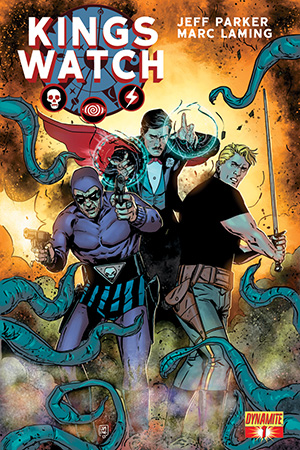
Kings Watch #4 – Review

by Jeff Parker (Writer), Marc Laming (Artist), Jordan Boyd (Colorist)

The Story: Ming comes out of the gate, ready to integrate Earth to his empire, whether its population wants to or not.

The Review: Revamping characters has got to be a rather hard task. Whenever a character needs to be updated for a newer audience, there is always the need to preserve what has been unique to the character while removing the elements that might not be working as well today. Some characters, in many ways, do tend to translate well to a modern audience thanks to a good imagination and some solid concepts behind them, but not all character are so lucky.

It’s why it’s rather impressive to see that Jeff Parker has successfully brought back some older pulp character to the forefront without removing much of what made them likable to begin with. In Kings Watch, parts of the fun was the merging of old-school sensibilities with newer methods to push forward some characters that were definitely simple back in what some might call ”the good old days”. However, with the way the story got bigger with each issues, how could Parker actually continue in a way that could keep up with the conflict without sacrificing any of the previous strengths?

The writer mostly find a way. Without being a perfect continuation to this rise in terms of threat, the opening of the issue as well as the ways the trio of protagonists deals with the army from Mongo does make for an interesting continuation of the story.

The threat that Ming represent is made clear in this issue, bringing in various humanoid beasts, aliens and some clever additions and changes in the battlefield that is the Earth that allows for the heroes to shine in various ways. The way their army and their technology makes them a superior force to reckon with makes it so the stakes are big, but also indubitably clear. Those are the kind of problems that super heroes are there for.
Continue reading

Red Sonja #7 – Review

by Gail Simone (Writer), Walter Geovani (Artist), Adriano Lucas (Colorist)

The Story: It must take a mean chef to make sure human flesh is worthy of fine cuisine.

The Review: It has been a while since we last saw an issue of this title. With the conclusion of the first arc being actually sound in term of quality, the wait was not exactly the best of things for those who had been won over by Simone’s portrayal of the she-devil with a sword. However, with the beginning of a new arc, does Simone bring enough to sate those whose patience was starting to grow weary?

It is a quality return, that’s for sure, as the more nuanced and definitely entertaining version of the character return in full form, with a mission that is actually quite original and also full of potential as far as story goes.

What works quite well here is the new depths that Simone adds to the character. Adding quite a lot of humanity to Sonja, the motivation behind her quest is a rather noble one, which does work very well in contrast to her methods and her demeanour. The complexity between her rude behaviour and her desire to not inflict violence unless it is absolutely necessary adds a good bit of nuance that makes her an interesting lead. Her reactions, her actions and her code makes for a titular character that can still surprise readers, which makes her more and more compelling with close to every issues being released.
Continue reading

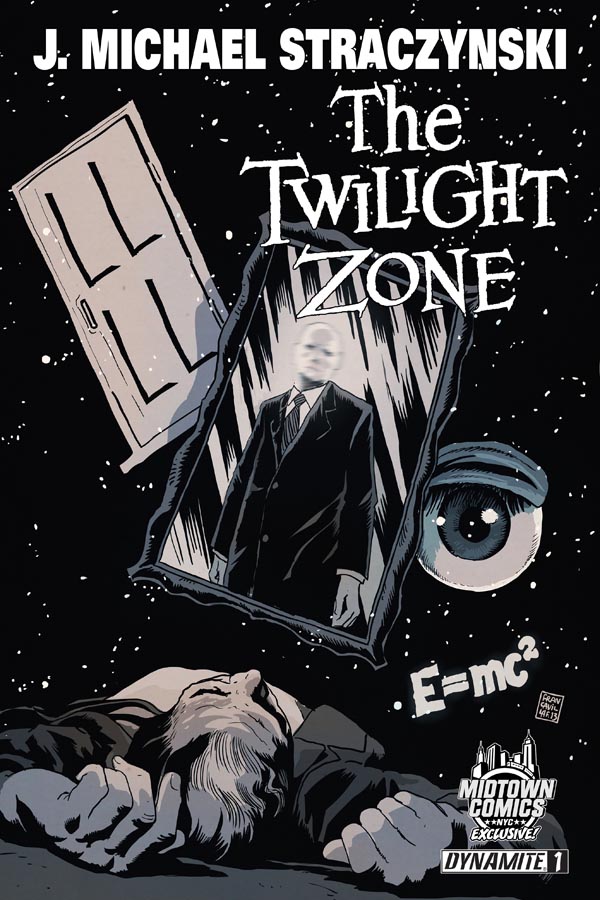
Twilight Zone #1 – Review

By: J. Michael Straczynski (writer), Guiu Vilanova (illustrator), Vinicius Andrade (colorist)

The Story: We all know that money can buy power, but can it buy freedom?

The Review: Happy New Year, everyone, and what a fine time for a new Twilight Zone comic. Clearly Dynamite has high hopes for this series, having handed the reins to Twilight Zone veteran, J. Michael Straczynski. Even so he’ll have his work cut out for him, The Twilight Zone has quite a lofty reputation and not without reason.

Straczynski does an admirable job of recreating the tone of the classic series.  His ‘opening,’ as it were, is a spot-on evolution of Serling’s narration, adjusted for the modern day. It hardly stops there, J.M.S. provides an old-fashioned, yet suitably topical, premise for his story; a smarmy financial shark seeks to escape his life with the help of a mysterious firm specializing in new identities.

The issue’s priority bounces back and forth between establishing tone and exposition in a manner that is, admittedly, somewhat awkward, but generally does so with sufficient charm to pull itself through. The larger than life professions of the characters help to smooth out the script’s tendency towards verbosity and theatrics. It would be strange to hear lines like this in everyday life, but our subject’s pomposity makes it believable and Straczynski’s talent makes it enjoyable. There’s an attention to lyricism, stops, and starts in the dialogue that reminds that this series is based on the brainchild of a playwright. “What about love,” one character asks our subject, “Is there anyone special in your life?” “Yes. Natalie,” he responds, “Beautiful, vacuous Natalie. Hold her to your ear and you can hear the sea.” That line makes me smirk each time I read it, particularly as its narrator grows more and more unreliable.
Continue reading

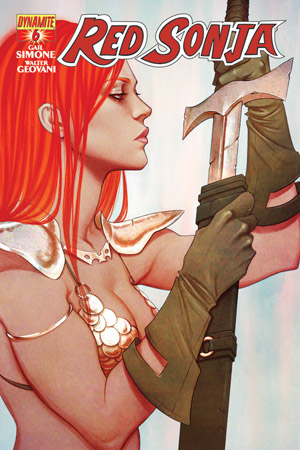
Red Sonja #6 – Review

by Gail Simone (Writer), Walter Geovani (Artist), Adriano Lucas (Colorist)

The Story
: As the true culprit of every evils that has befallen the town and Red Sonja lets itself be known, it is time for a little savagery from the warrior woman herself.

The Review: Well played Gail Simone, well played indeed. I’ll be honest here and actually say that I’ve been taken by surprise by this issue and its quality. There are always time when a series become a bit tedious, not because of a lack of quality but only because of a certain lowering of the readers excitation. Gail Simone on this title seemed like it was a match made in heaven, yet the series never did seem to be on the same level I thought it could reach someday. The previous issues were very competent in many regards, yet they did not impress me in the best of ways in a lot of areas.

It seem that this issue does a lot of things in order to circumvent my initial impression of this series, with Gail Simone working very thoroughly in order to not only bring this story to a close in a great way, but provide plenty of opportunity for twists and turns along the way.

One the better aspects of this issue, which had been a staple of the series so far is how Simone writes Red Sonja herself, making her much more than just a mere bloodthirsty barbarian out for battle and alcohol. In this issue, every single nuances is brought forth, with her thirst for vengeance, her personal code, her beliefs, her past and most of everything that can make her an interesting protagonist is present. Being presented in a more nuanced way, Sonja ends up being not only interesting and important, but also serves as a good window to the world Simone has built.
Continue reading

Kings Watch #3 – Review

by Jeff Parker (Writer), Marc Laming (Artist), Jordan Boyd (Colorist)

The Story: The protagonists finally band together as the secret of the Kings Watch stands revealed.

The Review: Patience is a virtue that I can be lacking sometimes. In a world where everyone wants everything straight away, these kind of thoughts tend to parasite things we enjoy among a multitude of others. While I am a fan of Jeff Parker, I was getting a bit tired of this mini-series, with how disconnected some of the events could seem and how its three protagonists did not seem to do much beside explain one or two points in each issues. It wasn’t tedious or boring, yet I had seen Jeff Parker write much better comics than this.

Well, it seems my impatience has been unjustly rewarded as the third issue of this series is where not only everything connects, but it also give plenty of rather entertaining and awesome moments for either fans of the characters and those that wish to know a little bit more about them.

One of the rather great elements of this issue is the sensation of spectacle, as there are some introductions and display of major players and what they can do, all done in impressive and satisfactory ways here. Mandrake the magician, the legacy of the Phantom, the secret of the Kings Watch, Ming the merciless and other such concepts are presented in ways that are rather big and expansive. It’s a bit reminiscent of modern super hero comics in a way, as reveals here are treated as results of huge buildup, which is what this story does in a lot of pages. In terms of action and development, it is a ton of fun.
Continue reading

Red Sonja #5 – Review

by Gail Simone (Writer), Walter Geovani (Artist), Adriano Lucas (Colorist)

The Story: Sonja gets cured as she prepares to finally meet Annissia in battle.

The Review
: There are certain times when any reader begin to question why exactly he or she is following a certain writer or artist. That particular person may have made some spectacular work before, getting loyalty from a good deal of potential buyers in the process, yet there will always be weaker or stronger work depending on the subject and character. I rather like Gail Simone, thanks to her work on titles like Secret Six and the first volume of Birds of Prey, yet I can’t say I am her biggest fan, with what she is writing right now not exactly doing it for me. I am rather uninterested by Batgirl and The Movement, yet I know that she can do some really great work.

This is the mindset in which I read Red Sonja, with a lot of elements being rather good and fitting with the voice Simone has established for herself as a writer, yet there’s just something missing to make it something absolutely enjoyable and memorable.
Continue reading

King’s Watch #2 – Review

Jeff Parker (Writer), Marc Laming (Artist) Jordan Boyd (Colorist)

The Story
: The Phantom learn more about what is going on about the Kings Watch, while Flash gets attacked by the Cobra.

The Review: Old characters still hold some kind of charm, don’t they? After all, the most iconic of super heroes all picked up one or several elements from pulp characters or other old tales in their conception, as traces of the Shadow and Zorro can be seen in Batman, some bits of Mandrake the magician can be seen in Dr. Strange and the list goes on. They may not be the most seriously taken characters nowadays thanks to some of most silly aspects that are attributed to them (like the Phantom’s costume), but for some they hold a cherished place in the collective consciousness of comic readers.

It seems they hold a dear place to Jeff Parker’s heart as well, as he seems to not only respect the origin of those characters, but also manage to bring them to modern time without making them look ridiculous or dated. It would be particularly tough to see the Phantom as an effective and threatening figure, yet Parker seem to succeed as he build on many elements of his mythos to bring the story up to speed while adding flavour to the ongoing narrative. The same also goes with Flash Gordon, a character mostly know for the serials that would nowadays look quite dated, as he participates in the action, showing what makes him special without destroying the tale in the process.
Continue reading

Red Sonja #4 – Review

Gail Simone (Writer), Walter Geovani (Artist) Adriano Lucas (Colorist)

The Story: Sonja remembers some more of her personal history as she battles some foes sent from Dark Annisia.

The Review
: Many people who are really into comics are looking for the next big thing. Be it the next event that delivers on its promises, the big breakout writer or artist who made it big or the next Saga. It’s normal to be anxious to be able to read something exceptional, yet a lot of the time some comics merely pass through, some that don’t quite fit the bill when it comes to superb or unique, but still delivers a certain amount of quality in a consistent manner. Those aren’t the book that will impress readers with impossibly amazing and expansive ideas or cool concepts, yet they are pleasant with but their solidly executed ideas nonetheless.

Red Sonja by Gail Simone is one of the latter, as although it doesn’t really break any new ground, it mostly delivers on things that are promised, notably action and strong female characters. There is some fantasy, a lot of brutality and some potent sword and sorcery tropes to be found in this book, which should please those that enjoy the genre in the first place.

What is enjoyable first and foremost, though, is the characterization that Simone write Sonja with, giving her plenty of different sides. She can be a violent and drunken barbarian as well as rather caring and introspective without really jumping the shark. Showing the readers a bit of the character’s past along with her current predicament allow for a three-dimensional approach to the character as well as a deeper understanding about why she is like this in the first place. Those who merely think of Red Sonja as the objects of countless fetishes could learn a whole lot more about her in this title a Simone treats the character with the respect she deserves.
Continue reading

Red Sonja #3 – Review

by Gail Simone (Writer), Walter Geovani (Artist), Adriano Lucas (Colorist)

The Story
: Becoming delirious thanks to the plague, Red Sonja remembers her childhood and how she lost her family.

The Review: Big writers bring their readers with them. When an author has accomplished some very well-received work on a title, usually a popular one, they generally receive a certain following. There are reasons why creators like Grant Morrison, Scott Snyder, Jonathan Hickman and the such always seems to receive high gigs and create their own stuff all the while, as they have an audience that are fully willing to try whatever they will receive from these giants of the industry.

Sometimes, it can lead to people trying new stuff that they perhaps weren’t willing to even touch before said creator decided to write said concept, team or character to begin with. I have no shame in saying that I began to read this title solely because of Gail Simone, who kept me highly entertained with titles like Secret Six and Birds of Prey (the first volume). While I was not a newcomer to the sword and sorcery genre, I had close to no actual desire to read any Red Sonja comics before she even announced that she’d be writing the title from now on. Willing to try the comic, it was with a bit of scepticism that I went along, only to be fairly impressed by what I had read. However, consistency in quality needs to be upheld if the book has to survive beyond the mere mention of Gail Simone’s name. Does this issue provide the quality the first two issues had?

In many ways, this issue does give the readers a lot of good moments, as Simone takes a good chunk of the issue in telling parts of the origins of the character. After all, no strong character actually begins its life with a sword in hand, as the story of Sonjita is told as the character continues to be affected by the plague. While it is not exactly the most original origin for a character to have, to have her family being slaughtered by barbarians, Simone do try to make the most of it as she adapts and deepens some of the lousiest part. It does not lessen the lack of innovation, yet it is competently told nonetheless.
Continue reading

King’s Watch #1 – Review

by Jeff Parker (Writer), Marc Laming (Artist), Jordan Boyd (Colorist)

The Story: It seems the end of the world is close at hand, as people investigates it, some reacts to it while heroes are on the move.

The Review: There always comes a time for any readers when they decide to follow an artist or a writer. Most people go and buy most of the series involving their favourite characters, but most of us do have a tendency to try out some of the names in the industry. It might be because of a title they wrote, or their personal view on certain subjects and theme, but whichever the reason, it makes us want to see more from that particular author.

It’s no secret that I have a fondness for Jeff Parker’s work, who made me a fan of the Red Hulk and made me love the dysfunctional yet always likeable cast from Thunderbolts. He also had a knack for inventive stories and using golden age heroes, which has been a staple for the numerous Agents of Atlas volumes written by him. With such a pedigree, it seems that him handling a bunch of pulp heroes and teaming them up together should be right up his alley, but is it so?

In a way, it’s a mixed issue, as it does bring up some of the themes rather nicely, yet fails in some other areas. One of the aspects which he does nicely, however, is bring in the general tone that is fitting of each of the character, with Flash Gordon being the reckless adventurer he always is, Mandrake being a bit unsure, yet full of mystery and the Phantom being the brave action he always had been. Even with the minimal knowledge that some may possess of these characters, Parker does not fail to bring their personalities to the forefront.
Continue reading

Red Sonja #2 – Review

Gail Simone (Writer), Walter Geovani (Artist), Adriano Lucas (Colorist)

The Story: Red Sonja tries to defend a village from Dark Annisia as she learn a great deal about what is happening to others and herself.

The Review: The propensity to surprise is not something that many writers have the ability to create very often. In a world where perhaps hundreds of stories are produced each and every day, originality and the potential to twist the audience expectation is not something that everyone can pull off.

Thankfully, Gail Simone is not a run-of-the-mill writer, as she do know how to build up a situation, only to subvert it for the readers pleasure. What she has done, in this issue, is construct a premise that could have very well offered a potent, yet unsurprising premise for a sword and sorcery title, only to reveal some key information at the right time, creating a delightful plot twist that bodes well for the future of this title.

The issue opens where the first one left off, as the conflict between the invaders and the village that Red Sonja is trying to defend open. Right off the bat, Simone goes a bit deeper in the first scenes of the previous comic as we get some explanation of just what kind of character Dark Annisia is. What we get from this character is something strange, yet compelling as this new character starts off as a clear foe, yet evolve into something more as the story develops and the connection between Sonja and her is explained. The evolution of the situation from the readers grasp is something that is handled well and that promise more from that specific character, which is something to look forward to.
Continue reading

Red Sonja #1 – Review

Gail Simone (Writer), Walter Geovani (Artist), Adriano Lucas (Colorist)

The Story: To settle a debt of honor, Red Sonja has to train poor villagers how to defend themselves from a brutal horde in a few days.

The Review: I have to confess, I didn’t particularly have high expectations out of this one. It is a sad thing to say, but I have close to no knowledge of who Red Sonja is and what she does, as her character, to me, consist mainly of being a epitome of fanservice. Let’s face it, to those left in the dark, a woman clothed in the thinnest of armour that leaves pretty much nothing to the imagination may lead a lot of readers to think so about the character. The only reason I was interested to begin with, beside the fact that I do rather like the sword and sorcery genre, was that Gail Simone, the writer who brought us the delightful Secret Six was going to be the one telling us stories with this character. With the knowledge that she is quite talented when it comes to strong female characters and female-centric book, could she be the one to make me see the character in a different light?

It is, much to my surprise, pretty much what she did. Not only is Red Sonja a character that has many facets, which Simone manage to show us here, but she also does so in a way that makes it interesting for the readers to explore further. She is a brute, a savage with a sword that can beat most without even thinking about it, yet also able to show mercy and compassion during a fight. She can be bashful and without any reservation, yet has a personal level of honor that shows she has a code even though her violent tendencies may lead otherwise. In the very first issue of this first volume, Simone shows us just who is Red Sonja in a way that feels compelling, proving that she is much more than mere eye candy. I have no problem saying that my initial thoughts on the character were wrong and that thanks to Simone, I have seen the error of my way. The bikini armour may still be there, but the character filling it is interesting.
Continue reading

Game of Thrones #7 – Quick Review

By: George R.R. Martin (story), Daniel Abraham (adaptation), Tommy Patterson (art), Marshall Dillon (letters) & Ivan Nunes (colors)

The Story: About midway through the first novel we find the Imp hanging out with the Night Watch and Ned Stark in King’s Landing.

Quick Review: Now that the second season of HBO’s excellent Game of Thrones TV show is underway, it makes sense to touch base with the comic adaptation of the first novel in George R.R. Martin’s Song of Ice and Fire series.

The story itself kinda “it is what it is.”  This is a straight adaptation from the novels, so there aren’t any surprises to be found.  Adapting a novel like GoT is always going to be tricky because knowing what to include, what to leave out and when to add breaks between issues is always going to be an inexact science.  Much like Marvel’s adaptation of Stephen King novels, this comic is kinda written for a whole different audience than the “Wednesday crowd.”  This is a comic to have on your pull list to share with a significant other or family members who have enjoyed the TV show or the novels.  Plus, it’ll make a splendid collected edition someday that’ll sell well in the bookstore.
Continue reading

The Shadow #1 – Review

By: Garth Ennis (writer), Aaron Campbell (artist), Carlos Lopez (colorist)

The Story: It seems The Shadow isn’t the only one who knows what evil lurks in the hearts of men, as he is joined by none other than Garth Ennis in a new ongoing series.

The Review: It’s hard not to admire the pulp heroes of old. In the absence of optic blasts that could reduce mountains to powder, or Kryptonian DNA capable of absorbing solar radiation and turning a child into a demigod, the Pulps put themselves in harm’s way and did what they could to fight the Good Fight using the means available to them. They were, at best, Optimized Men, talented individuals that represented the pinnacle of human achievement, but still men and quite capable of being killed in their self-appointed line of duty. And on some level I’ve always identified with that. I think it’s largely why I’ve always preferred reading titles like Batman, Daredevil, and Punisher over more epically-scaled books like Superman, Justice League, and X-Men; the latter don’t deal with the likelihood of death nearly as often as the former, and I’d argue it takes a real Hero to willingly put himself in mortal danger like that and still fight on. This quality is what made the pulp heroes so appealing to me as a kid, so when I first read that Garth Ennis would be redefining one of the great pulp heroes of all time, I was excited to see what the creator of Crossed, Hitman, and Preacher would do with such an icon of the industry. The result, I’m pleased to report, is more than I expected and hugely promising.
Continue reading

Flash Gordon – Zeitgeist #3 – Review

By: Eric Trautmann (plot and script), Alex Ross (plot and art direction), Daniel Indro and Ron Adrian (art), Slamet Mujiono (colors), Joseph Rybandt (editor)

Chapter Three: The Monsters of Mongo: Flash, recently escaped with an assist from the luscious Princess Aura, is shot down in the territory on the lion men. Pursuing agents: should we use surgical strike? Ming: no, make it messy. Meanwhile, back on Earth, Adolph is getting some military aid from old Merciless. Hail Ming!

What’s Good: This is one of two sword and planet titles I’ve picked up from Dynamite this week (see Warlord of Mars: Dejah Thoris #10, for the other). Sword and planet is a fun, escapist form (well, let’s face it, the whole comics medium is an escapist form, but this is more escapist than say, the street level crime of the Kingpin or something). Ross and Trautmann make full use of its conventions. We’ve got alluring evil princesses, quick getaways, strange moons with dangerous aliens, an empire full of goons, all lead by an implacable tyrant. Our hero is daring, truehearted and consummately dangerous, and he’s setting his sights on the bad guy. This is swashbuckling adventure for adventure’s sake, modernized with better tech and science, but at its core, beats a heart of pulp.
The art by Indro and Adrian under the direction of Ross is awesome. I love the draftsmanship and especially the close attention to facial expression, and the shadow and texture required to make it real. The castles and moons and trees and ships and other costumes are evocatively alien, and basically, it is a fiesta for the eyes.
Continue reading

Warlord of Mars #14 – Review

By: Arvid Nelson (writer), Edgar Salazar (artist), Marcelo Pinto (colorist), Joseph Rybandt (editor), Edgar Rice Burroughs (creator)

The Story: The Gods of Mars Part Two: The Black Pirates: John Carter and Tars Tarkas meet Thuvia, formerly a prisoner of the predatory Therns. They use her special talent to try to break out of the valley of death, and no sooner make a good run for it, than run into the people who prey on the Therns, the Black Pirates of Mars.

The Review: Wow! Salazar’s artwork was astonishingly fresh and vital. Just the composition of the splash page alone, complemented by fine detail, and beautiful colors, totally blew me away. Check out the way Tars tarkas is standing. This is the most realistic balancing I have seen for a Thark outside of a Michael Whelan cover. And the fine lines and detailed draftsmanship were just beautiful to pause over, throughout the book. The detail in the accoutrements of the characters were awesome, like the leather strapping of Tarkas’ wrists, the clothing and jewelry on the princess of the Therns, the expressions throughout, but especially on the Dator Xodar’s face near the end. I can and should go on about Salazar’s art, especially the banths, the Thern architecture and the external sets. The action sequences were dynamic and clear and Tars Tarkas, winded after holding off the banths was worth a thousand words. And this is all said without even mentioning the excellent color work of Marcelo Pinto, who made the red Martians closer to what I’d always pictured and who brought the banths and the Valley Dor to life, while bringing a lurid, bloody tinge to the Barsoomian twilight.
Continue reading

Silver Star #2 – Review

By: Jai Nitz (writer), Alex Ross (art direction and story), Johnny Desjardins (art), Vinicius Andrade (colors), Joseph Rybandt (editor)

The Story: Silver Star regroups and starts looking for Norma. He explains the gravity of the situation to his new psychologist, through a series of flashbacks.

The Review: On visuals, I thought Desjardins was a fine artist who did some nice work in bringing some Kirby special effects to life, as well as the corpse of the giant kraken that had attacked them. The layouts were effective and drew the eye across the page on the paneled pages and especially on the collage-like double splash of the flashbacks. Some of the facials were a bit rough, but others were evocative. This occasional unevenness did not detract from my enjoyment of the story, as other elements, like scenery and Silver Star himself were cool to look at.
Writing and story caused me more problems. Anyone who has followed my reviews for a while knows I’m a Jai Nitz fan. I thought he did something magical with the narrative voice in Kato: Origins, while also bringing a real-world resonance to the stories, in terms of racism, crime, the ghosts that we carry with us, and the ghosts that we acquire. Unfortunately, that same inspiration and subtlety didn’t get to the table in Silver Star.
Comics is a medium of stewarding brands and characters and universes, of protecting or rejecting history, and expanding the fields that future writers can till. A writer can, without consequence, create a crime book, a horror book, a fantasy book or a sci-fi book without a sense of deep history or vast community. But in superhero books, the deep history has become a convention. Arch-villains become arch because they keep coming back. The first time they are just bad guys in funny suits. The vast community has also become a convention in superhero books. Heroes fight villain #1 on Monday, villain #2 of Wednesday, and team up with another hero on Thursday, and each character brings their history and baggage to the conflict. I think the hardest thing to do in the superhero genre is create a new hero and a new world out of whole cloth. We’ve seen so many origins that it is difficult to find anything fresh. We’ve seen so many motivations that they mostly appear trite or cliché, unless you bought into them as a kid. What writers can do when put in the bind of creating a new world is to deeply personalize the hero. Engage the reader powerfully in the humanity of the hero.
Continue reading

Warlord of Mars #13 – Review

By: Arvid Nelson (writer), Edgar Salazar (artist), Maxflan Araujo (colorist), Joseph Rybandt (editor), Edgar Rice Burroughs (creator)

The Story: The Gods of Mars, Part 1: John Carter has been gone from Mars for 10 years. When he is finally able to return, he is in a lush, jungle environment, unlike the deserts he knew. And finds strange plant creatures attacking friends he once knew.

The Review: Right off, the visuals were awesome. This is Edgar Salazar’s first turn on Dynamite’s Barsoom, and he is very well assisted by Maxflan Araujo on colors. Salazar’s world is beautifully detailed. The opening page and following double splash page are arresting. The combination of distant mountain top forts, wide lawns edged by blue trees and an ocean make a scene that is strangely haunting. The skill of the colorist really makes itself obvious on the double splash where he has constructed a play of primary colors that fit beautifully together and draw the eye to the blues, which are the strangest to us, and point to Carter’s danger. Carter and Tars Tarkas are heroically drawn and I love Salazar’s pencil-gray shading instead of the usual black. It’s a bit of seeing the puppet strings, and the construction of the art, which layers in more texture.

Storywise, Nelson is working with a hit with Burroughs’ second Barsoom novel “The Gods of Mars”. Burroughs never wasted any time in throwing his heroes into the fire and Nelson doesn’t either. Readers unfamiliar with the Barsoom canon will have to hang on, but this is a good roller coaster to get aboard. The action, danger, spills and mysteries will keep any adventure reader satisfied.

Conclusion: OK. So, no secret. I love this series and I loved this issue. The visuals are beautiful. The adventure is breakneck. Pick it up.

Grade: A-

-DS Arsenault


Flash Gordon – Zeitgeist #1 – Review

By: Eric Trautmann (writer), Alex Ross (plotting and art direction), Daniel Indro (illustrator), Slamet Mujiono (colors), Joseph Rybandt (editor), Alex Raymond (creator)

The Story: Ming the Merciless is looking for fun on a Friday night. Earth is handily in his cross-hairs. The Earth of 1934 reacts with confusion to the super-technology attacking them that manifests as natural disasters. Everyone except Dr. Hans Zarkov. And by coincidence, Flash Gordon, emissary of the President of the USA, and Dale Arden, cartographer, happen to be with him as he is blasting towards Mongo.

What Was Good: Right out of the gates, I have to declare that I grew up on Filmation’s Flash Gordon cartoons as a kid, so obviously I’m coming from a pulpy place of love for sword and planet adventures. Although this is early in the story, I could already see Trautmann assembling the pieces that make Flash Gordon fun. These are: (1) the terrifying Ming and his fragile empire, (2) Flash, the brave, classic hero, (3) Dale, the damsel-love interest, (4) Zarkov, the scientist ally, and (5) the servants of the emperor, but not necessarily loyally so. Ross and Trautmann also pulled in some elements that promise to give this story a theme or gravitas that the pulp original did not have. The addition of the Third Reich and Hitler say a lot about the kind story this is going to be and the foils and thematic contrasts that will be offered. All that being said, this issue was only the inciting incident. The real story begins in issue #2.

Artwise, I was delighted. Indro was a bit quirky, but I found myself liking the way he exaggerates certain elements (Zarkov, for example), cleaves close to traditional styles for heroics (Flash and Dale), while pursuing very modern takes on villainy (Ming and his entourage). All of it was well done and the detail in the 1930s tech was wonderful, right down to the fraying piece of tape labeling a switch in Zarkov’s laboratory.
Continue reading

Warlord of Mars: Fall of Barsoom #4 – Review

By: Robert Place Napton (writer), Roberto Castro (illustrator), Alex Guimaraes (colors), Joseph Rybandt (editor), Edgar Rice Burroughs (inspirer)

The Story: General Van Tun Bor makes some hard choices about what kind of man he is and how far he can follow the Jeddak of Horz. In the meantime, the Jeddak is sponsoring some lurid biotech through his cannibal mad scientist. And, the great scientist Tak Nan Lee reaches a crossroads not that different from the General’s.

The Review: Napton had pretty firm control of the plotting, emotional moments and the reveals in this issue. All parts of the story were competently done, but some shone. For example, although the wistful sense of loss associated with a dying planet had been communicated in many ways, both in words and pictures, in the first three issues of this series, Napton nailed me with a powerful, personal, emotional moment with General Van Tun Bor. The immediacy, intimacy and suddenness of Barsoom’s fall was surprising. The Jeddak’s arrogance and Bor’s struggle, as well as Tak Nan Lee’s were well developed, with the growing sense of tension as the Jeddak started making his moves. The other powerful emotional high of the book was the passing of the symbolic and thematic torch from white man to red woman. Very well done. The story is now set to conclude.
Continue reading

Dejah Thoris #8 – Review

By: Arvid Nelson (writer), Carlos Rafael (illustrator), Carlos Lopez (colorist), Joseph Rybandt (editor), Edgar Rice Burroughs (creator)

The Story: When we last left Dejah Thoris and her unlikely ally, the Pirate Queen of Mars, they were trapped in the clutches of dangerous cannibals.

**Warning: Very minor spoiler, that anyone ought to have guessed**

The Review: On art, Rafael and Lopez continue to deliver beautiful visuals, whether it be the great flying battleships of Barsoom, the radium pistols, the Tharks or the stars of this arc. Since Dejah Thoris #1, Rafael has demonstrated a deft hand for the expressions necessary for Nelson’s story. Faces are mobile and flexible, registering surprise, fear, determination and confusion so Nelson doesn’t have to. It’s pointless to choose one or two exemplary visuals for the review, since cover to cover, the beauty and clarity of the art is quite high.

Storywise, as a sophisticated, modern reader, I was at first nonplussed by the way Dejah Thoris and her de facto allies escaped from the kitchens of the pirate warship. It was mildly convenient storytelling and did not hinge on the decisions or actions of Dejah Thoris, but on that looney assassin who’d been tracking Dejah since Helium. But then, I thought about it, and realized that this is exactly how Burroughs would have engineered this escape. In the classic pulp tradition, small, fast heroes with quick wits and great initiative always beat out the bad guys. In this case, the hidden knife from Dejah Thoris #7 was used to surprise their captors. The escape also included a tense moment with the big villain, where again, an extrinsic factor (in this case, true Deus ex machina) saved the day and put off the final showdown with the pirate leader. Both of these plot devices harken from a less sophisticated age of storytelling and fit totally within the conventions of pulp fiction. So, while it is not cutting-edge literature, the Dejah Thoris series is a breathing homage to the pulp tradition that Dynamite is reviving. And the last half of the story was the icing on the cake of a good pulp story in the midst of Act Two: the set up for a race for a lost treasure, perhaps cursed, shrouded in legend.

Conclusion: More and more, Dynamite is drawing on classic pulp tropes to build a new pulp tradition. Tune into Dejah Thoris for classic sword and planet adventure, riding on pirate themes, rascally allies and grostesque villains.

Grade: B

DS Arsenault


Silver Star #1 – Review

By: Jai Nitz (story and script), Alex Ross (art direction and story), Johnny Desjardins (artist), Vinicius Andrade (colorist), Joseph Rybandt (editor), Jack Kirby (concepts and characters)

The Story: This issue, spun out of Dynamite’s Kirby Genesis series, follows the story of Silver Star, a US super-powered asset in an alternate history that branches from ours sometime in the late Vietnam War.

The Review: Nitz and Ross have a ton of work to do in this first issue. They’ve got to introduce the characters, make us care about them, intrigue us with their world and launch the conflict. Slowing this down (as in the first act of any story) is the exposition and showing the character “in his normal day.” Luckily, Silver Star’s days are not normal. He seems to live in covert international conflicts. Nitz and Ross let Desjardins and Andrade do the heavy lifting on the “day in the life” exposition and the action and sets are more than enough to keep the reader turning the pages. What I found more intriguing was the interlaced Presidential Orders through history and tracking against my (admittedly Canadian) knowledge of US presidents to see where the turning points happened and where history changed. Despite all this, I didn’t feel that by the end of the story that I cared about Silver Star. A first act, day-in-the-life start (prior to the introduction of the conflict) makes for a passive main character. A character in action does not equal an active character. I don’t fault Nitz and Ross for this. It looks like they’ve risked a slower-paced start to properly launch a long arc, so the amount of stuff that has to go in issue one crowds out some of the gripping stuff.
Continue reading

Warlord of Mars #11 – Review

By: Arvid Nelson (writer), Stephen Sadowski (artist), Shane Rooks (colors), Joseph Rybandt (editor), Edgar Rice Burroughs (creator)

The Story: Carthoris and Tars Tarkas are in it deep as they are shot down by the Warhoon. And Dejah Thoris is trying to puzzle through the mystery of who framed John Carter while navigating the intrigue between the Jeddak of Zodanga and the Hekkador of the Therns.

What’s Good: OK, by the second part of this three-part arc, I’m really digging the story. I like the mystery of the planted amulet, the steward’s death, the murder of the atmosphere plant worker, the madness of the other, and the slow, suggestive reveal of the Therns and Zodangans. I get that this is a set-up arc, to bridge the last few months of that ten years while Carter is back on Earth, and I’m good with that. I love seeing both Dejah and Carthoris in action, especially the son. He’s a character with obvious growth to do, and a lot to prove and that’s fun. I also loved the telepathy he’s got. Quite cool.

Artwise, I’m enjoying Sadowski’s work on the Tharks, the thoats, the atmosphere factory, the mad keeper, and Tars Tarkas. Sadowski’s Tharks are much larger than Lui Antonio’s and match more closely Roberto Castro’s (which themselves are closer to the green men Burroughs described as engines of destruction). I also enjoyed the newer designs of the Heliumite fliers, complete with stirrups, but my favorite visuals were Carthoris. Sadowski’s young, driven, conflicted hero works for me.

Continue reading

Warlord of Mars: Dejah Thoris #7 – Review

By: Arvid Nelson (writer), Carlos Rafael (illustrations), Carlos Lopez (colors), Edgar Rice Burroughs (creator), Joseph Rybandt (editor)

The Story: The Pirate Queen of Mars, Part 2: Dejah Thoris, on a mission of mercy to the south pole, has been captured by the Phondari, a dark-skinned pirate captain, supposedly from one of Mars’ moons. It turns out that Phondari’s impressive ship is much, much smaller than the one chasing her, and now Dejah Thoris is caught in the middle.

The Review: Nelson’s exploration of Barsoom’s different races, their politics, culture and mores, is a ton of fun. And while the setting and characters are fresh to modern eyes, he’s following one of the classic pulp structures of being captured by unkown pirates. It doesn’t matter that here, the seas happen to be the skies above dusty Mars. Nelson is channeling the sense of adventure and excitement the pulps did so well. I enjoyed the careless, ne’er do well character of Phondari and the rising tension as the pirate ship is attacked. I also enjoyed the no-nonsense, take-charge attitude of Dejah Thoris. In Warlord of Mars #10, I had noticed that she was a bit passive, which is closer to the role Burroughs had envisioned for her (damsel in distress, face that launched a thousand ships), but I have to say, after seven issues of watching her in her own title, I now prefer this handy-with-a-sword, young go-getter. I liked Xen Brega, the big pirate captain, and will only note that, with so many writers in so many books striving to rapidly characterize their villains as the most heinous monsters in history, cannibalism is eventually going to lose its impact and become part of the splatterporn background of every villain. And although Dynamite (pulp adventure) and Image (psychological horror) are going for different effects, it’s worth comparing the execution of cannibalism in Dejah Thoris #7 to the cannibalism in Severed #3.

Artwise, Rafael and Lopez continue to lay down beautiful visuals. Dejah Thoris, Phondari, Xen Brega, and the secondary cast were all attractive, with clean lines and subtle coloring. For a while, I was a bit disoriented with the colors used on Phondari, because first I thought she was of a new Martian race (from one of the moons), but the dialogue had suggested she was of the black race of Barsoom, so then I had to revisit and compare colors and see where the range of the palette might be for that race on Mars that Burroughs introduced in his second Martian book, The Gods of Mars. None of this is bad. I don’t mind when the reader has to do more work. The most impressive visuals for me though, were the two pirate ships. I loved the designs and their similarities, and especially of the shot of Phondari’s ship being brought into Xen Brega’s. Impressive demonstration of scale.

Conclusion: Warlord of Mars: Dejah Thoris is exploring Barsoom in Burroughs’ classic style. Well, well worth checking out.

Grade: B

-DS Arsenault

Follow DS on Twitter.

Follow WCBR on Twitter and Facebook.

Design a site like this with WordPress.com
Get started